Ecommerce and Online Business Accounting For Canadian Businesses
Ecommerce accounting tracks every dollar across your sales channels, revenue, platform fees, payment processing, COGS, refunds, and ad spend, so you see true profit. Most bookkeepers treat ecommerce like any other business. We don’t. We understand multi-channel payouts, FBA fees, Shopify settlements, GST/HST place-of-supply rules, and how to track landed costs in CAD for imported inventory.
Book a consultation
2000 +
Happy Clients
12 +
Years in industry
150 +
Strong team






We Offer
Ecommerce Accountants Who Offer
-
SKU-level profitability analysis -
Payment gateway fee accounting -
Revenue recognition across platforms -
Tax compliance and CRA filing support -
Payroll and contractor expense tracking -
Accounts payable and vendor payments -
Refunds, returns, and chargeback management -
Monthly financial statements and cash flow reporting -
Sales channel reconciliation (Amazon, Shopify, and more) -
GST/HST and provincial sales tax (PST/QST/RST) tracking and filing -
Inventory and COGS tracking (ASPE/IFRS -FIFO and weighted-average)
 Good for us. Great for you.
What Makes Ledger Labs the Best Ecommerce Accounting Service in Canada?
See Your Real Profit, Channel by Channel
We reconcile bank deposits against true sales, strip out platform and gateway fees, and track COGS by SKU -so you know actual profitability by channel, not just topline revenue.
GST/HST and Provincial Sales Tax, Handled
Canadian ecommerce tax depends on where your customer is, not where you are. We manage GST/HST and PST/QST/RST on place-of-supply rules across every province, handle registration once you pass the $30,000 threshold, and keep your filings on time.
Marketplace Facilitator Rules, Decoded
Since 2021, marketplaces like Amazon have collected and remitted GST/HST on many third-party sales. We untangle what the platform handles versus what you still owe -so you don’t double-remit or under-report.
Inventory and Landed Cost Done Right
We value inventory on a Canada-compliant basis (FIFO or weighted-average -never LIFO) and build duties, customs, and CAD landed cost into your COGS, so margins reflect reality.
Cross-Border Without the Headaches
Importing stock or selling into the US adds GST-on-imports, CARM obligations, US nexus exposure, and multi-currency complexity. We build it all into your books so cross-border growth doesn’t create a compliance mess.
Fast, Real-Time Financial Visibility
No more 30–45-day closes or mystery ad spend ROI. You get a quick month-end close and live dashboards showing cash position, channel profitability, and marketing return.
Typical Ecommerce Accounting Problems We’ve Solved for Canadian Sellers
Over the years, we’ve met many ecommerce brands facing the same issues behind the scenes and helped them regain control when the finances got messy. Most bookkeepers make the same critical ecommerce mistakes, and they cost you thousands: recording bank deposits as revenue, expensing inventory when purchased, missing GST/HST obligations across provinces, not tracking COGS by SKU, ignoring payment gateway fees, and mixing business with personal expenses.
The worst part? Most owners don’t know these problems exist until tax season hits or they try to raise funding. If you’re nodding at any of these, you’re not alone.
Common problems we’ve solved:
-
Month-end close dragging 30-45 days -
20-30 hours a month lost to bookkeeping -
Tax-season chaos and worry about CRA audits -
Payment processor fees are quietly eating margins -
Bank deposits that don’t match sales reports across channels -
Uncertainty about GST/HST registration and provincial sales tax -
No visibility into true product profitability; COGS wrong or missing -
Marketplace facilitator confusion (what Amazon remits vs. what you owe)
The Benefit of Outsourced Ecommerce Bookkeeping Like Ledger Labs
Stop spending 20+ hours a month on bookkeeping. We provide outsourced ecommerce accounting built around how online businesses actually operate, multi-channel payouts, platform fees, refunds, inventory, and Canadian sales tax -so you can focus on growth.
You get clean, reconciled books across every channel, accurate COGS and inventory valuation, GST/HST and provincial tax handled correctly, and real-time reporting on channel profitability and cash flow.
Instead of discovering problems at tax time or during a funding round, you stay ready year-round -with a team that scales support as you add channels, products, and markets.
Real Profit Clarity
We reconcile every channel, strip out fees, and track COGS by SKU, so you see true profitability, not just deposits hitting your bank.
Sales Tax Off Your Plate
GST/HST, PST, QST, and RST handled on place-of-supply rules across provinces, with marketplace facilitator obligations sorted -no more sleepless nights before a filing deadline.
Your Time Back
We take 20–30 hours of monthly bookkeeping off your plate and close your books fast -so you run the business instead of the spreadsheets.
We reconcile every channel, strip out fees, and track COGS by SKU, so you see true profitability, not just deposits hitting your bank.GST/HST, PST, QST, and RST handled on place-of-supply rules across provinces, with marketplace facilitator obligations sorted -no more sleepless nights before a filing deadline.We take 20–30 hours of monthly bookkeeping off your plate and close your books fast -so you run the business instead of the spreadsheets.
Book a consultation
Ecommerce Platforms We Serve
Amazon (FBA & FBM)
We know Amazon inside out -reconciling FBA fees and reimbursement claims, tracking FBM shipments, and applying Canadian marketplace facilitator GST/HST rules. Whether you use Amazon warehouses or ship directly, we keep Seller Central up to date.
Shopify
We sync directly with Shopify to track every order, payment-processor fee (Shopify Payments, PayPal, Stripe), and fulfillment cost -from multi-currency transactions to GST/HST by province, your books match your store to the cent.
Walmart
We reconcile Walmart Marketplace payouts, fees, and tax handling, keeping your multi-channel financials consistent and your COGS accurate across every order.
eBay
eBay’s fee structure is notoriously complex -final value fees, promoted listings, store subscriptions, managed payments. We untangle it all, reconcile every transaction, and keep GST/HST compliant across provinces.
BigCommerce
BigCommerce sellers need enterprise-level handling without the price tag. We integrate to track orders across storefronts, manage complex tax rules, and consolidate multiple gateways -B2B, B2C, or both.
Multi-Channel & Cross-Border
Selling across several platforms or into the US? We consolidate every channel into one clean set of books, reconcile multi-currency payouts, and handle import GST, duties, and CARM, so cross-border growth stays clean.
Book a consultation
When to Bring in Ecommerce Accounting Support?
A. You’ve crossed (or are about to cross) $30,000 in sales
That’s the GST/HST registration threshold. Once you’re near it, registration, tracking, and provincial sales tax stop being optional and getting them right from the start avoids penalties later.
B. You’re selling across multiple provinces
Place-of-supply rules mean a sale to Ontario, BC, Alberta, and Quebec can each carry a different tax. We make sure you charge, collect, and remit the right amount everywhere your customers are.
C. You’re on more than one channel
Amazon, Shopify, Walmart, eBay, and your own site all settle differently. When reconciling them by hand eats your evenings, it’s time to consolidate into one clean set of books.
D. You’re importing inventory or selling into the US
Duties, GST on imports, CARM, US nexus, and multi-currency all complicate the picture fast. We build them into your accounting, so cross-border doesn’t become a liability.
E. Your close takes weeks, and your margins are a mystery
If the month-end drags 30–45 days and you can’t say which products or channels actually make money, you’re flying blind. We deliver fast closes and SKU-level profitability.
Closing: In ecommerce, small errors compound across thousands of transactions. The earlier your books, sales tax, and inventory are handled properly, the more profit you keep and the faster you can scale.
Why Canadian Ecommerce Brands Choose Ledger Labs?
Multi-Channel Reconciliation
Ledger Labs’ Ecommerce Accounting Services
Every channel reconciled to the cent -Amazon, Shopify, Walmart, eBay, and your own site
Other Services
Deposits booked as revenue; channels never truly reconciled
True COGS & Inventory
Ledger Labs’ Ecommerce Accounting Services
SKU-level COGS with ASPE/IFRS valuation and CAD landed cost
Other Services
Inventory expensed on purchase; COGS missing or wrong
GST/HST & Provincial Sales Tax
Ledger Labs’ Ecommerce Accounting Services
Place-of-supply tax across every province, registration, and filing handled
Other Services
US-style nexus logic that doesn’t apply in Canada
Marketplace Facilitator Rules
Ledger Labs’ Ecommerce Accounting Services
Clear split of what platforms remit vs. what you owe
Other Services
Confusion leading to double-remittance or under-reporting
Payment & Fee Accounting
Ledger Labs’ Ecommerce Accounting Services
Gateway and platform fees tracked so margins are accurate
Other Services
Fees ignored, quietly eroding profitability
Cross-Border & Multi-Currency
Ledger Labs’ Ecommerce Accounting Services
Import GST, duties, CARM, US nexus, and CAD/USD handled cleanly
Other Services
No cross-border structure; compliance and FX gaps
Speed of Close & Visibility
Ledger Labs’ Ecommerce Accounting Services
Fast month-end and live dashboards on channel profit and cash
Other Services
30-45 day closes with no real-time visibility
Ongoing Advisory & Scaling
Ledger Labs’ Ecommerce Accounting Services
Support that scales as you add channels, products, and markets
Other Services
One-time setup with no growth support
Ledger Labs’ Ecommerce Accounting ServicesEvery channel reconciled to the cent -Amazon, Shopify, Walmart, eBay, and your own site
Other ServicesDeposits booked as revenue; channels never truly reconciled
Ledger Labs’ Ecommerce Accounting ServicesSKU-level COGS with ASPE/IFRS valuation and CAD landed cost
Other ServicesInventory expensed on purchase; COGS missing or wrong
Ledger Labs’ Ecommerce Accounting ServicesPlace-of-supply tax across every province, registration, and filing handled
Other ServicesUS-style nexus logic that doesn’t apply in Canada
Ledger Labs’ Ecommerce Accounting ServicesClear split of what platforms remit vs. what you owe
Other ServicesConfusion leading to double-remittance or under-reporting
Ledger Labs’ Ecommerce Accounting ServicesGateway and platform fees tracked so margins are accurate
Other ServicesFees ignored, quietly eroding profitability
Ledger Labs’ Ecommerce Accounting ServicesImport GST, duties, CARM, US nexus, and CAD/USD handled cleanly
Other ServicesNo cross-border structure; compliance and FX gaps
Ledger Labs’ Ecommerce Accounting ServicesFast month-end and live dashboards on channel profit and cash
Other Services30-45 day closes with no real-time visibility
Ledger Labs’ Ecommerce Accounting ServicesSupport that scales as you add channels, products, and markets
Other ServicesOne-time setup with no growth support
Team You Can Count On

Gary Jain
Founder | Fractional CFO
Gary started Ledger Labs in 2014 and has helped over 2,000 ecommerce businesses improve their finances. He focuses on CFO services, setting up ERP systems such as NetSuite, Odoo, and QuickBooks, and automating financial processes for growing online brands.

Allison Rinehimer
Operations Manager
Allison is a Certified Public Accountant (CPA) and a member of the AICPA. She oversees operations at Ledger Labs, ensuring accurate, compliant financials for hundreds of clients. With experience in both public and private accounting, she builds scalable systems that support fast-growing ecommerce businesses.

Matt Hidalgo
Accountant
Matt brings 7+ years of accounting experience across ecommerce, SaaS, and technology. He specializes in financial reporting, month-end close management, and ERP implementations (including NetSuite transitions). Matt ensures our clients get accurate, timely financials they can rely on for growth decisions.
Accounting Software We Work In


























Our Testimonials
Hear from More Business Owners Who Were in Your Exact Position
Find out what our customers are saying about our products.
“We sell on Amazon and Shopify across every province, and our sales tax was a guess. Ledger Labs set up GST/HST and PST/QST properly on the place-of-supply rules. No more filing-deadline panic.”
Nicole Bennett
Founder, DTC Brand
“We didn’t realize Amazon was already remitting GST/HST on some of our orders, and we were double-counting. They sorted out exactly what we owed versus what the marketplace handled.”
Ashley McKenna
Owner, Amazon Seller
“Importing from overseas wrecked our COGS. They built duties, CARM, and CAD landed cost right into our books, and for the first time, we know our true margin per SKU.”
Tyler Henderson
Co-Founder, Ecommerce
“Our month-end close took six weeks, and we couldn’t tell which channel made money. Nowadays, the dashboards show profit by channel. Total turnaround.”
Trevor Lawson
CEO, Multi-Channel Retailer
“Selling in Quebec meant QST on top of GST, and we were getting it wrong. Gary’s team handled it cleanly, and we stopped worrying about a CRA audit.”
Rebecca Callaghan
Founder, Online Store
FAQs
Questions We Get A Lot
1. How does GST/HST work for Canadian ecommerce sellers?
Canadian ecommerce sellers charge GST/HST based on where the customer is located — not where the seller is — under place-of-supply rules. A sale to an Ontario customer attracts 13% HST; a sale to a BC customer attracts 5% GST plus 7% PST; a sale to a Quebec customer attracts 5% GST plus 9.975% QST. Once your revenue crosses $30,000, registration is mandatory and you must collect and remit correctly by province. We configure this in your platform and accounting software so every transaction is taxed correctly.
2. What are the Canadian marketplace facilitator rules for Amazon and eBay?
Since July 1, 2021, major digital platforms including Amazon, eBay, and Etsy are required to collect and remit GST/HST on many third-party sales made through their platforms, under the CRA’s digital economy measures. This means a portion of your GST/HST obligation is handled by the marketplace — but not all of it in all cases. Knowing exactly what the marketplace remits versus what you still owe is critical to avoid double-remittance or under-reporting. We track both sides of this split for every platform you sell on.
3. What inventory costing method should Canadian ecommerce sellers use?
Under ASPE and IFRS, Canadian businesses must use FIFO (first-in, first-out), weighted-average cost, or specific identification. LIFO is prohibited. For most ecommerce sellers, FIFO is the most straightforward — especially for businesses with perishable or time-sensitive inventory. The chosen method must be applied consistently and disclosed. We select and configure the right method for your business and make sure it flows correctly through COGS to your financial statements.
Canadian ecommerce sellers charge GST/HST based on where the customer is located — not where the seller is — under place-of-supply rules. A sale to an Ontario customer attracts 13% HST; a sale to a BC customer attracts 5% GST plus 7% PST; a sale to a Quebec customer attracts 5% GST plus 9.975% QST. Once your revenue crosses $30,000, registration is mandatory and you must collect and remit correctly by province. We configure this in your platform and accounting software so every transaction is taxed correctly.
Since July 1, 2021, major digital platforms including Amazon, eBay, and Etsy are required to collect and remit GST/HST on many third-party sales made through their platforms, under the CRA’s digital economy measures. This means a portion of your GST/HST obligation is handled by the marketplace — but not all of it in all cases. Knowing exactly what the marketplace remits versus what you still owe is critical to avoid double-remittance or under-reporting. We track both sides of this split for every platform you sell on.Under ASPE and IFRS, Canadian businesses must use FIFO (first-in, first-out), weighted-average cost, or specific identification. LIFO is prohibited. For most ecommerce sellers, FIFO is the most straightforward — especially for businesses with perishable or time-sensitive inventory. The chosen method must be applied consistently and disclosed. We select and configure the right method for your business and make sure it flows correctly through COGS to your financial statements.
4. How do you handle multi-currency for Canadian ecommerce sellers?
When you transact in USD or other foreign currencies, each transaction must be translated to CAD at the exchange rate on the date of the transaction (or the average rate for the period, in some cases). This affects revenue, COGS, and any foreign-currency balances on the balance sheet. We configure multi-currency accounting correctly and handle foreign-exchange gains and losses so your CAD financial statements are accurate.
5. What is CARM and how does it affect Canadian ecommerce businesses importing inventory?
CARM (CBSA Assessment and Revenue Management) is the Canada Border Services Agency’s system for processing import declarations and duty payments. Ecommerce businesses importing inventory into Canada need to be registered with CARM as importers of record to clear goods, claim duty drawbacks, and manage their import accounting. We integrate CARM-related duties and fees into your landed cost setup so import costs flow correctly into inventory valuation and COGS.
6. How do you reconcile Shopify, Amazon, and other platform payouts to the books?
Each platform settles differently — Amazon bi-weekly, Shopify on a rolling 2-day basis, eBay weekly — and each payout is net of fees, refunds, and adjustments. We reconcile every payout against the platform’s transaction report so revenue, fees, and refunds are correctly separated. We also integrate tools like A2X to automate the mapping so entries land in the right accounts without manual imports or catch-all coding.
When you transact in USD or other foreign currencies, each transaction must be translated to CAD at the exchange rate on the date of the transaction (or the average rate for the period, in some cases). This affects revenue, COGS, and any foreign-currency balances on the balance sheet. We configure multi-currency accounting correctly and handle foreign-exchange gains and losses so your CAD financial statements are accurate.CARM (CBSA Assessment and Revenue Management) is the Canada Border Services Agency’s system for processing import declarations and duty payments. Ecommerce businesses importing inventory into Canada need to be registered with CARM as importers of record to clear goods, claim duty drawbacks, and manage their import accounting. We integrate CARM-related duties and fees into your landed cost setup so import costs flow correctly into inventory valuation and COGS.Each platform settles differently — Amazon bi-weekly, Shopify on a rolling 2-day basis, eBay weekly — and each payout is net of fees, refunds, and adjustments. We reconcile every payout against the platform’s transaction report so revenue, fees, and refunds are correctly separated. We also integrate tools like A2X to automate the mapping so entries land in the right accounts without manual imports or catch-all coding. BLOGS
Our Thought Leadership
Our multidimensional experience and wide exposure have been channelized beautifully in these articles!
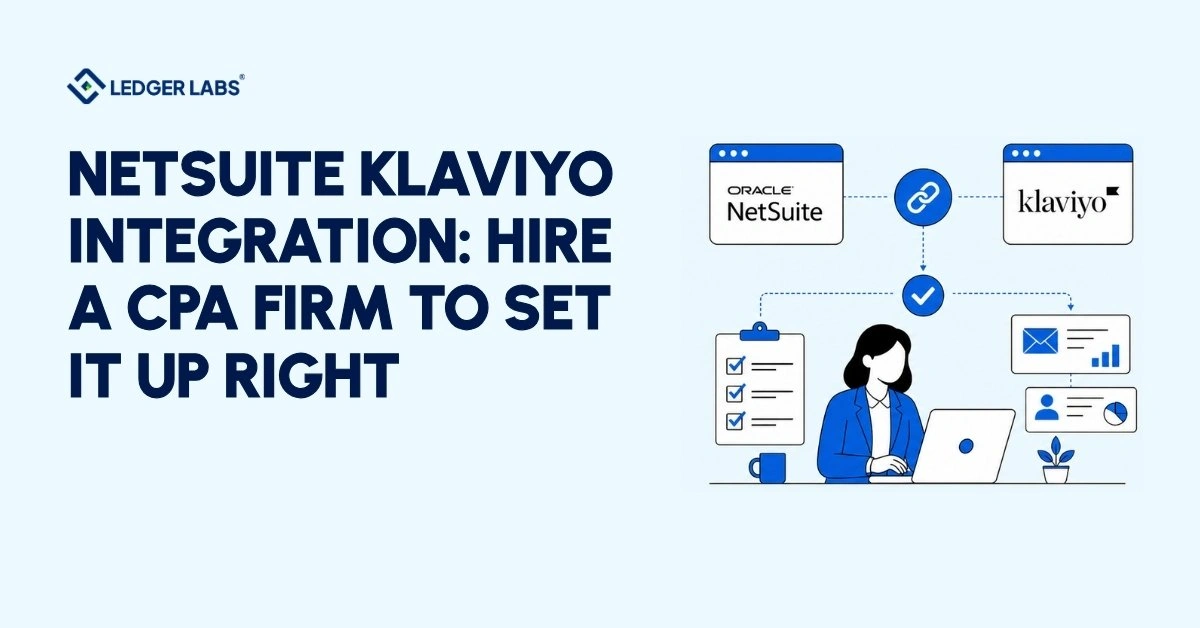
NetSuite Klaviyo Integration: Hire a CPA Firm to Set It Up Right
NetSuite Klaviyo Integration: Hire a CPA Firm to Set It Up Right
Sumit Chandrawal
•
July 7, 2026
See What Happens When You Work With Us
From saving thousands to scaling fast, these stories highlight how we help businesses grow smarter with real financial strategy and execution.