
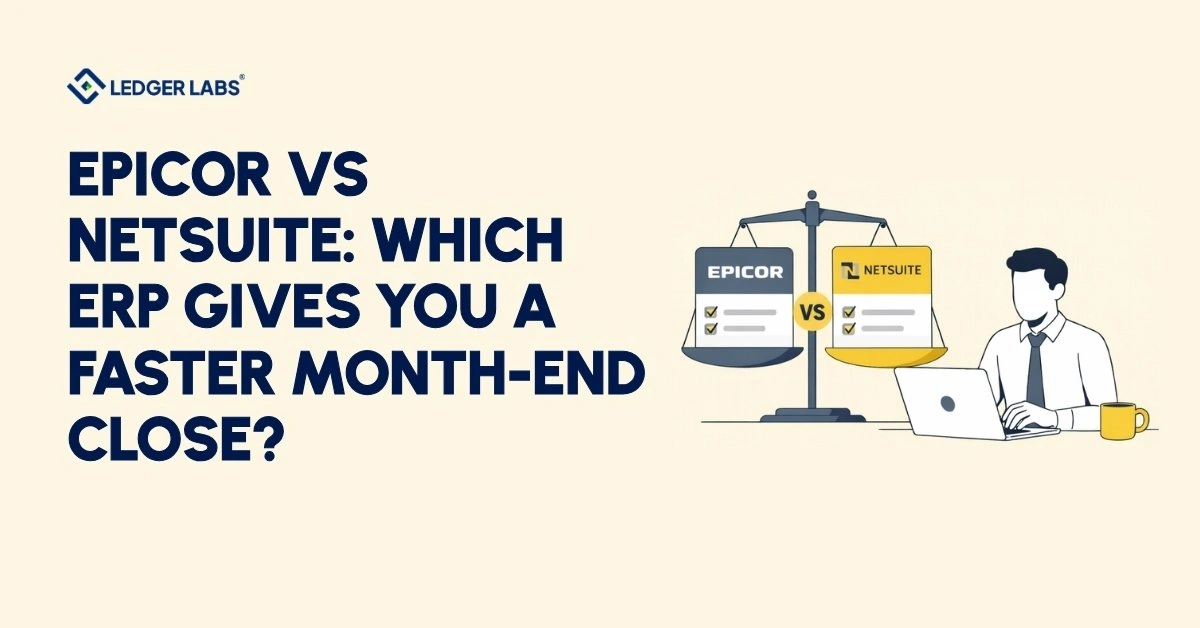
Neither Epicor nor NetSuite gives you a faster month-end close on its own. NetSuite usually closes faster for multi-entity and non-manufacturing businesses thanks to its native Period Close Checklist and consolidation; Epicor closes the production side faster for complex manufacturers. But the bigger driver of close speed is your chart of accounts, your process, and your team, not the brand on the login screen.
That gap is where the frustration lives. You’re ten business days into the month and still can’t hand leadership numbers you’d stake a decision on. Last month, it was day nine, and every month, you promise to fix the close after this one. So you start wondering whether the software is the problem.
This page gives you a CPA’s verdict on which system actually closes faster, and the four things that move the number far more than the ERP you run.
By the end, you’ll understand how Epicor and NetSuite affect your close process, the monthly costs of a slow close, and how to achieve a three- to five-day close on your existing system without migrating.
Key Takeaways
- Neither Epicor nor NetSuite delivers a faster month-end close on its own.
- NetSuite closes faster for multi-entity, non-manufacturing businesses; Epicor wins on complex manufacturing costing.
- The brand rarely separates a three-day close from a fifteen-day one.
- Roughly 80% of close speed comes from your COA, process, and ownership.
- A slow close costs most $2M–$50M businesses four to five figures monthly.
- You can hit a 3–5 day close without switching ERPs at all.
Why Your Month-End Close Drags and Why It's Rarely Just the Software?
Your month-end close drags because of four factors: your ERP, your chart of accounts, your close process, and the team running it, and the software is only one of them. In most slow closes, the constraint sits in the other three.
You see it as symptoms: still chasing accruals on day eight, re-keying numbers between a subledger and your GL, waiting on one person to reconcile inventory before anything ties out. That’s not a software gap. That’s a process running on top of software.
The chart of accounts is the quietest cause of a slow close. When your COA mirrors how the founder thinks about the business rather than how the ERP groups transactions, every close requires manual work to reconcile what the system recorded with what the P&L shows. In the close engagements we’ve run, that mismatch is the root cause in a large share of slow closes, more often than any software limitation.
A faster month-end close is an operations problem wearing a software costume.
Here’s what this looks like in practice: a Shopify brand with roughly $6M in revenue came to us, convinced NetSuite was the bottleneck behind their 12-day close. The real issue was a COA with no clean split among platform fees, payment processing, and COGS, which forced a manual reclass every month. We restructured the COA and built a checklist; the close moved to five days on the same NetSuite instance.
Before you compare Epicor and NetSuite on close speed, separate what the software controls from what your setup and team control, because switching ERPs fixes the first and leaves the other three exactly where they were. That distinction only makes sense once you see how each system handles the close.
How Epicor Handles the Month-End Close?
For complex manufacturers, Epicor can close quickly because it tracks work in process and job costs effectively. However, in our closing process, the inventory-to-GL reconciliation is where we often lose time.
It only stays fast when someone takes responsibility for that reconciliation every period. Epicor is designed for manufacturing and distribution, which gives it depth. But this is also where it can quietly slow down.
Where Epicor Closes Fast (and Where It Stalls)
The costing engine is key for us. For manufacturers, the challenging part of any close is valuing Work in Progress (WIP) and finished goods, managing overhead costs, and reconciling inventory to the General Ledger (GL). Epicor manages standard, average, and job-level costing in a single system. This means that when we close a make-to-order client, production costs come together more quickly than with simpler ERPs. That’s our advantage.
How we deploy Epicor affects the level of control we have over the close. On-premises Epicor gives you control, but it can lead to upgrade delays and customizations that depend on your IT team. If a report fails during the close, we wait for your IT team, not a vendor.
We highlight this issue from day one of any Epicor project because it determines whether the close goes smoothly or stalls.
When we audit a new Epicor client’s close, the same three problems surface almost every time:
- Customizations that turn routine reconciliations into manual exception handling
- Inventory and WIP that won’t tie to the GL without a manual true-up each period
- Financial reporting is built outside the core module, so the GL “closes” before the numbers are presentable
Everything is fixable. None fixes itself, and each adds days when no one owns it.
Epicor helps product-heavy businesses quickly and accurately close their costs, but it needs careful setup and a designated manager for the inventory-to-GL tie-out. If mismanaged, it can delay the process by two weeks. In contrast, NetSuite faces delays for a different reason.
How NetSuite Handles the Month-End Close?
NetSuite helps multi-entity and non-manufacturing businesses close their books faster with a clear process. We use the Period Close Checklist and OneWorld consolidation to make it repeatable.
However, delays can occur if reconciliations and intercompany rules are not set up, which often happens. While Epicor focuses on the factory floor, NetSuite centers on the closing process itself, which is helpful until the setup is complete.
Where NetSuite Closes Fast (and Where It Stalls)
The Period Close Checklist is crucial for our process. It provides a clear step-by-step guide: lock subledgers, review, reconcile, allocate, and close. This way, we follow a set procedure instead of relying on one person’s memory. When we onboard a NetSuite client, we customize this process to fit your accounts and assign someone to own each step. This is why our team can quickly make a NetSuite close repeatable.
Native consolidation is the feature that saves our multi-entity clients the most time. If you manage several entities or currencies, OneWorld can consolidate them and handle intercompany eliminations without needing an extra tool. This means a multi-entity close won’t turn into a two-week task as it does elsewhere. For our clients with multiple entities, this feature significantly reduces closing time.
However, having this capability isn’t the same as using it correctly. In the NetSuite setups we take over, the closing process often takes longer for reasons unrelated to NetSuite’s abilities.
Common issues include:
- Subledger reconciliations remain manual rather than being set up to flow into the general ledger.
- Intercompany and elimination rules were not established before they were needed.
- Custom scripts and saved searches are becoming untested and failing mid-close.
NetSuite usually has the necessary capabilities, but the closing process drags on because no one has activated them. Our job is to turn these features on correctly.
NetSuite offers most multi-entity and non-manufacturing businesses a quicker, more repeatable closing process than they would get from building a system themselves. But this only happens once the checklist and reconciliations are properly set up, rather than left at default settings. This raises the main question you want to answer.
Epicor vs NetSuite Close Speed, Head-to-Head
Head-to-head, NetSuite usually closes faster for multi-entity and non-manufacturing businesses, while Epicor closes the production side faster for complex manufacturers, but in the closes we run on both, the brand is almost never what separates a three-day close from a fifteen-day one.
Here’s how they compare on the dimensions that move close time, and what each one actually means for your close, not the software’s spec sheet:
| Close Dimension | Epicor | NetSuite | What It Means for Your Close |
|---|---|---|---|
| Guided Period-Close Workflow | Module-driven; more manual sequencing | Native, sequenced checklist | With Epicor, you build the sequence; with NetSuite, you configure the existing workflow |
| Multi-Entity Consolidation | More setup-dependent | Native (OneWorld) eliminations | A major time saver for multi-entity companies when configured before the close process |
| Inventory / WIP Costing | Deep, built for complex manufacturing | Capable; lighter for make-to-order operations | Epicor is stronger for true make-to-order; accurate GL tie-outs remain critical in both systems |
| Real-Time Reporting at Close | Strong; varies between cloud and on-premise | Native dashboards | On-premise Epicor can create IT dependencies; NetSuite provides built-in reporting visibility |
| Deployment & Upgrade Cadence | Cloud or on-premise | Cloud-only, continuous updates | On-premise upgrade delays can impact close cycles, while cloud reduces upgrade risks |
| Audit Trail | Strong, configuration-dependent | Strong, native | Both can support clean audits; the difference depends on proper system configuration |
NetSuite and Epicor serve different needs in the business world. NetSuite is often a better fit for companies that sell online, use software services, or provide other non-manufacturing services. Epicor shines at managing complex manufacturing costs, especially when set up correctly.
However, the comparison charts often miss a crucial point. The difference between closing in three days or fifteen days usually comes down to how well a system is configured and whether a business has an effective process in place, not just the choice between Epicor and NetSuite.
We have experienced 12-day closes on NetSuite and 5-day closes on Epicor, and vice versa. The software brand does not explain these differences.
Choose the right ERP system: NetSuite for multi-entity and non-manufacturing needs, Epicor for complex production. Improvements depend on your team’s implementation. Assess the cost of additional closing days before investing heavily in a system switch.
What a Slow Close Is Actually Costing You
A slow financial closing costs businesses in three ways: it delays decision-making, wastes senior finance time, and postpones reports for lenders and investors. For many businesses making $2M–$50M, these costs can reach four to five figures each month. Since this expense isn’t listed as a line item, it’s easy to overlook, but it’s not free.
- The first cost is decision lag: When your numbers land on day twelve instead of day four, every pricing, hiring, inventory, and spend decision in that window runs on stale or gut-feel data. For a business making real capital and headcount calls monthly, that’s the most expensive line here and the hardest to see.
- The second cost is labor: Count the people in your close, the hours each spends, and their loaded hourly cost. A four-person close, running an extra week, means dozens of hours of senior finance time per month spent on reconciling rather than analyzing.
- The third cost is external: Late closings mean late lender packages, late investor updates, and covenant reporting that goes out under pressure, which quietly raises your cost of capital and your risk profile.
Do the math on your own numbers: (close days × people involved × loaded hourly rate) + the decision-lag cost of running a month on last month’s picture.
A $9 million distributor takes fourteen days to close a deal. Four staff members work about 25 hours each to finalize this deal. This amounts to roughly $11,000 per month in labor costs just for closing, before accounting for any delays in decision-making.
Your slow closing process already costs you several thousand dollars each month in measurable labor and hidden costs due to decision delays, regardless of whether you switch ERPs. Keep this number in mind; you’ll need it later.
The 80% That Actually Determines Your Close Speed
About 80% of how quickly you can close depends on four things you control without changing ERPs: a chart of accounts ready for reporting, a checklist for closing tasks, integration setup, and a person responsible for the process.
It isn’t about the features you have. It’s about how you set up the closing process and who manages it.
You Stop Fighting Your Chart of Accounts
A Chart of Accounts (COA) designed for your ERP’s reporting engine simplifies your closing process by reducing manual steps. When accounts align with how the system organizes transactions, rather than how you think about the business, the Profit and Loss statement will be accurate without the need for monthly reclassification.
This change saves more closing time than any software upgrade listed on this page.
You Close Off a Real Checklist, Not Someone's Memory
A detailed checklist makes the closing process repeatable rather than a one-time effort. It clearly defines every task, who is responsible, any dependencies, and deadlines. This way, the closing won’t get delayed if one person is unavailable.
NetSuite provides this checklist feature by default, while in Epicor, you need to create it yourself. In either case, the checklist helps ensure a predictable closing.
You Stop Re-Keying Between Systems
Using configured integrations saves you time by eliminating manual data entry. When your sales channels, payments, payroll, and subledgers automatically connect to the general ledger, you no longer need to re-enter data. This reduces the time you spend on tasks and prevents errors caused by manually moving numbers.
Someone Owns the Cadence
A close run quickly when one person takes full responsibility. Without a named owner to manage the checklist and track tasks, even a well-set-up system can fall back to a two-week close within a quarter.
To speed up the month-end close, focus on four things you can control: a ready chart of accounts, a real checklist, a clear data flow, and a designated owner. These elements contribute to improvements more than simply choosing between Epicor and NetSuite. The key question is who will build and manage them.
How do we run a 3–5-day close in either Epicor or NetSuite?
We handle your month-end close using the Epicor or NetSuite system you already have. Our accounting team, which includes licensed CPAs, takes over, rebuilds the chart of accounts, and creates a checklist to ensure you close within three to five days without needing to migrate to a new system. We are not a software vendor trying to sell you something.
From the start, you no longer need to manage the close. We begin by diagnosing your current process, reviewing the chart of accounts, identifying gaps in the checklist, fixing broken reconciliations, and understanding where delays occur. Then, we build a documented process for closing within your existing system, so you won’t have to wait for a migration to speed things up.
You will have a qualified team running your close, not just one bookkeeper. Qualified accountants handle your close monthly, with experience in ecommerce, SaaS, manufacturing, and distribution, so we’ve already resolved common issues.
For example, a manufacturer that previously used Epicor took 13 days to close. After we took over, we improved the inventory-to-general ledger tie-out, documented the checklist, and assigned an owner. Now, they close in four days after just two cycles.
You won’t have to spend time chasing accruals, re-entering data, manually reconciling inventory, or recreating reports each month. Instead, you will have a reliable close in three to five days with accurate numbers that help you run your business.
You don’t need to switch ERP systems or manage the close yourself to achieve quick and dependable month-end results. We run the process on your current system with a skilled team and a clear approach, delivering ready-to-use numbers in days rather than weeks.
The Bottom Line
Choose Epicor if you’re a complex manufacturer whose close depends on work-in-progress and job costing being tracked inside the ERP.
Choose NetSuite if you run multiple entities or a non-manufacturing business and want consolidation and a structured period-close checklist built in.
Either way, most of your close speed comes from your chart of accounts, close checklist, integrations, and having one named close owner, not the ERP alone.
Go back to the cost section and look at the number you calculated. It’s your close days multiplied by your team size and their loaded rate, plus the time lost in decision-making. Take that monthly figure and multiply it by twelve.
This is what you spend each year to maintain your current closing process. This amount stays the same whether you continue with Epicor, NetSuite, or spend a large sum switching between them.
Doing nothing costs you money. That annual figure continues to grow every month you wait to make a change.
You don’t need a new ERP to make improvements. You just need a reporting-ready Chart of Accounts, a checklist you own, and a team to manage the closing process, all on the system you already use.
Book a free consultation call to find out which of your close days are due to software issues and which can be fixed, and see what a three-to-five-day close looks like with your current ERP.
Where we stand
Ledger Labs provides accounting services on NetSuite, so we have a commercial interest in this comparison.
Comparing costs? Plans and what each one includes are on our pricing page.
FAQs
1.Can you speed up my close without switching ERPs?
Yes, and in most cases that’s the right call. Most close delays come from your chart of accounts, missing checklist, and manual reconciliations, none of which a migration fixes. We rebuild those on your current Epicor or NetSuite instance, so you get a faster close without a six-figure platform change. A Close Diagnostic shows which of your close days are software-related and which are fixable processes.
2.Will moving from Epicor to NetSuite actually give me a faster close?
Sometimes, but rarely on its own. If you’re multi-entity or non-manufacturing and fighting Epicor’s complexity, NetSuite’s native close checklist and consolidation can help. But a default NetSuite instance with no owned processes closes just as slowly as the system you left. The platform sets the ceiling; configuration and team decide your real close speed. Our Close Diagnostic tells you whether switching genuinely pays in your case.
3.Which ERP closes faster for a manufacturing business?
Epicor’s Work in Progress (WIP) and job costing often complete production faster than NetSuite when set up correctly for complex manufacturing. NetSuite is effective for simpler manufacturing, but Epicor excels in detailed make-to-order costing. The key factor is configuration, not the brand. We can help you determine which system suits your operations in a Close Diagnostic.
4.How many days should a clean month-end close take in NetSuite or Epicor?
A well-run close on either system lands in three to five business days for most $2M–$50M businesses; multi-entity consolidations may add a day or two. If you’re closing in ten or more, the constraint is process and ownership, not software. A Close Diagnostic benchmarks your current close against that target and shows where the extra days go.
5.What actually causes a slow ERP month-end close?
Four things, in order: a chart of accounts that doesn’t match the ERP’s reporting engine, no documented close checklist, manual re-keying between systems, and no single owner of the cadence. The ERP itself is the least common cause. Fix those four and the close compresses on the system you already run. Our Close Diagnostic maps which of the four is costing you the most days.