
Every month-end, someone on your finance team is manually exporting closed-won opportunities from Salesforce, cross-referencing them against NetSuite sales orders, and trying to explain why three invoices do not match what the sales rep says closed.
That is the gap the NetSuite Salesforce integration is supposed to close. And most companies that attempt it still have that gap – because they connected the systems without accounting for what happens to the financial data on the NetSuite side.
As a CPA firm that has implemented NetSuite Salesforce integration for B2B companies across SaaS, manufacturing, and distribution, we have seen firsthand what breaks when a software team configures the connector without a finance lead in the room. The technical sync works. The GL entries are wrong.
This guide covers which integration method fits your business, what actually syncs, the lead-to-cash workflow to automate first, and what financial validation looks like after go-live, so you don’t spend month two reconciling what month one broke.
Start with the most fundamental question.
Key Takeaways
- NetSuite and Salesforce integrate natively, but native does not mean automatic – configuration decisions determine whether your financial data is clean or broken.
- There are three integration methods. The right one depends on your data model and company size, not on which vendor’s sales rep called you first.
- The most common failure point is not the connector. It is what happens to your NetSuite GL entries after the first sync runs.
- A CPA firm implements this differently from a software vendor: we reconcile both sides and own the financial accuracy, not just the connection.
Does NetSuite Integrate with Salesforce?
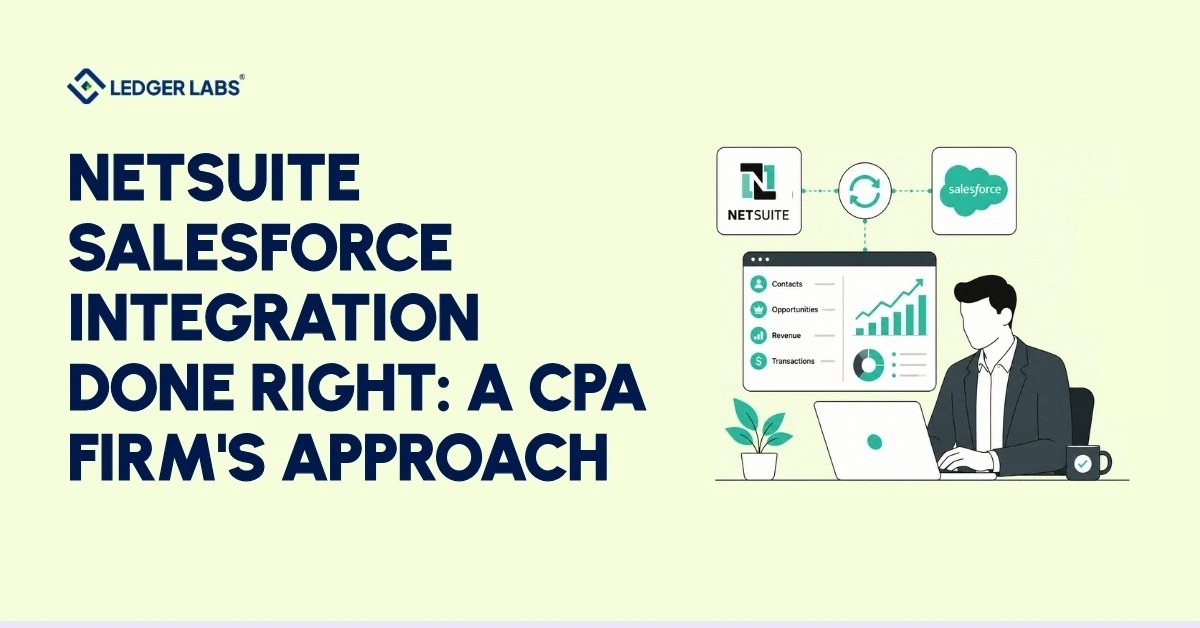
NetSuite and Salesforce can be integrated via an Oracle-built connector. This connector is available in the NetSuite SuiteApp marketplace. It helps transfer key sales information, such as opportunities, accounts, contacts, and products, from Salesforce to sales orders and invoices in NetSuite.
However, just because these systems can connect does not mean they will work perfectly for your business right away. The connector handles standard data fields well. But if your Salesforce setup includes custom objects, unique opportunity stages, product bundles, or transactions in multiple currencies, you will need to do some configuration work. This may feel more like building a custom solution.
Also, the connector does not ensure that financial data is correct in NetSuite. For example, if a closed-won opportunity in Salesforce leads to a sales order in NetSuite with the wrong general ledger account or a missing revenue recognition schedule, this can create accounting issues. The connector does not catch these types of errors; that’s the responsibility of accounting professionals.
For those considering this integration, it is well known and widely used. Many businesses in the mid-market B2B sector use both NetSuite and Salesforce. The key decision is not whether to connect them, but rather how to do it properly and who will oversee the process after the initial sync.
3 Ways to Integrate NetSuite with Salesforce
The integration method you choose affects several key factors: cost, implementation time, customization options, and the level of control your finance team has over what goes into NetSuite. The best option for your business may be different from what works for other companies.
Option 1: NetSuite Native SuiteApp Connector
Oracle’s connector works directly within NetSuite. It doesn’t need any third-party tools and is managed by Oracle. This option is best for companies with standard Salesforce data, like clean account records, simple opportunity stages, and straightforward product lists.
It offers the quickest setup and the lowest ongoing costs, taking about two to four weeks to configure. Some NetSuite license tiers include this connector. However, it has limitations: if your company uses custom objects or complicated pricing, the connector may not meet your needs.
Best fit: Companies under $5M with standard Salesforce configurations.
Option 2: iPaaS Middleware (Celigo, Workato, Boomi)
iPaaS middleware sits between Salesforce and NetSuite, handling data translation, transformation, and routing. Celigo is the most widely used tool for this specific integration in the mid-market. It ships with pre-built NetSuite Salesforce integration flows covering standard lead-to-cash objects, plus the ability to add custom mappings and error handling without writing code. Monthly cost ranges from $500 to $2,000, depending on data volume. Implementation takes four to eight weeks.
Best fit: B2B companies in the $1M–$50M range with non-standard data models and finance teams that want visibility into sync errors without managing code.
Option 3: Custom RESTlet API
NetSuite’s RESTlet API allows you to create custom integrations using JavaScript. While this offers maximum flexibility, it also comes with high costs and a significant maintenance burden. Building these integrations can take eight to sixteen weeks or longer and can create a dependence on the original developer for ongoing support.
For many mid-market companies, an Integration Platform as a Service (iPaaS) can handle about 90% of what a custom build does, at a much lower cost.
Best fit: Companies with data models that genuinely cannot be handled by SuiteApp or iPaaS.
Which Method Is Right for Your Business?
From a CPA’s perspective, the method you choose has direct implications for how reliably your financial data flows into NetSuite, and whether your GL entries are clean on day one.
| Dimension | SuiteApp | iPaaS | Custom RESTlet |
|---|---|---|---|
| Setup time | 2–4 weeks | 4–8 weeks | 8–16+ weeks |
| Monthly cost | Included or low cost | $500–$2,000/month | Development cost + ongoing maintenance |
| Customization | Limited | Moderate | Full |
| Best for | Businesses under $5M with standard configurations | Mid-market businesses ($1M–$50M) needing multiple integrations | Organizations with complex custom data models and advanced business logic |
Start with SuiteApp if your license includes it. Move to iPaaS if complexity demands it. Commission a custom RESTlet only when the first two genuinely cannot handle your data model.
What Data Syncs Between Salesforce and NetSuite?
Knowing the integration method is the framework decision. Knowing what syncs is the financial decision, and it is where most implementations create errors that do not surface until month-end close.
The table below covers the standard sync objects across all three methods. Custom objects require explicit configuration regardless of method.
| Salesforce Object | → NetSuite Object | Sync Direction | Financial Note |
|---|---|---|---|
| Opportunity (Closed Won) | Sales Order | Salesforce → NetSuite | Trigger the sync when the Opportunity reaches Closed Won. Amounts and line items must map accurately or the Sales Order will carry incorrect values. |
| Account | Customer | Bidirectional | Deduplicate customer records before go-live. Existing NetSuite customers should be matched to avoid duplicate master data. |
| Contact | Contact | Bidirectional | Contacts remain linked to the Account/Customer. Secondary deduplication is recommended to prevent duplicate contact records. |
| Product (Line Item) | Item | Salesforce → NetSuite | Products must match the NetSuite Item catalog exactly. Unmatched items can prevent order creation and invoicing. |
| Quote | Estimate / Quote | Salesforce → NetSuite | Represents the pre–Sales Order stage. Confirm whether quote synchronization is required before configuring the integration. |
| Invoice (from NetSuite) | Opportunity Field | NetSuite → Salesforce | Invoice number and payment status are synchronized back to Salesforce, giving sales teams visibility into billing progress. |
| Payment | Closed Invoice Status | NetSuite → Salesforce | Updates invoice payment status in Salesforce, completing the lead-to-cash lifecycle. |
Sync Direction: What Goes Which Way?
Customer and contact records sync bidirectionally. Transactional objects flow primarily from Salesforce to NetSuite, with financial status flowing back. Bidirectional sync on customer records introduces a conflict-resolution requirement: if a record is updated in both systems simultaneously, the connector needs rules that determine which system wins. Most iPaaS tools default to last-write-wins. Left unconfigured, a finance update to payment terms in NetSuite can be overwritten by a sales rep updating a phone number in Salesforce. Define conflict rules before go-live.
What Doesn't Sync Automatically
Three categories that finance teams assume will sync but do not in standard configurations:
- Credit memos and refunds – not included in standard flows. NetSuite refunds do not automatically reflect in Salesforce without custom logic.
- Revenue recognition schedules – the integration syncs the invoice, not the recognition schedule. Businesses running ASC 606 in NetSuite must verify that closed-won opportunities trigger the correct recognition treatment. This is a configuration function, not a connector function.
- Partial payments – standard connectors sync invoice status (paid/unpaid), not partial payment amounts. Payment plan businesses need custom logic.
These are not integration failures. They are standard scope limitations that must be documented in field mapping before go-live.
The Best Way to Sync Salesforce Deals to NetSuite Invoices
This is the workflow that drives most companies to pursue this integration: a deal closes in Salesforce, and a NetSuite invoice exists within minutes, without anyone manually creating it. Getting this right requires five configuration decisions, not just a connected system.
Step 1: Define the trigger precisely
Set the sync trigger on Opportunity Stage = Closed Won AND Amount > $0 AND Close Date is not future. Stage alone allows pre-staged opportunities to create premature NetSuite sales orders. The amount guard prevents zero-dollar test records from generating real transactions.
Step 2: Reconcile your product catalog before go-live
Every Salesforce product on a closed-won opportunity must have a corresponding NetSuite Item record. Unmatched products create SO line items with no item code, which blocks invoicing and requires manual intervention. Run the full catalog reconciliation before launch, not after.
Step 3: Set SO creation defaults
The NetSuite sales order created from Salesforce needs a subsidiary assignment, revenue class, and payment terms. These values do not exist in Salesforce. Define defaults for each field, or map them from Salesforce account fields, before configuration begins.
Step 4: Automate SO approval
Most NetSuite configurations require SO approval before invoicing. Build a NetSuite workflow that auto-approves SOs created via the Salesforce integration, so invoices generate without requiring manual finance team intervention on every transaction.
Step 5: Write invoice data back to Salesforce
Once NetSuite generates the invoice, the invoice number and due date should sync back to the Salesforce opportunity record. This closes the information loop for sales reps and eliminates the “did they get invoiced?” question that generates unnecessary internal communication.
When these five steps are configured correctly, a closed-won opportunity in Salesforce becomes a NetSuite invoice within minutes, with the correct line items, correct GL coding, and the invoice number visible in Salesforce.
NetSuite Salesforce Automation: Workflows You Can Run After Integration
The closed-won-to-invoice workflow is the starting point. Once the base integration runs cleanly, three additional automation workflows deliver meaningful time savings for the finance team with relatively low additional configuration effort.
Closed-Won Opportunity → Auto-Invoice in NetSuite
The core workflow covered in Section 4. The metric to track post-go-live: time from Salesforce Stage = Closed Won to NetSuite invoice creation. In a well-configured integration, this runs under fifteen minutes. If it takes hours or requires manual steps, the SO approval workflow or line item mapping has a gap that needs immediate diagnosis.
Payment Status Sync Back to Salesforce
When a NetSuite invoice is paid, ACH, check, or card, that status should update automatically in Salesforce on the corresponding opportunity record. Sales reps see which of their accounts carry outstanding invoices without needing NetSuite access or submitting an AR aging request to finance.
Configure the trigger on NetSuite Invoice Status = Paid In Full, mapping payment date and amount received to Salesforce opportunity custom fields. Most iPaaS connectors support this as a standard flow. The operational benefit: finance stops receiving “has this customer paid?” emails from sales. That category of internal communication overhead disappears.
AR Aging Push to Sales Rep Dashboard
Your NetSuite AR aging report, showing which customers carry invoices 30, 60, or 90 days overdue, can sync to Salesforce account records on a daily schedule, giving sales reps visibility into past-due balances before they make account calls.
Two practical benefits. First, a rep calling for an upsell conversation who sees a 60-day overdue invoice on the account can avoid the awkward moment where the customer raises it first. Second, reps become a passive collections touchpoint; a relationship call that incidentally mentions an outstanding invoice often produces faster payment than a collections email from finance. Configure via a scheduled daily sync from NetSuite AR data to Salesforce account fields.
What Ledger Labs Does That Integration Platforms Can't
Software vendors configure the connection between Salesforce and NetSuite. They verify that data flows from one system to the other. They do not validate whether the financial data that arrives in NetSuite is correct from an accounting standpoint.
That is the gap we fill.
Financial Data Validation Post-Sync
When we implement this integration, the first post-go-live reconciliation checks three things no connector validates automatically.
GL account mapping accuracy. Every Salesforce product maps to a NetSuite Item, and every NetSuite Item posts to a GL account. If an Item maps to the wrong revenue GL account, which happens when product catalog reconciliation is done quickly without CPA review, revenue hits the wrong line on your P&L. Both systems show clean data. The financial statements are wrong. The connector cannot flag this. We do.
Sales order to invoice reconciliation. Every closed-won opportunity should produce exactly one NetSuite sales order and one invoice. In the first thirty days of a live integration, duplicates appear regularly, from sync retries on failed connections, from test records, from opportunities reopened and re-closed. We run SO-to-invoice reconciliation in weeks one and two and at the 30-day mark.
Revenue recognition trigger review. For businesses with deferred revenue, the closed-won trigger that creates a NetSuite SO must also initiate the appropriate revenue recognition schedule. If it does not, revenue is recognized on the invoice date rather than the performance obligation schedule, a direct ASC 606 compliance issue.
Revenue Recognition Implications (ASC 606)
For SaaS companies and businesses with multi-period contracts, the Salesforce–NetSuite integration directly affects ASC 606 compliance. A closed-won 12-month contract in Salesforce creates a NetSuite SO. If that SO is not configured to attach the correct revenue recognition schedule at creation, NetSuite recognizes the full contract value on the invoice date rather than spreading it over 12 months.
Most connector implementations do not configure revenue recognition schedules; that is a NetSuite accounting configuration, not a connector function. We configure, test, and validate recognition treatment as part of every implementation. For any business with subscription or multi-period revenue, this is not optional.
How Long Does NetSuite Salesforce Integration Take?
Timeline varies by integration method and data complexity. The ranges below reflect actual implementation timelines, not vendor estimates.
| Phase | What Happens | Duration |
|---|---|---|
| Discovery | Map the lead-to-cash process, inventory the Salesforce data model, define sync direction, and establish conflict resolution rules. | 1–2 weeks |
| Field Mapping | Define object-to-object mappings, reconcile the product catalog, resolve duplicate customer records, and configure multi-entity defaults. | 1–2 weeks |
| Connector Configuration | Build and configure the selected integration method, including error handling, logging, and alerting. | 2–4 weeks |
| User Acceptance Testing (UAT) | Test all synchronization scenarios using real business data, validate general ledger entries, and confirm duplicate records are not created. | 1–2 weeks |
| Go-Live | Deploy the integration to production and monitor the first live synchronization cycle. | 1 week |
| 30-Day Reconciliation Review | review covering GL mapping accuracy, sales order-to-invoice reconciliation, and revenue recognition trigger validation. | 30 days |
| Total | End-to-end implementation | 6–11 weeks |
Two main factors can delay timelines. First, issues with Salesforce data quality, such as duplicate accounts and inconsistent product names, can add two to four weeks for cleaning. Second, complex multi-entity NetSuite setups complicate every step.
The 30-day reconciliation review is essential. It identifies issues that arise with real transactions, preventing larger month-end problems. Skipping this review is the most common reason companies contact us six months after going live to ask why their accounts don’t match.
Conclusion
Many companies that integrate NetSuite and Salesforce still have trouble with monthly financial reconciliation. This often happens because the setup is done by a software team without focusing on data accuracy afterward.
Ledger Labs, led by qualified accountants, handles the integration and verifies financial data in both systems. We ensure that general ledger mapping, sales order reconciliation, and revenue recognition are accurate before completing the project.
During your free 30-minute consultation, we will analyze your lead-to-cash process to identify data issues between Salesforce and NetSuite. We will check your Salesforce data for errors like duplicate accounts, unmatched products, and missing default fields.
We will also recommend the best integration method for your business size and complexity. Additionally, we will provide a realistic timeline and explain what the 30-day reconciliation review includes.
We don’t pitch vendors or sell software. You’ll receive an honest assessment from a CPA on how to ensure your integration is financially accurate.
FAQs
1. Does NetSuite integrate with Salesforce natively?
Oracle has a connector for NetSuite and Salesforce integration, available in the NetSuite marketplace. It supports key objects like opportunities, accounts, contacts, and products. This is the fastest option for standard Salesforce setups. For custom data models, middleware like Celigo offers better reliability and error visibility. We assess your integration needs to find the best approach before starting any work.
2. How long does NetSuite Salesforce integration take?
Most projects take six to eleven weeks, including one to two weeks for discovery, two to four weeks for setting up connections, one to two weeks for user acceptance testing (UAT), and a 30-day review after going live. Data quality is a key factor; issues like duplicate Salesforce accounts or unmatched products can add two to four weeks. Our discovery process identifies these problems early.
3. What is the best way to sync Salesforce deals to NetSuite invoices?
To set up your workflow, follow these five steps: first, set your Closed Won trigger with limits on amount and date. Next, ensure your product catalog matches NetSuite Items before going live. Then, establish default settings for sales order creation, including subsidiary and payment terms. After that, automate sales order approvals to generate invoices without manual steps. Finally, sync the NetSuite invoice number back to Salesforce. Keep in mind that most financial errors occur in the product-to-item mapping and GL coding steps, so have a CPA review these areas, not just technical configurations.
4. Can you run bidirectional sync between NetSuite and Salesforce?
Customer and contact records sync both ways. Transaction data primarily goes from Salesforce to NetSuite, with payment status and invoice details coming back to Salesforce. Full bidirectional syncing of transactional records can create complex conflicts that most businesses don’t need. In this setup, Salesforce manages pre-sale records, while NetSuite handles financial records. Status updates return to keep sales reps informed. We will define the sync direction for each object in your data model.
5. What does a CPA firm do differently in a NetSuite Salesforce integration?
Software vendors check data flow between systems. We ensure data in NetSuite meets accounting standards by verifying that GL entries are coded correctly, sales orders match invoices, and revenue recognition schedules for deferred revenue are accurate. For businesses following ASC 606, this compliance is critical. A connected system that sends data to the wrong GL accounts can cause serious issues, creating the appearance of agreement while hiding financial errors.