
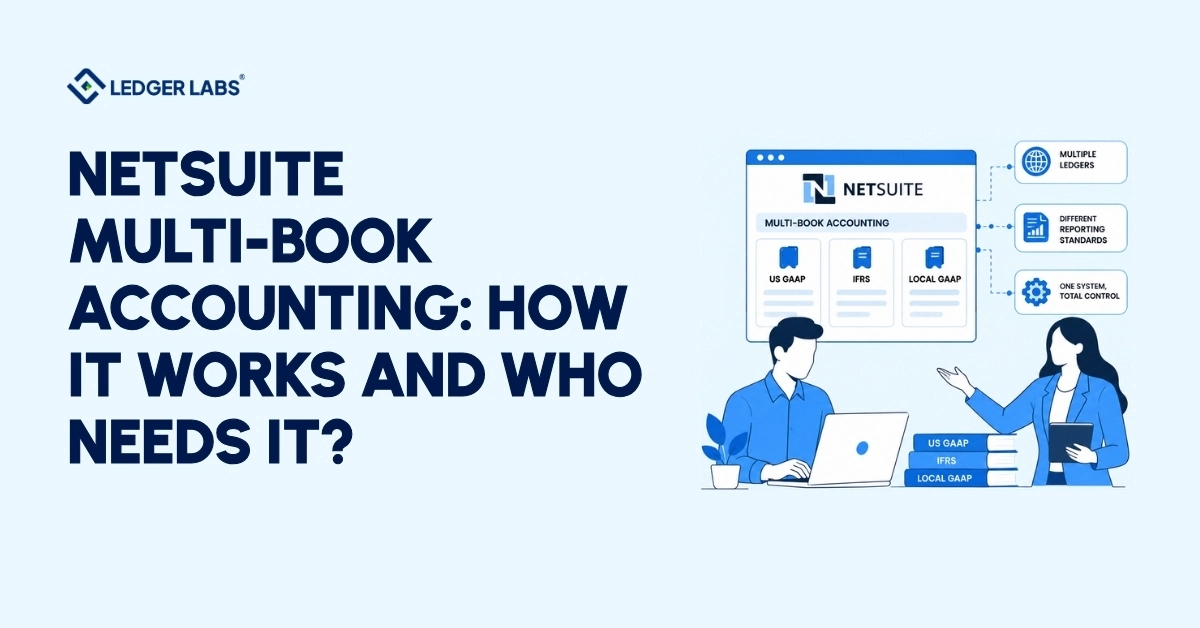
NetSuite Multi-Book Accounting is a feature of NetSuite OneWorld that allows you to manage your financial records using more than one accounting standard, such as US GAAP and local accounting rules or tax requirements, all based on the same transactions. You can choose between Full Multi-Book Accounting or a simpler Adjustment-Only Books option.
If you’re considering your options, choose wisely to avoid costly mistakes. Full Multi-Book requires assistance from NetSuite Professional Services or a certified partner, which can be pricey to implement. On the other hand, Adjustment-Only can be enabled by an administrator without that project, but it may not suit you if your accounting needs differ significantly.
Choosing incorrectly can add unnecessary complexity or force you to manually adjust GAAP to tax figures in a spreadsheet at each financial close, which is what Multi-Book is designed to prevent.
That manual work has a real cost: according to BlackLine’s 2024 survey of over 1,300 finance leaders, nearly 40% of CFOs don’t completely trust the accuracy of their own financial data, and hand-adjusted, multi-standard reporting is exactly the kind of gap that erodes it.
We are an accounting team that sets up and manages NetSuite for $2M–$50M clients. We provide ongoing support, unlike vendors or partners who drop off after setup.
This page explains how the features work, helps you choose the best option, and describes the changes when we take over.
Key Takeaways
- NetSuite Multi-Book Accounting runs GAAP, tax, and local books off one transaction, no manual re-entry required.
- Two paths exist: Full Multi-Book Accounting and Adjustment-Only Books; picking the wrong one wastes money either way
- Full Multi-Book needs NetSuite Professional Services or a certified partner; Adjustment-Only, your own admin can enable directly
- Multi-book accounting isn’t the same feature as multi-entity consolidation; confusing the two sends you toward the wrong fix
- We configure and manage both paths for clients directly, and stay on to reconcile the books every month after
Why Multi-Standard Reporting Breaks Down Without NetSuite Multi-Book Accounting?
NetSuite Multi-Book Accounting helps companies manage different accounting rules at the same time. A single general ledger can’t meet US GAAP, local rules for foreign subsidiaries, and IRS tax rules at the same time without monthly manual adjustments. NetSuite solves this by recording one transaction in multiple books at once. Each book can have its own chart of accounts mapping, exchange rates, and revenue recognition and expense amortization rules, all without having to enter the data multiple times.
Imagine your controller finishes closing the US GAAP books on time but still has to pull those numbers into a spreadsheet. They need to adjust depreciation to local tax rules, reclassify revenue based on how the subsidiary’s home country sees it, and hope nothing changes before the local filing deadline. That spreadsheet is doing the job that this NetSuite feature was designed for.
Here’s where it gets costly: every manual adjustment increases the risk of errors, and many times these errors go unnoticed until an auditor or local regulator points them out.
We see this often with clients who don’t know the feature exists, aren’t sure which version fits their setup, or think it automatically includes everything they need. It doesn’t.
This gap between doing things manually and using automation costs not only time but also real money, depending on the type of mistake made.
What Does Getting This Wrong Actually Cost You?
Getting this wrong costs money, and there is no easy way out. You either pay for a setup you didn’t need, or you waste time and accuracy on a manual routine that NetSuite can handle inside the system. We see both of these mistakes often, and they end up costing about the same. You pay either in cash upfront or in hours every month.
The Cost of Implementing Full Multi-Book When You Didn't Need It
Full Multi-Book Accounting isn’t a checkbox; it’s a real engagement. NetSuite Professional Services or a certified Multi-Book-authorized partner must configure it, and knowing how to hire a NetSuite consultant matters more here than for most NetSuite decisions. The setup itself involves:
- Running Historical Transaction Processing to transfer the general ledger impact of past transactions into the new secondary book.
- Checking that all accounts are correctly mapped for any differences between the books.
- Testing the secondary book against the primary book before go-live to ensure the numbers are reliable.
If your business only needs a few specific adjustments, like one type of depreciation entry that differs between GAAP and tax, a full secondary book may be more complicated than necessary. You will incur significant implementation costs and ongoing maintenance for a level of separation you might not need.
However, the opposite mistake is more common.
The Cost of Staying Manual When Adjustment-Only Books Were Available
NetSuite offers Adjustment-Only Books, the lighter version of this feature, on any OneWorld account, and any administrator can enable them directly. Most businesses that stay manual simply don’t know that.
Instead, someone on your team runs the same routine every close:
- Pulls the GAAP figures out of NetSuite
- Applies the tax or local treatment by hand, usually in Excel
- Hopes this month’s logic matches last month’s
That manual process doesn’t just take longer. Here’s the part that actually hurts: it’s the exact point where reconciliation errors enter the books, because a hand-keyed adjustment is the one entry nobody cross-checks against the system of record.
Both mistakes trace back to the same root cause: not knowing which path this feature actually offers, or how each one works, before you commit to anything.
How NetSuite Multi-Book Accounting Works: Full vs. Adjustment-Only Books
Full Multi-Book Accounting builds a genuine second ledger that runs independently; Adjustment-Only Books layer a handful of correcting entries on top of the one you already have.
The right choice comes down to one thing: how far apart your books actually need to be, not your revenue size or entity count.
Here’s how the two compare directly:
| Factors | Full Multi-Book Accounting | Adjustment-Only Books |
|---|---|---|
| Who Can Set It Up | NetSuite Professional Services or a certified Multi-Book partner | Any NetSuite administrator |
| Data Handling | Duplicates the full GL impact of every transaction | Stores only the incremental adjustment |
| Currency | Can use a different functional currency per book | Must match the primary book's currency |
| Accounting Period | Closes independently of the primary book | Tied to the primary book's close |
| Revenue Recognition | Separate rules per book, from source transactions | Book-specific entries only, via manual journal entry |
| Best For | Genuinely different reporting bases, foreign GAAP, distinct fiscal calendars, standalone secondary reporting | Book-specific adjustments layered on otherwise identical books |
To choose the right setup, ask yourself this: If your secondary book will often differ from your primary book, like using a different currency, different rules, or timing, then go with Full Multi-Book. If you need only a few small adjustments to mostly identical numbers, Adjustment-Only is more cost-effective.
Knowing how each option works matters only after you decide which one fits your business.
Who Needs NetSuite Multi-Book Accounting and Who Doesn't
You need NetSuite Multi-Book Accounting if you have different reporting needs for GAAP, taxes, local laws, or management reports. If your reporting needs are the same across these areas, you don’t need it. Your decision should not depend on how much revenue you have or how many subsidiaries you manage.
Signs You Need Multi-Book Accounting
You’re a likely candidate if any of these describe your business:
- You operate a foreign subsidiary that must report under local GAAP or IFRS alongside your US GAAP parent financials
- Your tax treatment of revenue recognition, depreciation, or expense timing genuinely differs from GAAP, a structural difference, not a handful of line items
- You need a management reporting view, stripped of GAAP-only items like certain accruals, that leadership actually uses to run the business
- You’re heading into an acquisition or divestiture and need to track pre- and post-transaction financials separately, without corrupting your historical numbers
If any of these apply to you, the question is not whether to use multi-book accounting, but which version to choose. We often see businesses struggling, just like before, with a spreadsheet doing what a proper system should handle. This misunderstanding drives much bad advice.
When Multi-Book Accounting Is Overkill
Vendors and consultants often exaggerate this feature. If your business only operates in one area, your tax rules and GAAP treatments usually differ by just a line or two.
If you don’t plan to add a foreign subsidiary or make an acquisition soon, having a second full accounting book can complicate things without providing real benefits. Your main accounting book should already meet your needs, or a few simple Adjustment-Only entries can fill any gaps. There’s no need to worry about your five-book limit or budget.
Multi-entity businesses often ask about this, usually because they confuse multi-book accounting with another NetSuite feature.
NetSuite Multi-Book Accounting vs. Multi-Entity Accounting
Multi-entity accounting and multi-book accounting serve different purposes, and it’s common to confuse them. Multi-entity accounting shows how many legal entities your NetSuite account manages, such as subsidiaries combined into one view.
Multi-book accounting reflects the different versions of a single entity’s financial records, including GAAP, tax, local statutes, or management reports, all based on the same transactions.
A business can need one without the other:
- A single-entity US company with GAAP-versus-tax differences needs multi-book, not multi-entity
- A four-subsidiary company reporting under one standard needs multi-entity consolidation, not multi-book
- A business with foreign operations often needs both: multi-entity to consolidate the subsidiaries, multi-book within one or more of them to satisfy local-versus-GAAP reporting
We see that third case constantly.
A client with four subsidiaries faced issues with consolidated reports that never matched up. Every attempt to combine their numbers failed. We completely overhauled their intercompany accounting and foreign exchange processes, turning consolidation into a task the finance team can trust instead of dread. Multi-entity tools were the solution, not multi-book.
Identifying the actual issue is key. This ensures you address the right problem rather than wasting money on useless features. If your reporting challenges sound similar, you likely need multi-entity consolidation, not what this page talks about.
After pinpointing the problem, the next step is figuring out how to fix it with a team instead of relying on your admin to work late nights.
What Working With Ledger Labs on Multi-Book Accounting Looks Like
When you work with us, we help you choose the right setup, either Full Multi-Book or Adjustment-Only. After that, we stay with you every month to manage it, instead of just giving you the documents and leaving once it’s running.
What We Configure and Manage
We are a team led by qualified accountants that sets up and manages NetSuite Multi-Book Accounting for clients. We don’t sell software or offer a one-time Professional Services engagement that ends after implementation goes live.
For Full Multi-Book Accounting, we handle the complete setup, including:
- Activating the feature and mapping the chart of accounts for each book
- Setting up specific revenue recognition and expense amortization rules for each book
- Processing historical transactions so your secondary book has a full record to start with
- Checking the secondary book against the primary book before we hand over control
For Adjustment-Only Books, we provide a simpler version that accurately configures book-specific journal entries from the start, instead of guessing with a spreadsheet.
We don’t just set things up and leave. Our team continues to work with you every month to reconcile both accounts. Most implementation partners don’t provide this ongoing support. If the setup reveals additional needs beyond the multi-book function, our NetSuite consulting services can help.
What Changes for Your Close
Before: Someone on your team gathers GAAP numbers, manually adjusts for tax or local changes, and hopes this month’s calculations match last month’s.
After: The system automatically makes the adjustment, specific to each book, at the same time as the original transaction no extra spreadsheet, no separate reconciliation, and no version of the truth that only lives in someone’s head.
If you’re unsure whether you need Full Multi-Book, Adjustment-Only Books, or neither, discuss this before hiring anyone for implementation.
Conclusion
You know an important number: how many hours your team spends each month adjusting GAAP figures for tax or local reporting. You also know how much a Full Multi-Book setup would cost if you didn’t really need it.
Multiply that number by 12 to see how much you lose each year by delaying this decision. This isn’t just a one-time issue; it’s an ongoing cost that adds up every month the problem isn’t resolved.
However, don’t rush into an implementation you don’t need. Before the next close, it’s crucial to know whether you need Full Multi-Book, Adjustment-Only, or neither.
Not sure if you need Full Multi-Book, Adjustment-Only, or neither?
Book a Consultation with the CPA– and accountant-led team that runs NetSuite books like this every day.
FAQs
1. Is NetSuite Multi-Book Accounting a paid add-on, or is it included?
Both Full Multi-Book Accounting and Adjustment-Only Books are available only in NetSuite OneWorld; confirm licensing terms with your NetSuite account team. The cost you can plan for is implementation: Full Multi-Book requires NetSuite Professional Services or a certified partner, a real cost tied to your setup’s scope. Your administrator can enable Adjustment-Only Books directly.
2. Can our internal admin set up full multi-book accounting?
No. Full Multi-Book Accounting requires NetSuite Professional Services or a certified Multi-Book-authorized partner; an in-house administrator can’t configure it alone, however experienced. Adjustment-Only Books are the exception: your own administrator can enable those directly under Setup; no outside help required.
3. Do you need NetSuite OneWorld to use multi-book accounting?
Yes. NetSuite offers both Full Multi-Book Accounting and Adjustment-Only Books exclusively through OneWorld. NetSuite’s standard edition doesn’t offer either version, regardless of how many accounting standards you need to satisfy.
4. How long does implementation take?
You can configure Adjustment-Only Books in as little as a day. Full Multi-Book Accounting takes considerably longer, weeks, not days, once you account for chart-of-accounts mapping, Historical Transaction Processing on existing data, and validating the numbers before go-live. Your transaction volume and the number of secondary books you’re adding determine the exact timeline.
5. What happens to historical transactions when you turn it on?
For Full Multi-Book Accounting, Historical Transaction Processing copies the GL impact of your past transactions into the new secondary book so it doesn’t start empty, it duplicates only the financial impact, not the original transactions. Adjustment-Only Books don’t touch historical data at all; they apply going forward from the date you enable them.
6. Why do companies keep multiple sets of accounting books?
One general ledger cannot satisfy every rulebook at once. A US parent may need US GAAP figures, a foreign subsidiary may need local statutory rules, and tax filings follow IRS rules. Multiple books give each set of rules its own record of the same transactions, so your team is not adjusting a spreadsheet at every close.
7. How many accounting books can you have in NetSuite?
You can have up to five active books in total, including your main book. This means you can have up to four additional books. Most businesses that need Full Multi-Book typically add only one or two books beyond the main one. Adjustment-Only Books do not count towards this limit.