
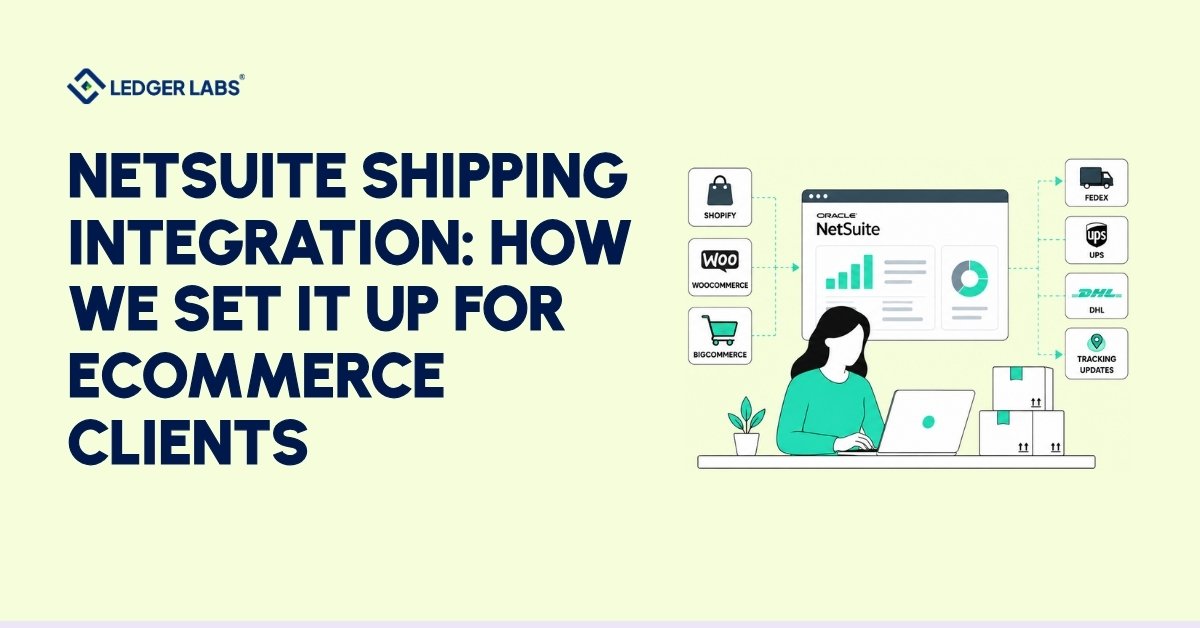
Your shipping integration launched six months ago, but your carrier invoices still don’t match your NetSuite shipping costs. Your accountant manually checks the numbers at the end of each month. As a result, your Profit and Loss statement shows shipping expenses as either too high or zero, and no one can explain which General Ledger account is recording the costs.
While the integration itself worked fine, the accounting setup did not. This problem is common for accounting firms that set up NetSuite shipping integrations for ecommerce clients. The focus often goes to choosing the right tool, while the financial setup, including General Ledger mapping, carrier invoice checking, and item fulfillment processes, often gets overlooked or done last.
This guide covers both the integration and the accounting setup. Before you choose a tool, read the section on accounting setup; it’s important no matter which integration you decide on.
We set this up for ecommerce clients by mapping each carrier charge and invoice to inventory cost and COGS, then reconciling it in the month-end close, which finishes one week after month end.
By the end, you will know which integration works for your operation, how your accounting should look before going live, and what your accounting team needs to confirm before you proceed.
Start by asking a key question that many operators overlook: does NetSuite need a third-party tool at all?
Key Takeaways
- NetSuite Ship Central handles simple setups – high-volume, multi-carrier, or 3PL operations need a third-party integration.
- ShipStation, ShipHawk, Pacejet, ShipJunction, and ShipBob each serve a different operation; volume, carrier mix, and 3PL setup determine the right choice.
- GL mapping, carrier invoice reconciliation, and item fulfillment configuration must be correct before go-live, not fixed after.
- Ledger Labs implements these integrations and handles the accounting setup as part of the same engagement.
How NetSuite Handles Shipping: Native vs. Third-Party
NetSuite offers two shipping options: Ship Central, which is built in, or a third-party integration. Which option you choose depends on your shipping volume, the types of carriers you use, and if you work with a third-party logistics (3PL) provider.
Many ecommerce businesses think they need a third-party shipping app from the start, but this isn’t always necessary. Oracle has significantly improved Ship Central. For simple shipping needs, it provides everything you need without extra costs or complications.
Here are the key points to consider:
NetSuite Ship Central – Oracle’s Built-In Shipping Option
Ship Central is Oracle’s shipping module and, in Oracle’s words, NetSuite’s standard shipping solution, available for all NetSuite accounts. It ships through the carriers you connect to a ShipStation API account that you create inside NetSuite, so rate and label data stay in the same system.
If you’re using NetSuite for the first time, Ship Central should be your starting point. It connects directly to your carrier accounts, creates shipping labels within NetSuite, and automatically fulfills items when you create a label. Your shipping account captures costs as soon as you create the label, so make sure your accounting setup is correct before your first shipment.
Ship Central is a good fit when:
- You ship with one or two carriers and don’t need automated rate comparisons.
- You handle under 300–500 orders daily.
- You don’t ship freight or large shipments.
- All your fulfillment is done in-house without a 3PL.
It can struggle if your shipping volume grows, if you have multiple carriers, or if you need features like real-time rate comparisons, freight management, branded packing slips, or batch processing.
Keep in mind: If you’re still using the Legacy Shipping Label Integration from a setup before 2024, ask Oracle or your NetSuite partner whether it is still supported on your account, and plan a move to Ship Central.
When You Need a Third-Party Integration?
You need to use a third-party shipping service when Ship Central can’t meet your needs, especially if you ship a lot, need freight services, or want to compare rates from different carriers.
Switch to a third-party tool if any of these situations apply:
- You have more than 400–500 orders per day. At this level, batch processing speed and queue management become important issues.
- You are dealing with LTL or freight shipments. Ship Central only handles parcel deliveries; for LTL, use ShipHawk or Pacejet.
- You need to compare shipping rates from multiple carriers. To automatically compare UPS, FedEx, USPS, and DHL for each shipment, you need a shipping app.
- You have 3PL fulfillment. You need a connector that can communicate with your 3PL’s WMS and update NetSuite.
- You want a branded post-purchase experience. Custom packing slips, tracking emails, and returns portals are not available with Ship Central.
The five third-party options below cover every operational profile in this range.
NetSuite Shipping Integration Selection Matrix (Six Options, Including NetSuite Ship Central)
Most vendors recommend the tool they know best. Here’s an independent view of who each integration is actually built for, how much it costs your accounting team to connect, and where each one breaks down.
Use four variables to shortlist before reading the detail: daily order volume, whether you ship LTL, whether you use a 3PL, and how many carriers you rate-shop across.
| Tool | Best For | Volume | LTL | 3PL | Setup Time | Accounting Complexity | Pricing |
|---|---|---|---|---|---|---|---|
| Ship Central | New implementations, simple setup | Under 500/day | ❌ | ❌ | 1–3 days | Low | Included in NetSuite |
| ShipStation | Multi-channel eCommerce (Shopify, Amazon, DTC) | Up to 500/day | ❌ | Limited | 3–5 days | Medium | From $14.99/mo |
| Pacejet | Multi-carrier rate shopping | Mid–High | ✅ | Yes | 1–2 weeks | Low–Medium | Custom |
| ShipHawk | High-volume, wholesale, LTL freight | 500+/day | ✅ | Yes | 3–4 weeks | High | Custom |
| ShipJunction | Parcel throughput at scale | 50,000+/day (vendor-stated) | ❌ | Limited | 2–3 weeks | High | Custom |
| ShipBob | ShipBob 3PL operations | Mid | ❌ | ✅ Native | 1–2 weeks | Medium | Enterprise tier |
Accounting Complexity legend: Low = standard GL mapping, minimal reconciliation. Medium = rated vs. billed cost gap requires a weekly reconciliation workflow. High = multi-account mapping, or volume makes a mapping error expensive to fix retroactively.
Vendor pricing in this table is taken from each vendor’s published pricing page; setup times and accounting-complexity ratings are our own project data.
ShipStation NetSuite Integration
Verdict: The right choice for branded multi-channel ecommerce, Shopify, Amazon, DTC, where clean order sync, branded labels, and a warehouse-friendly UI matter most.
Accounting implication: ShipStation writes the rated cost to NetSuite at label creation, not the billed cost. Your UPS or FedEx invoice will differ due to dimensional weight, fuel surcharges, and address corrections. Set up a weekly carrier invoice reconciliation workflow before go-live. Skip it, and your accounting team closes that gap manually every month-end.
What it does well:
- Normalises orders from Shopify, Amazon, eBay, and a wholesale portal into a single fulfillment queue
- Branded packing slips, tracking notification emails, and returns portal setup are all native
- SuiteApp installation is straightforward; a NetSuite administrator handles standard setup without a developer
Where it breaks down:
- No LTL or freight support; if you ship any pallets, you need a separate solution
- Order sync can lag during peak seasons, a real problem when your team checks order status in NetSuite
- Multi-warehouse routing requires explicit configuration; it’s not automatic
Setup: 3–5 days for standard configuration | NetSuite administrator | No middleware required
Pricing: Plans start at $14.99/month, and Standard runs $29.99–$149.99/month for 50–1,000 shipments (ShipStation pricing). Confirm any NetSuite connector fees with ShipStation or your partner.
ShipHawk NetSuite Integration
Verdict: The right choice for operations that ship 500+ orders per day, run LTL freight, or manage wholesale and DTC fulfillment from the same warehouse.
Accounting implication: ShipHawk writes carrier cost at the shipment level back to NetSuite, the most granular cost data of any tool on this list. That’s exactly what you need for accurate shipping cost per order in your COGS or shipping expense reporting.
Confirm your shipping GL mapping with your CPA before go-live, not after; retroactive adjustments across hundreds of closed orders are expensive to fix.
What it does well:
- Smart Rating selects the optimal carrier and service level across parcel and freight automatically based on your configured rules
- Smart Packing selects the most cost-effective box configuration per order based on item dimensions and weight, reduces both material costs and dimensional weight charges at volume
- Handles mixed-mode operations: parcel, LTL, and white-glove delivery processed in the same workflow
Where it falls short:
This tool isn’t worth the cost if your revenue is under $5 million or you have fewer than 200 daily shipments. It is the most expensive option on this list.
To implement it, you need middleware (such as Celigo or Dell Boomi), a technical expert, and at least 3-4 weeks. If you try to implement it without help, expect extra weeks of trial and error.
Support response times can vary a lot. If you have a tight deadline, consider hiring a NetSuite partner to help you.
Setup: 3–4 weeks | NetSuite administrator + middleware resource | Celigo or Dell Boomi required
Pricing: Custom quotes.
Pacejet NetSuite Integration
Verdict: The right choice when carrier cost optimization is the primary goal, automated multi-carrier rate shopping running inside NetSuite, not in a separate application.
Accounting implication: Pacejet’s native SuiteApp architecture means shipping costs post directly to NetSuite without a middleware sync delay, no timing gaps between when the label fires and when the cost hits your books.
That’s cleaner for month-end close. Confirm your GL account mapping for shipping expenses before activating live volume. With many carrier connections running simultaneously, a misconfigured GL account creates a significant cleanup problem fast.
What it does well:
- Rate shopping, label generation, and tracking all happen inside NetSuite; your warehouse team never switches applications
- Connects to UPS, FedEx, USPS, DHL, and LTL freight carriers through a built-in network that Descartes says covers 95% of available U.S. and Canadian services
- Rules-based automation handles carrier selection automatically: cheapest available, fastest available, or custom logic by delivery zone or customer tier
- Shows estimated shipping cost at order creation, useful for accurate quoting
Where it breaks down:
- Pacejet’s support team is difficult to reach during go-live and peak periods; budget for a NetSuite partner to bridge the gap if your team needs hands-on help
- Because Pacejet runs natively inside NetSuite, any NetSuite downtime takes your shipping queue down with it; build a manual fallback procedure for peak periods
Setup: 1–2 weeks | NetSuite administrator | No middleware required
Pricing: Volume-based, not publicly listed.
ShipJunction NetSuite Integration
Verdict: The right choice when parcel throughput is the bottleneck, you process thousands of orders per day, and your current system creates fulfillment delays.
Accounting implication: At several thousand orders per day, your shipping expense GL account incurs thousands of hits. A misconfigured account at that volume creates a cleanup job measured in weeks, not hours. Get GL mapping confirmed with your controller before you process a single live order; this is not a fix-it-later situation.
What it does well:
- Handles very high volume (the vendor says customers ship over 50,000 orders in a single day) with automated batch order pulling, routing, and bulk label printing
- Automated packing optimization selects the smallest viable package per order; at high volume, this reduces dimensional weight charges and packaging material costs meaningfully
- Handles complex SKU configurations: bundles, kitted products, multi-unit orders with automated packing logic
Where it breaks down:
- No support for LTL shipments; only parcel shipping is available.
- Brand customization options are more limited than what you get with ShipStation. Packing slips and tracking emails work, but they lack flexibility.
- The partner and support network is smaller than those of ShipStation or Pacejet, meaning fewer options for implementation support.
Setup: 2–3 weeks | Technical resource required | API-based
Pricing: Not publicly listed
ShipBob NetSuite Integration
Verdict: The right choice if ShipBob is your 3PL; the native NetSuite connector handles the financial data flow between ShipBob’s WMS and your NetSuite books.
Accounting implication: Confirm whether ShipBob writes the rated cost or the billed cost back to NetSuite; that single distinction determines the size of your carrier invoice variance and how much reconciliation work lands on your accounting team monthly. We confirm this in writing with ShipBob before every client go-live; don’t assume it from the documentation.
What it does well:
- Orders flow from NetSuite to ShipBob for fulfillment; shipping confirmation, tracking numbers, carrier costs, and inventory adjustments write back to NetSuite on dispatch
- Inventory adjustments sync automatically when ShipBob processes a return or receives an inbound shipment
- Running both platforms without this integration means reconciling two inventory systems manually; that’s a liability, not a workflow
Where it breaks down:
- Only relevant if ShipBob is your 3PL; doesn’t extend to other fulfillment providers
- Complex kitting or multi-warehouse allocation rules may require custom development beyond the standard connector
Setup: 1–2 weeks | NetSuite administrator | Managed through ShipBob’s dashboard
Pricing: Included in ShipBob’s enterprise tier.
What to Check Before You Connect a Shipping Tool?
Many implementation guides only check if the integration works. However, as an accounting firm, we focus on ensuring your financial records are accurate afterward. Here are four accounting checks that help avoid common cleanup jobs after going live.
You can quickly see if the shipping tool is functioning well. But whether the accounting setup is correct often takes months to reveal. By then, you may have many posted transactions that become difficult to correct.
1. Confirm Your Shipping Cost GL Mapping
Every label created by your integration must connect to a General Ledger (GL) account. Ensure it connects to the correct account before processing any volume.
Outbound shipping labels are a cost of selling to a customer, so they do not go into inventory. Post them to a Shipping Expense GL account on your income statement, or to Cost of Goods Sold (COGS) if that is your documented accounting policy. Landed cost is different: it is inbound freight and duties to get goods into your warehouse, and it is added to inventory. Which account you use for outbound shipping depends on your accounting policy and gross margin reporting needs.
The most common issue we see is when the integration goes live, labels start generating, and no one checks the GL mapping. Three months later, the Profit and Loss (P&L) statement shows shipping expenses as zero (if they’re incorrectly capitalized to inventory) or too high (if they are charged to the wrong expense account). Both cases are configuration errors, and fixing them later can be difficult.
Before going live, confirm with your CPA which GL account will record the shipping expense. Does your policy consider shipping a direct cost of goods or a separate operating expense? Test the mapping with a live shipment before processing any volume.
2. Set Up Carrier Invoice Reconciliation Before Day One
Your integration records the rated cost at label creation. Your carrier invoices show the actual billed amount. The gap needs a reconciliation workflow, not a monthly manual scramble.
Carriers charge for the actual shipping costs, which include fees for dimensional weight adjustments, address corrections, fuel surcharges, and delivery area charges. These costs do not appear in the shipping estimates your system sends to NetSuite.
Based on our experience, the difference between estimated and actual bills usually ranges from 8% to 15% of total shipping expenses. This difference mainly comes from dimensional weight adjustments and fuel surcharges.
For example, if you spend $50,000 a month on shipping, you could be incorrectly accounting for $4,000 to $7,500 every month until someone creates a reconciliation process. The operations team often misses these discrepancies. The accounting team usually discovers them at the end of the month.
Set this up before go-live: reconciliation cadence (weekly recommended; monthly minimum), the GL account that absorbs the variance, and the team member who owns the process.
3. Test the Item Fulfillment Trigger - It's a Balance Sheet Event
When a label is created, NetSuite must automatically mark the item fulfillment as shipped and reduce inventory. This is not just an operations task; it is the transaction that takes items out of inventory (balance sheet) and records their cost in cost of goods sold (income statement).
If the trigger is misconfigured, labels may be generated, and items may physically ship, but NetSuite will still show them as available. This mismatch not only creates an operations issue but also a financial reporting problem that worsens with every order until someone conducts a manual inventory count.
Before going live, test explicitly: run five orders through the full process from order creation to label generation, and check that inventory is reduced correctly. Verify this against your specific NetSuite setup; don’t assume that the SuiteApp handles it automatically.
4. Confirm Revenue and Cost Line Accuracy Before Your First Order
Your accountant confirms this, not your warehouse manager. Shipping charges hitting the wrong revenue or cost line create a misstatement that compounds with every order processed before it’s caught.
Run this checklist with your CPA or controller before connecting any shipping integration to a live NetSuite environment:
- Shipping expense GL account confirmed and mapped in integration settings
- Carrier invoice reconciliation cadence defined (weekly recommended; monthly minimum)
- Item fulfillment auto-trigger tested with 10 orders before full cutover
- Shipping charges on sales orders verified to flow to correct revenue and cost lines
- Outbound shipping posts to expense or COGS per policy; inbound freight and duties handled as landed cost
This is exactly what we configure for ecommerce clients before every NetSuite shipping integration goes live.
How to Choose the Right NetSuite Shipping Integration?
Vendors sell the tool they implement. We recommend the one that fits your operation and creates the least accounting complexity at go-live. Work through these five questions in order.
- What’s your daily order volume?
- 1. Under 200/day – Ship Central or ShipStation.
- 2. 200–1,000/day – ShipStation (multi-channel sync) or Pacejet (rate optimization)
- 3. Over 1,000/day – ShipHawk (freight + high volume) or ShipJunction (parcel throughput).
- Do you ship LTL or freight?
Yes, ShipHawk or Pacejet. Both carry LTL carrier relationships and freight rating logic. No, LTL support is irrelevant to your decision.
- Are you using a 3PL?
Use ShipBob’s built-in NetSuite connector. If you choose a different 3PL, make sure they offer a NetSuite SuiteApp or API connector. If you don’t use a 3PL, the standard integration should work for you.
- How many carriers are you rate-shopping across?
If you need one or two carrier connections, consider using Ship Central or ShipStation for negotiated rates. If you have 3 or more connections, or want to reduce your shipping costs, choose Pacejet.
Keep in mind that each carrier connection will create an additional reconciliation line during your month-end process. Make sure your controller can handle this before you add any carriers.
- Does your accountant know this integration is going live?
Before activating the GL mapping, carrier invoice reconciliation workflow, and item fulfillment trigger configuration, get approval from your CPA or controller. If not confirmed beforehand, you could spend 10 to 20 hours cleaning up posted transactions and reconciliation issues. This does not account for the months of incorrect financial statements. We’ve helped clients with this cleanup, and it costs much more than getting it right initially.
Conclusion
Choosing the right shipping integration for NetSuite is crucial. Using the wrong tool with an incorrect accounting setup can lead to months of cleanup work. Properly setting up your general ledger, handling carrier invoices, and managing item fulfillment directly affect your financial record accuracy from day one and help prevent future issues.
To choose the right tool, ask yourself: What is your order volume? Do you need less-than-truckload (LTL) shipping or third-party logistics (3PL)? If you have fewer than 500 orders daily with one or two carriers and no freight, consider ShipStation or Pacejet. For higher volumes or more complex needs, consider ShipHawk.
Always involve your CPA or controller in the setup to avoid problems during the first month-end close. We implement NetSuite shipping integrations alongside accounting setup to ensure smooth operations and financial alignment from the start.
Ready to get this right from day one?
Book a free 30-minute consultation call. We’ll tell you which tool fits your operation, what the accounting setup involves, and what your controller needs to confirm before go-live.
FAQs
1. What is the difference between NetSuite Ship Central and a third-party shipping integration?
Ship Central is Oracle’s built-in shipping module; it connects your carriers to NetSuite through a ShipStation API account created inside NetSuite and generates labels without a separate shipping application. Third-party integrations like ShipStation or ShipHawk add rate shopping, LTL support, advanced automation, and features Ship Central doesn’t provide. New implementations with simple carrier setups start with Ship Central. High-volume or complex operations need a third-party tool. Either way, your CPA needs to confirm the GL mapping before your first live shipment.
2. Does NetSuite integrate with ShipStation natively?
Yes, via a native SuiteApp on the NetSuite SuiteApp Marketplace. Orders sync from NetSuite to ShipStation, labels generate in ShipStation, and tracking numbers write back to the NetSuite item fulfillment record automatically. Standard setup takes 3–5 days for a NetSuite administrator. Note that ShipStation writes the rated cost to NetSuite, not the billed cost; your carrier invoice reconciliation workflow needs to account for that gap from day one.
3. Can NetSuite handle FedEx and UPS rate shopping natively?
Only partly. Ship Central shows estimated costs for a variety of shipping services, but it isn’t built for automated, rules-based comparison across carriers. For automated rate shopping with three or more carriers, use Pacejet or ShipHawk, as they provide real-time comparisons. Remember, each carrier connection will create cost entries in NetSuite, so ensure your general ledger mapping includes all active carriers before going live.
4. What is the best NetSuite shipping integration for high-volume ecommerce?
Use parcel shipping only for over 1,000 orders per day. ShipJunction says its customers ship over 50,000 orders in a single day, while ShipHawk is best for high-volume freight. For reducing carrier costs, consider Pacejet. Proper account setup is crucial for high volumes, as misconfigurations can rapidly lead to cleanup issues.
5. How do I reconcile carrier invoices in NetSuite after connecting a shipping tool?
Your system records the estimated cost during label creation, while carrier invoices show the actual billed amount, including adjustments for weight and fuel surcharges. To stay accurate, reconcile weekly: import the invoice, match it with NetSuite shipment records by tracking number, and record differences in a shipping variance account. Set up this process before going live; we verify it for every client.
6. Can I use ShipBob with NetSuite?
Yes, ShipBob’s integration with NetSuite lets you sync orders from NetSuite to ShipBob. It also sends shipping confirmations, tracking numbers, carrier costs, and inventory updates back to NetSuite when you dispatch orders. Before you go live, check with ShipBob and your CPA to see if it records rated costs or billed costs, as this affects how you reconcile your carrier invoices. This integration is available for ShipBob enterprise customers, and the standard setup takes 1 to 2 weeks.
7. What's the typical cost to implement a NetSuite shipping integration?
Managing ShipStation yourself costs almost nothing and takes 3 to 5 days. With a partner, ShipStation costs $2,000 to $5,000. Pacejet with a partner ranges from $3,000 to $8,000, depending on complexity. ShipHawk costs $10,000 to $20,000 for setup, plus a middleware subscription. Also, account for 4 to 8 hours from a CPA or controller for GL mapping, reconciliation setup, and testing, which is often not included in quotes.
8. Do I need a developer to connect ShipStation to NetSuite?
No, a standard NetSuite setup takes a NetSuite administrator 3 to 5 days. For custom field mapping, automated workflows, or exception handling, you need a developer or implementation partner. A developer isn’t needed for the technical setup, but you must involve a CPA or controller to map and reconcile the general ledger before going live. Skipping this step can lead to cleanup work later.