
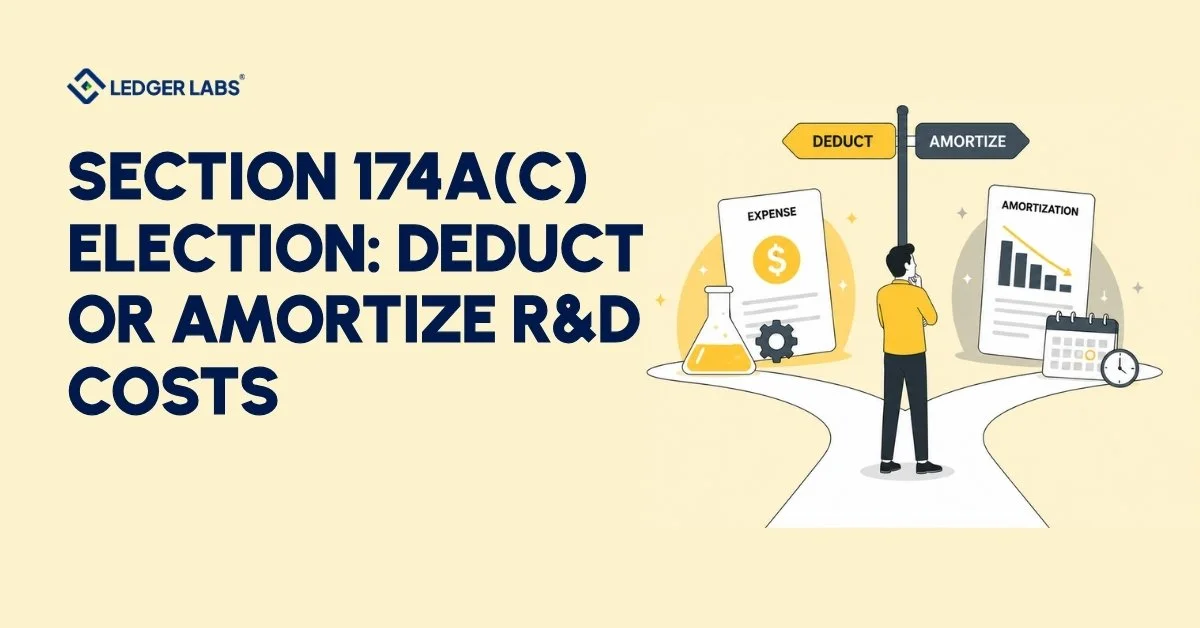
Since OBBBA allows immediate deductions for domestic R&D costs, many founders choose to deduct everything in the year they spend it. However, Section 174A(c) lets you capitalize those costs and recover them over time. The question is why you would wait for a deduction rather than take it now.
For some companies, delaying the deduction makes sense, but it complicates things. Once you decide, the choice is mostly permanent. A wrong choice can affect your tax returns for years, either by leaving deductions unclaimed or locking you into a specific recovery schedule.
Choosing Section 174A(c) deserves careful consideration. This guide helps founders and finance leaders understand: what this election is, when to capitalize costs, how the recovery period and accounting issues work, potential state rule impacts, and the steps to make the election.
Key Takeaways
- §174A makes immediate domestic R&D expensing automatic; §174A(c) is the opt-in to capitalize and amortize over at least 60 months.
- Capitalizing usually wins for loss-year or near-break-even companies, where the 80% NOL limit precludes an immediate deduction, not for unprofitable ones.
- The election is made on the return and binds future years unless the IRS consents, unlike the annual §59(e) election.
- Domestic software development qualifies; work performed abroad stays on the 15-year foreign-research schedule and must be allocated separately.
- Whether it’s a method of accounting or an annual election is unsettled; document each election as project-specific for now.
- Two deadlines: the 174A(c) election rides your return due date; the retroactive 2022–2024 election ends July 6, 2026.
What the Section 174A(c) Election Is (and What OBBBA Changed)?
The Tax Cuts and Jobs Act required you to treat domestic research costs differently from 2022 through 2024. You had to capitalize these costs and spread them over five years, which meant you paid taxes in the years you spent the money but couldn’t deduct it right away. This rule impacted software-heavy businesses the most.
Starting with tax years after December 31, 2024, Section 174A allows you to fully deduct domestic research or experimental costs in the year you pay or incur them. This immediate deduction is now the standard approach.
There is also an option under Section 174A(c). If you choose this option, you can capitalize your domestic R&D into a research capital account and amortize it over at least 60 months, starting when you first gain benefits from the work. Note that foreign research costs are unaffected by this choice; they continue to follow the original 15-year schedule under Section 174.
So, your decision comes down to whether you want to deduct R&D expenses now or choose Section 174A(c) to spread them out over time. The rest of this guide will help you make the right choice.
Deduct Now vs. Capitalize and Amortize: The Core Decision
Most guidance stops at “you can deduct, or you can amortize.” The useful question is which one leaves you better off, and that turns entirely on your taxable income picture, not on a preference for simplicity.
You actually have three paths, not two. Here is how they compare:
| Path | What it does | Timing | Reversible? | Best when |
|---|---|---|---|---|
| Immediate deduction (174A default) | Full domestic R&D is deducted in the year incurred | All in year one | Default, no election | You have a steady taxable income to absorb it |
| Capitalize & amortize (174A(c)) | Capitalized, amortized over ≥60 months | Spread over 5+ years | Binding without IRS consent | Loss/near-break-even years; matching to revenue |
| Amortize over 10 years (§59(e)) | Ratable 10-year recovery | Spread over 10 years | Annual election | You want flexibility year to year |
The 174A(c) election and the section 59(e) election are easy to confuse because both spread deductions out. The difference that matters: 59(e) is an annual election you can revisit each year, while the 174A(c) election binds the election year and the years after it. If you value the option to change course, that distinction alone may decide it.
For most profitable companies, the default immediate deduction wins outright; there is rarely a reason to defer a deduction you can use today. The election earns its keep in the specific situations covered next.
The 60-Month Amortization Period: How It Actually Works
If you elect under 174A(c), the statute sets a floor, not a fixed term: you amortize over a period of not less than 60 months. You can choose a longer period, but never a shorter one.
The clock does not start when you incur the cost. It starts in the month you first realize benefits from the research, for software, that typically means the month the developed product or feature first goes into use in your business. From there, you recover the capitalized amount ratably across the months in your chosen period.
You select the number of months as part of the election, and that period is locked in unless the IRS later consents to a change. Choose deliberately: a 60-month schedule front-loads your deductions faster than a longer one, which matters if you expect rising income.
When Capitalizing Makes Sense (NOL Years and Loss Companies)?
Here is where most businesses go wrong. They reach for the immediate deduction on instinct, without first checking whether they can actually use it this year.
The constraint is the net operating loss. If expensing a large R&D cost pushes you into a loss, that loss can only offset up to 80% of taxable income in a future year, so part of your deduction gets trapped, recovered slowly, and is worth less than if you’d applied it against income in a higher year. Amortizing instead spreads the deduction into the years when you have income to absorb it fully.
That logic holds in five specific situations:
- You’re in a loss or near-break-even year. There’s little income to deduct against now, so an immediate write-off mostly converts into a slow-recovering NOL.
- You expect higher tax rates ahead. A deduction is worth more in a year you’re taxed more; amortizing pushes it into those years.
- You want to match costs to revenue. Software you build this year generates income over several years; amortizing lines the deduction up with the revenue it produced.
- You’re managing to EBITDA or lender covenants. Spreading the cost protects the earnings figures that your lenders and investors watch.
- You need to smooth the income. Amortizing evens out taxable income instead of creating one distorted low year followed by artificially high ones.
A simplified illustration. Say a company expects $100,000 of taxable income in 2025 before R&D, then incurs $2,000,000 in domestic software development, with roughly $1,000,000 of income projected in each of the next several years. Expense it all in 2025, and you create a $1.9M NOL, but you only save tax on the $100,000 you actually had, and the carryforward then claws back slowly under the 80% limit.
Amortize instead, and each year’s deduction lands against income that can fully use it. The total deduction is identical; the value you capture is not. (Figures are hypothetical, for illustration only.)
The takeaway isn’t “amortize whenever you have a loss.” It’s “model both before you file, because the right answer depends on numbers only your projections can supply.
Software Development Costs Under Section 174A(c)
That income-timing logic matters even more once you realize where your biggest R&D line actually sits. If you build software, this section is the whole reason the election matters to you: Section 174A(d)(3) treats software development as a research or experimental expenditure, so your engineering spend is squarely inside these rules, not adjacent to them.
That cuts two ways. Domestic software development qualifies for the immediate deduction, or for the 174A(c) election if you’d rather amortize. Development performed abroad gets neither: foreign research stays on the 15-year Section 174 schedule. What determines domestic versus foreign is where the work is performed, not where your company is based or who manages the team.
For anyone using offshore developers, this means you can’t treat a project as a single block. Here’s where teams trip up: a US company with an overseas dev shop assumes the full project expenses in year one, files on that basis, then has to unwind it by carving out the foreign-performed portion of the schedule and amending the return.
You avoid that by allocating the spend between its domestic and foreign components up front and applying 174A only to the domestic portion, a documentation discipline that holds up if the return is ever examined. For ongoing books, this is exactly the kind of split SaaS accounting should track month to month, rather than reconstructing it at the time of filing.
Where exactly the domestic-versus-foreign line falls is one of the open questions still unsettled in the guidance, which is where we turn next.
Is It a Method of Accounting or a Year-by-Year Election?
The law and Rev. Proc. 2025-28 do not clearly answer the issue, but it is better to view the §174A(c) election as specific to each project rather than a general accounting method. This approach keeps treatment consistent across research efforts and avoids complex rules for method changes.
This distinction is important because it affects how binding the choice is and how to fix it later. A general method applies consistently across years and can only be changed formally, whereas a project-specific election is made for each year and project, allowing flexibility.
Viewing §174A(c) as project-specific is the safest option. It allows for the expensing of selected research, provides clear reasoning for each project, and avoids unsupported broad claims. It’s best to apply it consistently, document the rationale, and coordinate with any §280C(c) credit election.
State Conformity: How Decoupling Changes the Math
A 174A election is federal, but the amended federal figures flow into your state returns, and whether that helps, hurts, or does nothing depends on how your state conforms.
States fall into a few postures, and the friction differs in each:
| Conformity Type | What It Means | Example | Effect on the Election |
|---|---|---|---|
| Rolling | Follows the IRC automatically unless the legislature decouples | Many states (default) | Federal treatment generally flows through |
| Fixed-date | Applies the IRC as of a set date, possibly pre-OBBBA | California (Jan 1, 2015) | Already allowed expensing, little incremental benefit, little friction |
| Selective | Adopts federal provisions only as expressly incorporated | New Jersey | Must confirm 174A is incorporated for your year/entity |
Massachusetts shows why timing matters: it’s a rolling-conformity state at the corporate level, but a proposed bill would delay state conformity to 174A and disallow the retroactive small-business election for state purposes. Whether that’s the law on your filing date changes the answer. The discipline is simple: compute the federal benefit, compute the state modification the amended figures trigger, and net the two before you conclude the election is worth making.
How to Make the Section 174A(c) Election (Step by Step)?
The mechanics are unforgiving but not complicated. Here is the sequence.
Step 1: Confirm the year and the expenditures
The election applies to domestic R&D paid or incurred in the tax year you’re electing for, not to prior years’ costs.
Step 2: Choose your amortization period
Select a number of months, no fewer than 60, that fits your income outlook.
Step 3: Attach the election statement to a timely filed return
It must go on the return (including extensions) for the election year, marked at the top with the language Rev. Proc. 2025-28 specifies, and state that you’re capitalizing the expenditures to a domestic research capital account and the period selected.
Step 4: Coordinate section 280C(c)
If you also claim the R&D credit, you either reduce your deduction by the credit or elect a reduced credit, and the 280C election can’t be made or revoked through a method change, so handle it on the original return.
Step 5: Treat it as binding
Once made, the election holds for the election year and subsequent years unless the IRS consents to a change. There is no casual do-over.
Miss the timely-filing window for the year, and the election for that year is generally gone. That is why this belongs in your return-planning conversation, not a filing-day afterthought.
The Bottom Line
The 174A(c) election centers on one main idea: most profitable businesses should choose to deduct expenses immediately. You might want to consider other options if you have a loss, earn near break-even income, or need to plan for lenders or rates. Your decision should come from analyzing your numbers and documenting your choice, since it will impact you in the future, and the rules are not yet fully clear.
If you run a software or research-focused business and are deciding how to handle your domestic R&D expenses, or if you file under $31M and are considering changes to your 2022–2024 filings before July 6, 2026, we can help. We offer free reviews of the Section 174A election to help you find the best choice, document it correctly, and ensure alignment between federal and state requirements.
The election only requires one statement on one tax return, but that statement is important because of the five years of tax results it will generate.
See what each monthly plan includes on our pricing page.
FAQs
What is the difference between deducting and capitalizing R&D under Section 174A?
Deducting (the 174A default) writes off all your domestic R&D in the year you incur it. Capitalizing under 174A(c) instead spreads that cost over at least 60 months. Same total deduction either way, only the timing differs, which changes how much value you capture depending on your taxable income. Our review models both against your actual numbers.
How long is the Section 174A(c) amortization period?
At least 60 months. The statute sets 60 months as the floor; you may choose a longer period, but not a shorter one. Amortization begins in the month you first realize benefits from the research, not the month you incur the cost.
When is the deadline to make the Section 174A(c) election?
The 174A(c) election is made by the due date of your federal return, including extensions, for the year you’re electing. Note this is different from the retroactive small-business election to amend 2022–2024 returns, which has a one-time July 6, 2026, deadline. Confusing the two is the most common mistake; our team keeps them straight for you.
Is the Section 174A(c) election irrevocable?
Effectively, yes. Once made, the elected method and amortization period must be adhered to for the election year and all subsequent years unless the IRS consents to a change. Unlike the annual Section 59(e) election, you can’t simply revisit 174A(c) each year, which is why the decision deserves to be modeled first.
Is Section 174A(c) a method of accounting or an annual election?
It’s currently unsettled. Rev. Proc. 2025-28 contains language pointing both ways, and the AICPA asked Treasury in February 2026 to clarify whether the election is project-by-project or a binding method of accounting. Until guidance lands, the conservative course is to document each election as project-specific and preserve the amortization period per project, the posture least likely to be unwound on examination. We can document your election to that standard.
Does Section 174A(c) apply to software development costs?
Yes. Section 174A(d) treats software development as a research or experimental expenditure, so domestic software development is eligible for both the immediate deduction and the 174A(c) election. Development performed abroad stays on the 15-year foreign-research schedule and must be allocated separately.
How does the Section 174A(c) election affect the R&D tax credit?
Under section 280C(c), claiming the R&D credit means you either reduce your research deduction by the credit amount or elect to take a reduced credit instead. The election that produces the larger total benefit depends on your rate and credit profile, and it must be made on the original return; it can’t be added through a method change. We calculate both scenarios as part of the engagement.