
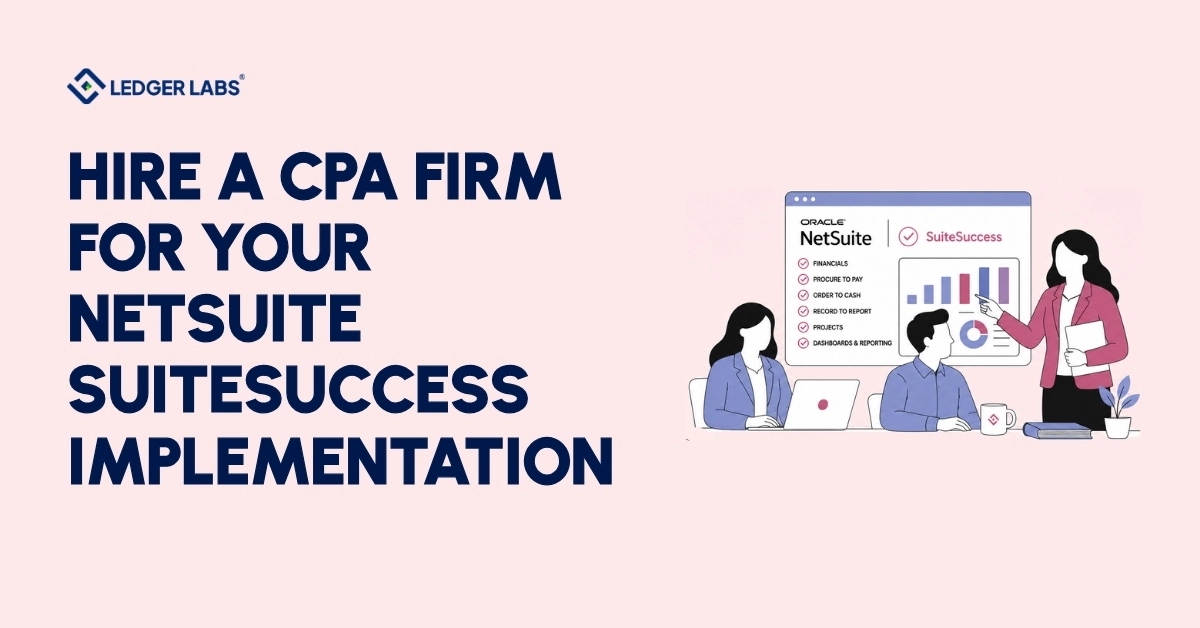
If you’re evaluating NetSuite SuiteSuccess, the implementation partner you choose matters more than most people realize, not just for whether you go live on time, but for whether your financials come out of the other side correctly built.
Most businesses that come to us after a failed or incomplete SuiteSuccess implementation share the same story. They went live on schedule. The ERP works. But the chart of accounts is structured wrong, revenue recognition is misconfigured, and month-end close takes two weeks longer than it should. The implementation partner delivered a working system; they just didn’t have a CPA on the team to build the accounting layer correctly.
The gap isn’t visible during implementation. It shows up in the first audit, the first board report, or the first time your CFO tries to close the books and realizes the system isn’t producing financials they can stand behind.
That’s the problem an implementation solves. At Ledger Labs, we implement NetSuite SuiteSuccess as an accountant-led firm.
This guide covers exactly how we do it, the four accounting areas that determine whether your implementation succeeds in the long term, our 7-milestone process, the six SuiteSuccess editions we implement, and what to look for when you’re comparing partners.
Key Takeaways
- Your SuiteSuccess implementation partner determines whether your financials are built correctly, not just whether you go live on time.
- Most ERP resellers configure NetSuite for function. A CPA firm configures it for compliance, audit-readiness, and financial accuracy.
- Chart of accounts, revenue recognition, financial close workflow, and tax configuration require CPA oversight rather than ERP configuration skills.
- SuiteSuccess takes 100–140 days to go live on a fixed fee, significantly faster than a traditional 6–9-month implementation.
- Six industry-specific editions cover ecommerce, SaaS, manufacturing, distribution, retail, and professional services, each personalized for your accounting model.
- The 7-milestone process separates at Milestone 3; Personalization is where implementations diverge from ERP-only ones.
- SME availability is the number one client-side timeline risk; plan for 10 hours per week during active phases.
- Go-live is the bottom of the SuiteSuccess Stairway, not the finish line; five maturity stages follow initial implementation.
Why Your SuiteSuccess Implementation Partner Determines Your Go-Live Outcome
What Most Implementation Partners Get Wrong
Many businesses discover accounting issues with their implementation partner only after they start using the system. The chart of accounts is set up for the ERP software, not for GAAP. Revenue recognition is designed for billing instead of compliance. The software works, but the financial statements do not.
This problem exists because many NetSuite implementation partners focus mainly on selling ERP systems. They excel at technical setup, feature activation, workflow mapping, and integration setup. However, they often fall short in accounting. Designing the chart of accounts, setting up revenue recognition, managing intercompany accounting, and organizing the financial close process are not just module configurations. These tasks need a CPA’s expertise, but most ERP sellers don’t have a CPA on their implementation teams.
The outcome is predictable: businesses launch on time, only to spend the next 6 to 12 months correcting their financials. Month-end closes take longer than they should. Revenue recognition often gets set up incorrectly. The ERP functions well, but the financials do not.
Why Accounting Depth Changes the Outcome
When your CPA firm handles your SuiteSuccess setup, it builds the accounting system correctly before you go live, rather than fixing it afterward. Your chart of accounts will be organized based on the financial statements you truly need. Your revenue recognition will match your specific model. Your financial close process will be planned, automated, and tested in a user acceptance test (UAT).
On the day you go live, your team will use a system that your CFO, controller, and auditors can work with from day one, without needing to clean it up before the first audit.
Below, we will explain what this looks like in four areas: chart of accounts design, revenue recognition, financial close workflow, and tax configuration.
What an Accounting-Led SuiteSuccess Implementation Gets Right
Chart of Accounts Built for GAAP Compliance, Not Retrofitted Later
The chart of accounts is the financial backbone of your NetSuite instance. Get it wrong at implementation and every report, every reconciliation, every audit is harder than it needs to be.
Most ERP partners use NetSuite’s default chart of accounts as a starting point and adjust minimally. We build yours from scratch, structured for your business model, your reporting requirements, and GAAP compliance. For manufacturing clients, that means proper cost of goods sold segregation, WIP accounts, and overhead allocation accounts. For SaaS clients, it means deferred revenue accounts aligned with ASC 606. For ecommerce clients, it means clean separation of product revenue, returns, and platform fees.
An ERP-only partner configures your chart of accounts for the system. We configure it for your financial statements, your audit, and your board, and the difference shows up every month-end close for as long as you run NetSuite.
Revenue Recognition Configured Before Go-Live (ASC 606)
Revenue recognition is often set up incorrectly in a NetSuite implementation. For software-as-a-service (SaaS) businesses, ASC 606 requires specific methods for handling subscription revenue, contract changes, and arrangements with multiple elements. For e-commerce companies, it defines when to recognize revenue, at the point of sale or upon delivery. For professional services firms, it relates to recognizing revenue based on the percentage of completion.
NetSuite has strong revenue recognition features. However, it does not configure itself correctly by default. An ERP reseller without CPA oversight will set it up for functionality rather than compliance.
We configure revenue recognition during the Personalization milestone, before any live transactions occur. Properly configuring revenue recognition from the start ensures clear audit trails, accurate deferred revenue balances, and reliable financial statements that investors and auditors can trust, reducing the risk of needing a restatement.
Financial Close Workflow Mapped and Built Into NetSuite
The average SMB on a traditional accounting setup runs a 10–15 day monthly close. After a properly configured SuiteSuccess implementation, that drops to 3–5 days, not because NetSuite is magic, but because the close workflow is mapped, automated, and built into the system from day one.
We document your current close process, identify the bottlenecks, and build the automated workflow into NetSuite during implementation. Bank reconciliation, intercompany eliminations, accruals, prepaid amortization schedules- each step is configured, tested in UAT, and handed off to your team with documented procedures.
Tax Configuration With Accountant Oversight
Sales tax nexus, multi-state tax setup, use tax, VAT for international transactions, tax configuration in NetSuite has direct compliance implications. Getting it wrong means under-collected sales tax, filing errors, and potential penalties.
How We Implement SuiteSuccess: Our 7-Milestone Process
Most SuiteSuccess partners run the same seven milestones. The difference is what happens inside each one. Here’s how we execute the process, and where the accounting layer changes the outcome.
Milestone 1: Project Kickoff
The kickoff is where our approach differs from a typical ERP implementation. Instead of starting with workflows, we first conduct an accounting discovery. This structured interview covers your current chart of accounts, revenue recognition model, close process, tax nexus, and reporting needs. The information we gather here directly influences Milestone 3.
Next, we align teams on the project’s scope, timeline, and responsibilities. We create a project charter, set up system access, and identify your subject matter experts (SMEs), ensuring they understand their time commitments.
Milestone 2: Bundle Provisioning
Your SuiteSuccess edition bundle is now active in your NetSuite account. It includes ready-to-use industry workflows, dashboards for different roles, key performance indicators (KPIs), and report templates that come with your edition. This bundle is just the beginning; in Milestone 3, you will customize it to fit your needs.
Milestone 3: Personalization (Where the Accounting Layer Gets Built)
This is the milestone that separates implementations from ERP-only ones.
Personalization is where your chart of accounts is structured, your subsidiaries and legal entities are configured, your revenue recognition rules are set, your roles and permissions are mapped, and your financial close workflow is built. For most clients, this is 4–6 weeks of intensive configuration work.
An ERP reseller completes Personalization with functional accuracy. We complete it with financial accuracy, every account, every rule, every workflow reviewed by a CPA before it moves to Milestone 4.
Milestone 4: Configuration
With the accounting foundation in place, Milestone 4 builds the operational layer. Custom fields, transaction forms, saved searches, automated workflows, third-party integrations, and custom reports are all configured here.
For ecommerce clients, this typically includes Shopify or WooCommerce integration, A2X or similar reconciliation setup, and inventory valuation method configuration.
For SaaS clients, it includes subscription billing module setup, usage-based pricing rules, and ARR/MRR reporting dashboards.
Milestone 5: Business Process Walkthrough
Before user acceptance testing (UAT) starts, we guide your team through each configured process from start to finish. This is not training; it is a structured review session in which your subject matter experts (SMEs) confirm that the system aligns with how your business operates.
During this review, we often find common issues, such as a workflow step that does not align with your approval process, a report that lacks the data your CFO needs, or a form missing a field your operations team uses.
We identify and resolve these issues before UAT begins, ensuring that UAT runs smoothly and on time.
Milestone 6: User Acceptance Testing (UAT)
User Acceptance Testing (UAT) is your team’s official approval of the system before launch. Your Subject Matter Experts (SMEs) will test real business processes in NetSuite, such as sales orders and invoices, and compare the results with expectations.
We provide a clear UAT test script for key processes, showing the scenario, expected result, and pass/fail status. Any issues found will be fixed and retested before launch approval.
The biggest risk to going live is the availability of client SMEs during UAT, which we will address in the client readiness section below.
Milestone 7: Go-Live and Cutover
Cutover weekend is when we migrate your historical data, disable your old system, and start using NetSuite as your primary system. We check data migration, verify opening balances, and provide first-day support.
The week after you go live is hypercare. We check in daily, resolve issues quickly, and support your team as they process their first live transactions. During hypercare, we also begin planning your Elevate roadmap for future optimization.
Beyond Go-Live: The SuiteSuccess Stairway
Go-live is not the finish line; it’s the bottom of the Stairway. NetSuite’s SuiteSuccess Stairway is a five-stage maturity model:
- Establish → get live and operational
- Elevate → optimize core processes, add automation
- Expand → add modules, subsidiaries, or product lines
- Accelerate → advanced analytics, forecasting, and planning
- Dominate → full business intelligence and strategic decision-making
Most implementation partners hand you off at Establish. We stay through the Stairway, because the value of NetSuite compounds as you climb it, and you need a finance team that knows the system to drive that progression.
That’s what our fractional CFO services deliver post-implementation: the same team, the same system, the next stage of growth.
SuiteSuccess Editions We Implement
We implement six SuiteSuccess editions. Each one is pre-configured for your industry; we configure it for your accounting.
Here’s what that looks like across the sectors we serve:
Financials First: Core Financials for SMBs Under $20M
Financials First is the broadest SuiteSuccess edition and the most common starting point for SMBs moving off QuickBooks or Xero. It covers core general ledger, accounts payable, accounts receivable, financial reporting, and basic CRM.
For businesses in the $2M–$50M revenue range without highly specialized industry needs, Financials First gets you live fastest, at the lowest cost, with the cleanest implementation path. You can expand into industry-specific modules post go-live.
Manufacturing Edition: Cost Accounting and Production Visibility
Built for product manufacturers who need production scheduling, work order management, demand planning, and supply chain visibility alongside their financials. Pre-configured KPIs include production efficiency, inventory turnover, and COGS by product line.
For manufacturing clients, we pay particular attention to cost accounting configuration, standard-cost vs. actual-cost, overhead allocation, and WIP account structure. These decisions affect every financial statement and are CPA decisions, not ERP decisions.
Wholesale Distribution Edition: Inventory, Orders, and Landed Cost
Designed for distributors managing multi-location inventory, complex order management, vendor relationships, and customer pricing tiers. Pre-configured with demand planning, purchase order automation, and landed cost tracking.
For distribution clients, the accounting focus during implementation is inventory valuation method (FIFO, LIFO, or weighted average), multi-location cost allocation, and accounts payable automation for high-volume vendor invoicing. Choosing the wrong inventory valuation method at implementation creates COGS distortion that compounds with every accounting period. We make that call with you at Personalization, not after the first audit flags it.
Software and SaaS Edition: ASC 606 and Recurring Revenue
The SaaS edition is built around subscription billing, recurring revenue management, and ASC 606-compliant revenue recognition. Pre-configured with MRR/ARR dashboards, churn metrics, and customer lifetime value reporting.
This is the edition with the most accounting complexity at implementation. Revenue recognition configuration for SaaS businesses, handling upgrades, downgrades, trials, and contract modifications, requires CPA oversight at the Personalization milestone. We’ve configured this correctly for SaaS businesses at every growth stage from seed to Series B.
Retail and Commerce Edition: Multi-Channel and Ecommerce
Built for multi-channel retailers managing POS, ecommerce platforms, inventory across locations, and customer data. Pre-configured with sell-through rate, inventory turnover, and gross margin by channel KPIs.
For ecommerce clients, this edition integrates with Shopify, WooCommerce, Magento, and Amazon. Platform fee accounting, return reserves, and sales tax nexus configuration are the three areas we focus on most during implementation.
Professional Services Edition: Project Billing and Rev Rec
Designed for service businesses that manage projects, track time, allocate resources, and bill on a project basis. Pre-configured with utilization rate, project profitability, and revenue-by-engagement reporting.
For services firms, percentage-of-completion revenue recognition and project cost accounting are the two areas requiring the most CPA attention during Personalization.
How Long Does It Take and What Does It Cost?
The 100–140 Day Go-Live Timeline
SuiteSuccess implementations run 100–140 days from kickoff to go-live. That compares to 6–9 months for a traditional NetSuite implementation and 12–18 months for a custom ERP build.
The speed comes from the pre-configured foundation; your edition bundle deploys industry-specific workflows, reports, and dashboards on day one, eliminating weeks of configuration work. What remains is personalization, integration, and testing, all of which run on a fixed timeline.
Phase-by-Phase Breakdown
| Phase | Duration | What Happens |
|---|---|---|
| Project Kickoff & Discovery | 1–2 weeks | Project team alignment, accounting and business process discovery, stakeholder interviews, scope confirmation, and project charter creation. |
| Bundle Provisioning | 1 week | NetSuite edition and required bundles are activated, baseline environment is configured, and initial system access is established. |
| Personalization & Configuration | 4–6 weeks | Configure the accounting layer, workflows, custom fields, roles, dashboards, reports, and third-party integrations based on business requirements. |
| Business Process Walkthrough | 1 week | Subject matter experts (SMEs) review configured workflows, validate business processes, and request any required adjustments. |
| User Acceptance Testing (UAT) | 2–3 weeks | Execute end-to-end business scenarios, validate accounting outputs, resolve defects, and obtain user sign-off before production deployment. |
| Go-Live & Cutover | 1 week | Complete final data migration, production cutover, system activation, and begin hypercare support. |
| Hypercare | 2–4 weeks | Provide daily support, monitor system performance, resolve post-go-live issues, and stabilize business operations. |
What Affects Your Timeline
Four factors most commonly extend SuiteSuccess timelines beyond 140 days:
- Data complexity: If your historical data is in multiple systems, poorly structured, or requires cleanup before migration, data preparation adds time. We assess data quality at kickoff and flag risks early.
- Integration count: Every third-party integration, such as payroll, ecommerce platforms, 3PL, and CRM, needs its own setup and testing process. A straightforward implementation with two systems is faster than one that involves six integrations.
- Scope creep: SuiteSuccess is a fixed-scope methodology. Adding customizations mid-implementation extends the timeline and erodes the fixed-fee advantage. We scope carefully at kickoff to prevent this.
- Client SME availability: The biggest timeline risk is not on our side; it’s on yours. We cover this in the client readiness section below.
SuiteSuccess uses fixed-fee pricing; you know your total implementation cost before signing, with no change orders for in-scope work.
What to Look for in a NetSuite SuiteSuccess Implementation Partner?
If you’re comparing SuiteSuccess implementation partners, most will check the same boxes, NetSuite experience, project management, go-live support. Here’s what separates a partner who gets you live from one who gets your finances right.
The Five Criteria That Matter
1. Accounting credentials on the implementation team
Ask specifically who configures your chart of accounts and revenue recognition, and what their accounting credentials are. A qualified accountant on the implementation team, not just in a sales role, is non-negotiable. Without accounting credentials on the configuration team, your chart of accounts and revenue recognition are being designed by someone who has never closed the books.
2. Industry experience in your vertical
SuiteSuccess editions are industry-specific. A partner who has configured the Manufacturing edition 20 times will catch risks that a generalist misses. Ask for references in your industry.
3. Post-go-live support model
Who do you call in month three when a new revenue stream needs to be configured? Some partners hand off at go-live. Others stay engaged. Know before you sign.
4. Fixed-fee clarity
SuiteSuccess is a fixed-fee methodology; your contract should reflect that. If a partner quotes time-and-materials for a SuiteSuccess implementation, understand exactly why before proceeding.
5. NetSuite partner status and certifications
NetSuite maintains a tiered partner ecosystem: Solution Provider, Alliance Partner, and BPO Partner designations. Verify your partner’s current tier and ask specifically about their SuiteSuccess implementation count, not just their general NetSuite experience.
Why an accounting firm Is Different From an ERP Reseller
An ERP reseller makes NetSuite work, while a CPA firm ensures your finances work, using NetSuite as the tool.
This is especially important during Personalization and User Acceptance Testing (UAT). When we set up your chart of accounts, we focus on your audit trail, financial statement presentation, board reports, and tax position, not just whether the fields connect to the right module. The result is a NetSuite setup that your finance team can use from day one, rather than one that requires a CPA to fix issues that the implementation partner overlooked six months later.
Questions to Ask Before You Sign
Take these into every conversation with your partner before you sign. The answers will tell you more than the sales deck.
- Who specifically will configure our chart of accounts and revenue recognition? What are their accounting credentials?
- How many SuiteSuccess implementations have you completed in our industry?
- What does post-go-live support look like, and is it included in the fee?
- How do you handle scope changes discovered during implementation?
- Can we speak to two references from implementations completed in the last 12 months?
What Your Team Needs to Do Before Go-Live?
A SuiteSuccess implementation runs 100–140 days when both sides are prepared. The implementations that miss that window almost always stall on the client side, not ours. Here’s what your team needs to have in place before we kick off.
SME Availability: The Number One Timeline Risk
Every SuiteSuccess implementation needs Subject Matter Experts (SMEs) from your team. This usually includes your controller or CFO, your operations lead, and your sales or fulfillment manager. Plan for about 10 hours per SME each week during the active implementation phases, and for full availability during User Acceptance Testing (UAT).
The most common reason implementations take longer is due to SME unavailability. If your controller can’t answer questions for two weeks due to the quarter-end close, Milestone 3 will be delayed. We will create your implementation schedule around your busy periods from the start. Let us know at kickoff about your quarter-end close, peak season, and board reporting cycles, and we will adjust our plans accordingly.
Before Milestone 3 starts, your team needs to have your data ready. This includes exporting and reviewing the chart of accounts, having open accounts receivable and accounts payable balances as of your cutover date, cleaning and de-duplicating item and customer master data, and identifying historical transaction data, what will migrate and what will stay in the old system. We will provide NetSuite CSV import templates and a data preparation checklist at kickoff to ensure nothing is overlooked.
NetSuite Training for Your Team
Your team needs to be comfortable in NetSuite before go-live, not after it. We recommend NetSuite Learning Cloud Pass training for your power users, the individuals running transactions, generating reports, and managing the system day to day.
Training runs concurrently with Milestones 4 and 5, so your team builds familiarity while the system is being finalized. By UAT, your SMEs should be navigating NetSuite independently and confident enough to sign off on go-live. For additional NetSuite training resources, we’ve got you covered there too.
Conclusion
NetSuite SuiteSuccess can get your business up and running in 100 to 140 days. However, it does not guarantee that your financial setup will be correct; that depends on who is building it.
Most implementation partners can get you launched on time. An accounting firm with CPAs on the team not only gets you live on schedule, but also ensures you have a chart of accounts that your auditors can use, revenue recognition your investors can trust, and a financial close process that takes 3 to 5 days instead of 15.
This is the difference between an ERP system that works and a finance function that operates effectively.
At Ledger Labs, our SuiteSuccess projects are led by qualified accountants. From the first accounting call to the launch and beyond, the same team that sets up your system will also support your business as your fractional CFO. They will use the NetSuite platform they know well to help drive your next growth phase.
If you want to implement SuiteSuccess the right way, we are here to help. Book a free 30-minute consultation call.
No commitment and no sales pitch. It’s simply a straightforward talk about what implementation means for your business.
FAQs
1. What is NetSuite SuiteSuccess?
NetSuite SuiteSuccess is Oracle NetSuite’s pre-configured implementation methodology. It bundles industry-specific workflows, role-based dashboards, KPI sets, and pre-built reports into a fixed-scope, fixed-fee implementation package. Instead of building your NetSuite instance from scratch, SuiteSuccess deploys a pre-configured foundation tailored to your industry and personalizes it for your business, reducing implementation time to 100–140 days versus 6–9 months for a traditional build.
2. What is NetSuite SuiteSuccess?
A standard SuiteSuccess implementation runs 100–140 days from kickoff to go-live, covering discovery, bundle provisioning, personalization and configuration, UAT, and cutover. Factors that extend the timeline include data complexity, integration count, and client SME availability. With proper preparation on both sides, 120 days is a realistic target for most SMBs.
3. What's the difference between SuiteSuccess and a standard NetSuite implementation?
A standard NetSuite implementation builds your instance from scratch, with custom configuration, workflows, and reports, and takes 6–9 months at a higher cost and with greater risk. SuiteSuccess starts with a pre-configured industry bundle and personalizes from there. It’s faster, fixed-fee, and lower risk- the right choice for most SMBs with reasonably standard business processes.
4. What is SuiteSuccess Financials First?
Financials First is the broadest SuiteSuccess edition, covering general ledger, accounts payable, accounts receivable, financial close, and basic reporting. It’s the most common starting point for businesses migrating from QuickBooks or Xero, and can be expanded with industry-specific modules post go-live.
5. Is SuiteSuccess right for small businesses?
Yes, SuiteSuccess was designed for small and mid-market businesses. The fixed-fee model, shorter timeline, and pre-configured foundation make it the most accessible path to NetSuite for businesses in the $2M–$50M revenue range.
6. Do I need a partner to implement SuiteSuccess?
In practice, yes. Businesses that self-implement consistently run longer, encounter more post-go-live accounting issues, and spend more correcting configuration errors than those that implement with an experienced partner. For a SuiteSuccess implementation where the accounting layer needs to be correct from day one, a partner is the lower-risk path.
7. How much does a SuiteSuccess implementation cost?
SuiteSuccess uses fixed-fee pricing; total cost depends on your edition, user count, and integrations required.
8. What is the SuiteSuccess Stairway?
The SuiteSuccess Stairway is NetSuite’s five-stage ERP maturity model: Establish, Elevate, Expand, Accelerate, and Dominate. Go-live puts you at Establish. Each subsequent stage adds optimization, modules, advanced analytics, and strategic capability. Ledger Labs supports clients through all five stages using the same NetSuite instance we built.