
Lenders don’t lend against what your inventory cost you. They lend against what your books can prove it’s worth.
Your best-selling SKU is about to stock out. The holiday purchase order has to go to your supplier this month, and the cash from last season won’t land until after the goods ship. So you start looking at inventory financing.
Then the lender asks for your books.
That’s where a lot of growing brands stall. In the Federal Reserve Banks’ 2025 Report on Employer Firms, 37% of firms applied for a loan, line of credit, or merchant cash advance in the prior year. Only 41% of those applicants received all the financing they asked for.
The brands that get the full amount usually aren’t the biggest. They’re the ones whose inventory numbers hold up when an underwriter starts testing them. This guide covers how inventory financing works, what lenders actually look for in your books, and a checklist to work through before you apply.
Key Takeaways
- Inventory lenders advance a percentage of your eligible inventory’s liquidation value, not its cost, so you can usually borrow far less than your balance sheet shows.
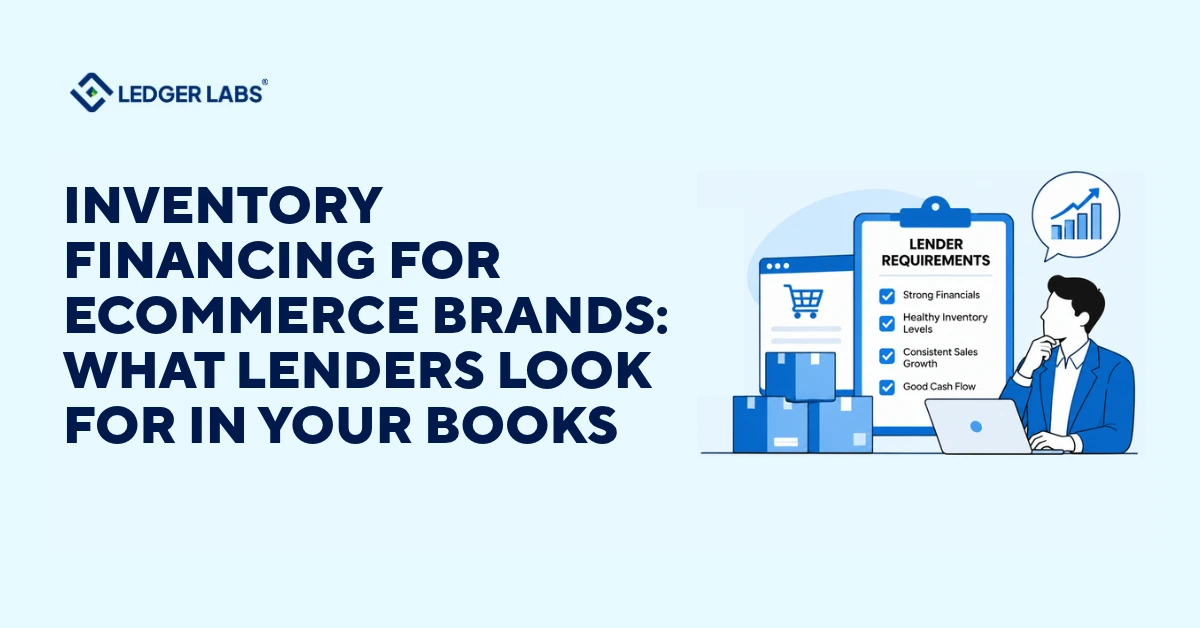
- Lenders test whether your inventory balance reconciles to the general ledger, whether your stock records are reliable, and how much of your stock is aged or ineligible.
- Inventory held at a 3PL or a marketplace fulfillment center can count as offsite stock, which may shrink your borrowing base.
- Existing debt, including stacked merchant cash advances, is one of the most common reasons applications get cut back or turned down.
- Getting approved is the start. Most facilities require ongoing borrowing base reporting, field exams, and periodic appraisals, so the bookkeeping has to keep up every month.
What Is Inventory Financing and How Does It Work for Ecommerce Brands?
Inventory financing is borrowing that’s either secured by the inventory you already hold or used to buy the inventory you need next. For an ecommerce brand, it’s usually how you fund a large production run or a seasonal buy without draining operating cash.
The part most founders miss is how the amount gets set.
How the Borrowing Base Works
Most inventory lenders don’t approve a fixed number and walk away. They calculate a borrowing base: the percentage of your eligible inventory they’re willing to lend against at any given time. As your inventory grows or shrinks, so does the amount you can draw.
That percentage is the advance rate. According to the Secured Finance Network’s primer on asset-based lending, inventory advance rates are usually lower than the rates lenders apply to receivables, and they may range from 20% to 75% of net orderly liquidation value.
Why You Can Borrow Less Than Your Inventory Is Worth
Net orderly liquidation value (NOLV) is roughly what your inventory would bring in an orderly sale, after the costs of selling it. For most consumer products, that’s well below what you paid.
Here’s an illustrative example. A brand carries $500,000 of inventory at cost. An appraiser puts its NOLV at $300,000. The lender advances 70% of NOLV, so the brand can borrow about $210,000, not $500,000.
And that’s before the lender removes anything it considers ineligible. The cleaner your inventory records are, the less the lender has to discount for uncertainty.
Inventory Financing Options: Which One Fits Your Brand?
Inventory financing isn’t one product. The right structure depends on how predictable your sales are and how much reporting you can keep up with.
| Option | How It's Secured or Repaid | Best For | Typical Reporting Burden |
|---|---|---|---|
| Asset-based line of credit | Revolving line against a borrowing base of eligible inventory (often with receivables) | Established brands with steady, recurring inventory needs | High: regular borrowing base reports, field exams, appraisals |
| Inventory term loan | Fixed amount, secured by inventory, repaid on a schedule | A one-time stock build or a new product line | Medium: financial statements and covenant reporting |
| Purchase order financing | Lender pays your supplier for goods tied to a confirmed customer order | Wholesale or retail orders larger than your cash can cover | Low to medium: tied to each order |
| Revenue-based financing | Repaid as a share of future sales | Brands with strong sales history but limited hard collateral | Low: usually based on connected sales and bank data |
| SBA-backed working capital loans | Bank loan partly guaranteed by the SBA, often secured by business assets | Brands that can wait for a longer approval in exchange for longer terms | Medium to high: full application and personal guarantees |
Terms, rates, and requirements vary widely by lender and change often, so treat this as a map, not a quote. You can find the current SBA programs, including CAPLines lines of credit, on the SBA’s 7(a) loan page.
One pattern holds across all of them: the more a lender relies on your inventory as collateral, the more closely it will look at your books.
What Do Lenders Look For in Your Books?
An inventory lender is trying to answer one question: if this brand stops paying, what can we actually recover? Every request in the diligence list traces back to that. Here are the six things underwriters test most closely.
1. A Timely, Consistent Monthly Close
Lenders want financial statements they can trust on a regular schedule, not a year-end cleanup. If your books close six weeks after month-end, or the numbers change every time someone revisits them, the lender has no reliable baseline to lend against.
Accrual-basis statements matter here. Cash-basis books can show a great month simply because a big supplier payment slipped into the next one.
2. An Inventory Balance That Reconciles
Your inventory system says one number. Your balance sheet says another. If you can’t explain the difference, the lender can’t tell which number to lend against, and it will usually assume the lower one.
A monthly reconciliation between the inventory system and the general ledger, with a reviewed workpaper behind it, is one of the clearest signals that your collateral figure is real.
3. A Reliable Perpetual Inventory Record
The Secured Finance Network notes that lenders check whether a borrower keeps a reliable perpetual inventory system, one that updates with every receipt, sale, and adjustment. A spreadsheet updated when someone has time doesn’t qualify.
This is a common weak spot. In inFlow’s State of Inventory Management 2026 survey of 400 operators, 44.8% named inaccurate inventory data as a top challenge.
Dedicated inventory software closes much of that gap. A platform such as inFlow keeps a perpetual record of every stock movement by location, then produces the aging, valuation, and stock-by-location reports a lender asks for through its inventory reporting tools.
4. Inventory Aging
Not all inventory is equal to a lender. Stock that hasn’t moved in six months is harder to sell in a liquidation, so it’s usually discounted heavily or excluded from the borrowing base altogether.
Expect to provide an aging report that sorts your inventory by how long it’s been on hand, for example:
- 0 to 90 days
- 91 to 180 days
- More than 180 days
If a large share of your balance sits in the oldest bucket, write it down or reserve for it before the lender does it for you.
The longer-term fix sits upstream. Inventory planning that ties purchase quantities to actual sell-through keeps slow movers from piling up in the first place, which protects your borrowing base before a lender ever looks at it.
5. What Counts as Ineligible
The Secured Finance Network lists packaging, consigned goods, offsite inventory, perishables, and certain specialized products as common ineligibles.
That “offsite” line matters for ecommerce. Stock held at a 3PL or a marketplace fulfillment center isn’t in your building. Depending on the lender, it may be excluded or only counted once the lender can confirm access to it, sometimes through an agreement with the warehouse. Confirm how a lender treats each location before you count on that inventory in your borrowing base.
6. Margins, Turnover, and Existing Debt
Lenders want proof that your inventory actually sells. Expect questions about:
- Gross margin by channel: your Amazon, DTC, and wholesale margins can look very different.
- Inventory turnover: cost of goods sold divided by average inventory.
- Days inventory outstanding: average inventory divided by cost of goods sold, multiplied by 365.
Getting that channel-level view right is a core part of ecommerce accounting, since each marketplace settles sales, fees, and returns on its own schedule. A blended margin can hide a channel that’s losing money on every order.
They’ll also look at what you already owe. In the same Fed report, 41% of firms that were denied some or all of the financing they sought cited too much debt as a reason. Stacked merchant cash advances, a common pattern for ecommerce brands, can sink an otherwise strong application.
What Happens After You're Approved?
Approval isn’t the finish line. With most inventory-backed facilities, especially asset-based lines, the lender keeps checking the collateral for as long as the loan is open.
Borrowing Base Reporting
You’ll prepare a borrowing base report on the schedule set in your loan agreement, often monthly. It applies the lender’s advance rates to your current eligible inventory, minus any reserves, and shows how much you can draw. If your inventory numbers are late or wrong, your available credit is too.
Field Exams
The Secured Finance Network describes a field exam as a review of a borrower’s “assets, liabilities, facilities, books, records and collateral reporting.” Lenders typically run one before the facility is approved and then on a recurring basis to check whether anything has changed.
Inventory Appraisals
Lenders often use periodic appraisals to validate inventory values. A new appraisal can move your NOLV, and with it your borrowing base, up or down.
The takeaway is simple. The bookkeeping that got you approved has to keep running every month, or your credit line shrinks when you need it most.
How to Get Your Books Lender-Ready Before You Apply
Start 60 to 90 days before you plan to apply. That gives you time to fix what a lender would find, instead of explaining it in the middle of underwriting.
- Close 12 months on an accrual basis: Lenders compare months against each other, so every month needs to be closed the same way.
- Reconcile inventory to the general ledger at each month-end: Keep the workpaper and the valuation report for every month, so you can show the balance was checked, not just reported.
- Run an aging report and deal with dead stock: Write down or reserve for inventory you don’t expect to sell at full value. A lender will discount it anyway.
- Confirm counts at every location: Include your 3PL and marketplace warehouses, and match those counts to what your system shows.
- Build margin reports by channel: Show which sales channels actually make money once fees, returns, and fulfillment costs come out.
- List every existing debt and advance: Include merchant cash advances and marketplace loans, with balances and repayment terms.
- Prepare a 13-week cash flow forecast: Show how the financing gets used and how it gets repaid.
If you can’t complete one of these steps, that’s the step a lender will find. Fix it first.
Conclusion
Inventory financing can fund the growth your cash flow can’t, but only up to what your books can prove. Lenders advance against liquidation value, strip out aged and offsite stock, and keep testing your numbers for the life of the loan.
The brands that borrow the most aren’t always the ones with the most inventory. They’re the ones with a clean monthly close, an inventory balance that reconciles, and reports a lender can trust without a second look.
FAQs
1. How much can I borrow against my inventory?
It depends on your eligible inventory and the lender’s advance rate. Lenders typically lend a percentage of the inventory’s net orderly liquidation value, not its cost, and the Secured Finance Network puts that range at 20% to 75% of NOLV. Aged, offsite, or otherwise ineligible stock is removed first, so the final figure is often well below your balance sheet value.
2. Can I use Amazon FBA or 3PL inventory as collateral?
Sometimes. Inventory held outside your own facility is commonly treated as offsite, which many lenders exclude or count only after they can confirm access to it. Ask each lender how it treats marketplace and 3PL stock before you apply, and make sure your records show exactly how much sits in each location.
3. What is a borrowing base certificate?
It’s the report you send your lender on a set schedule, often monthly, showing your current eligible collateral, the advance rates applied to it, and the amount you’re allowed to draw. It’s how an asset-based line of credit stays tied to the inventory you actually hold.
4. Is inventory financing the same as purchase order financing?
No. Inventory financing is secured by inventory you hold or are buying for general sale. Purchase order financing pays your supplier for goods tied to a specific, confirmed customer order, so it suits large wholesale or retail orders more than everyday direct-to-consumer sales.
5. What financial statements do lenders ask for?
Expect to provide accrual-basis income statements and balance sheets for at least the last 12 months, an inventory valuation report reconciled to the general ledger, an inventory aging report, a list of existing debts, and usually recent tax returns and bank statements. Requirements vary by lender, so ask for the full checklist early.
About the Contributor
Jared Plumb is the lead content creator at inFlow Inventory and co-host of the Secret Life of Inventory podcast, covering inventory, manufacturing, and supply chain for small and medium-sized businesses.