
Whether it is setting reminders or checking weather updates, artificial intelligence has become part of our everyday lives.
Considering its prominent role, it only makes sense that it is changing how we do business, especially if you look at the e-commerce landscape.
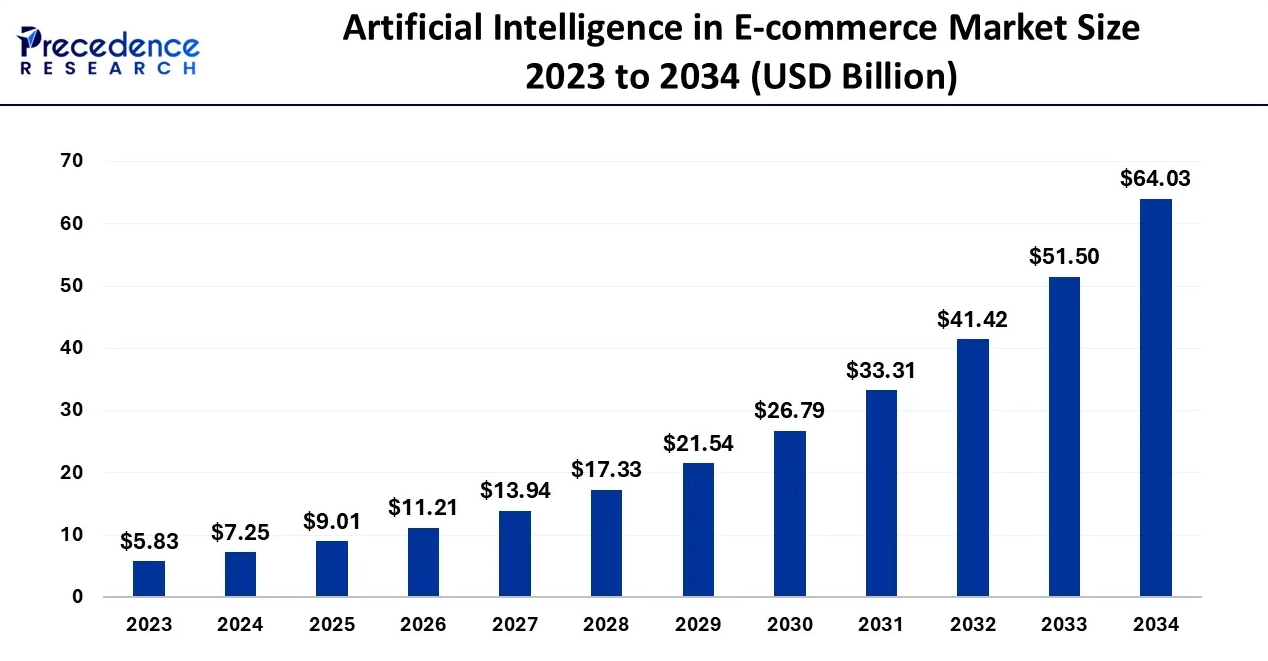
AI in e-commerce optimizes and automates business processes, increasing efficiency and boosting productivity, and that is why more companies are bringing AI into parts of their business.
As opposed to being a futuristic concept, AI is revolutionizing e-commerce businesses by creating personalized customer experiences, removing language barriers, and much more.
Let’s look at the impact of AI on e-commerce business in detail.
- AI helps businesses automate different processes to improve efficiency and boost productivity.
- Make sure you consider scalability and security before implementing AI in your e-commerce business.
AI in e-commerce businesses – the present and future
The most prominent example of AI in e-commerce is how the recommendation engines work today.
You can analyze customer’s browsing and purchasing behavior to tailor suggestions. It’s how Netflix recommends movies to viewers. Look at Amazon and you’ll see how it analyzes past customer interactions and makes recommendations.
Today, we have AI chatbots that play an essential role in improving customer service. They respond to customer queries immediately, speeding up the buying process.
Businesses provide product information and even support in placing orders 24/7. This way, you don’t lose the interest of a potential customer.
AI is part of your day-to-day e-commerce operations, from inventory management to pricing strategies. It has made all business processes efficient, increasing your sales and improving your bottom line.
Considering the strides AI is making today, you might wonder what the future will look like. And to say the least, the possibilities are endless.
More retailers are likely to leverage customer data to create more personalized buying experiences.
The role of AI in inventory management is constantly increasing.
How Amazon’s recommendation engine uses AI?
Amazon’s recommendation engine uses sophisticated AI to improve customer experience.
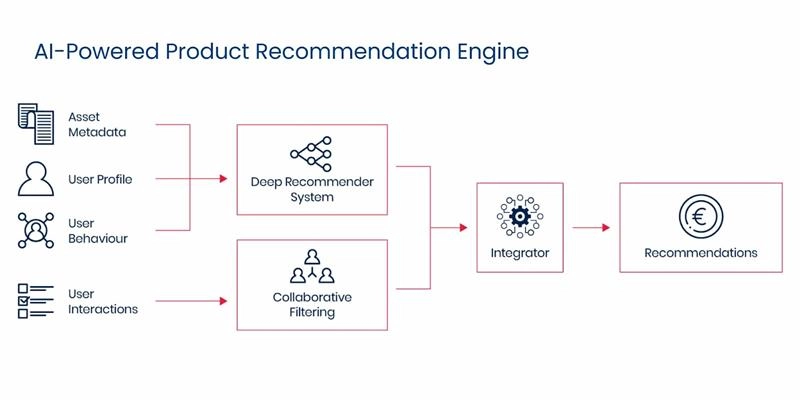
It uses collaborative filtering techniques where it evaluates a large amount of data, such as customer behavior, demographics, purchasing history, user reviews, and trending products to identify patterns among customers. So every time Amazon finds customers with similar likes and preferences, it recommends products that a customer with the same profile has liked.
Amazon also uses content-based filtering to evaluate different aspects of a product, such as its categories, description, and specifications. Then, Amazon recommends products to customers based on its content.
It uses NLP techniques on positive reviews you leave on a product. It identifies keywords and recommends products that match the description.
Since Amazon’s recommendation engine works in real-time, it adapts to match your behavior. It means your product recommendations will change depending on what you’re searching for at the moment. It will show you electric kettles if that’s what you’ve been looking for, and it could change to something else if your search changes.
Many businesses conduct A/B testing to see if their strategies are working or not. Amazon is no different. It uses the same technique to see customer engagement and their satisfaction. They check which algorithm boosts sales. The intention is to get the best results.
Context is important for everything in life, and Amazon understands that well. Thus, Amazon’s recommendation engine considers the time of the day, the user’s location, browsing history, and even the type of device you’re using for your search.
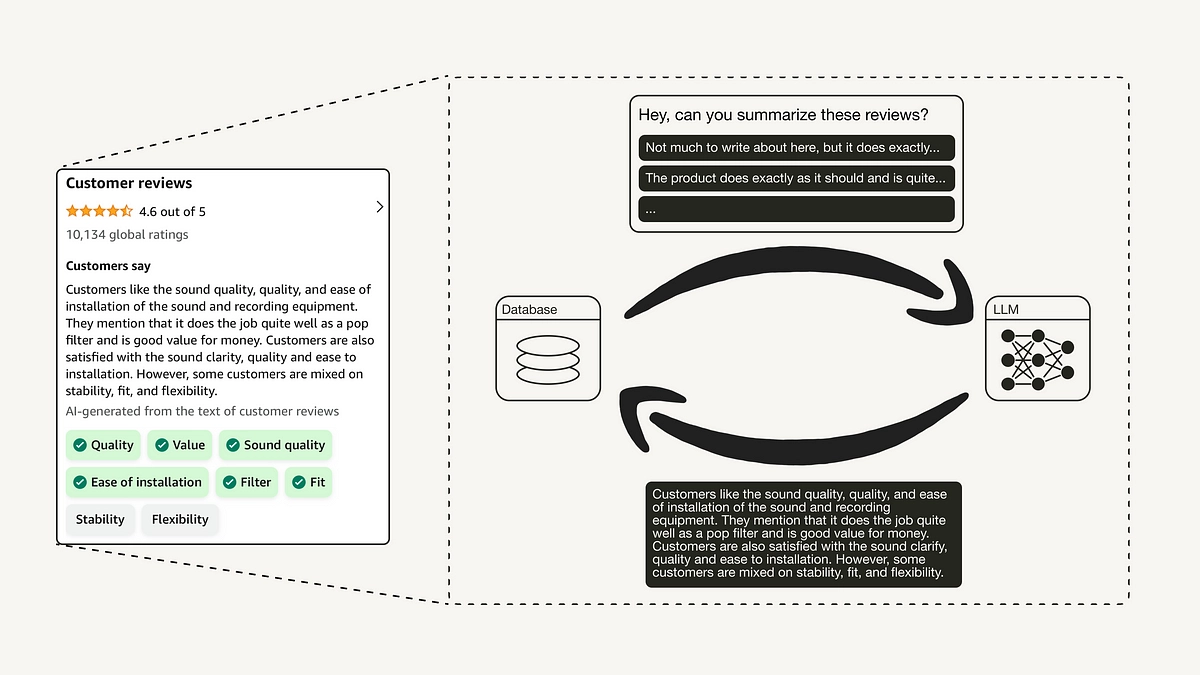
Feedback Loop Mechanism is another method used by Amazon. In this method, it uses customer feedback to give product recommendations.
Let’s say you purchased a leather jacket and left a positive review, you’re most likely to get similar product recommendations. You could start getting recommendations for different products from the same seller, or you’ll start getting other designs of leather jackets. This will also happen if you give it a good rating. So, Amazon draws from your feedback to give you something relevant.
4 ways AI helps e-commerce businesses
Let’s explore 4 ways AI is helping e-commerce businesses.
1. Enhanced customer experience
Today e-commerce businesses use AI to improve customer interactions, and using AI-powered chatbots and customer service Ai tools is one way to achieve that.
Their role isn’t limited to analyzing customer data to respond to inquiries. Instead, they now look into customer sentiments.
AI technologies analyze language patterns to understand the context. It also looks for emotional cues in customer reviews. So, basically, these insights help chatbots identify customer’s emotions more precisely.
Natural Language Processing (NLP) plays an important role in customer sentiment analysis as it uses various techniques like tokenization and sentiment classification to convert quantitative data into qualitative insights.
Both of these techniques take the feedback or inquiry and break it down into positive, negative, and neutral emotions.
This is how businesses use AI to respond to customer sentiment and their core issues more effectively.
2. Personalized product recommendations
Customers often struggle to find relevant products online, so they spend hours searching for something that appeals to their taste.
AI can analyze customer behavior and suggest products that they are likely to love.
AI-powered search algorithms change the game as they completely understand behavior and preferences, improving website searches and ensuring customers find exactly what they’re looking for.
This is how it happens.
It first collects customer and product details. It includes the customer’s browsing history so they get to know their interests and needs. It also helps them identify other online stores that they have visited earlier.
In addition, it looks into their purchasing patterns that highlight brand loyalties and individual preferences.
Other information includes customer demographics.
Now it gathers all of this information to make your product recommendations more personalized.
Different techniques like collaborative and content-based filtering, are used to make this possible.
In collaborative filtering, customers are shown products that other customers with similar interests have liked or bought.
In content-based filtering, customers are recommended products that have similar characteristics as the products they’ve initially bought.
Let’s say you were browsing trench coats earlier, through AI-powered product recommendations, you’ll get recommendations of different colors and styles of trench coats.
3. Eliminate fake reviews
Online reviews influence how customers decide what to buy. While that is reassuring, it can be alarming that some online reviews are fake.
Fake reviews damage a brand’s identity and add a negative connotation to dissuade customers from buying.
E-commerce businesses tackle this issue by implementing machine learning techniques that analyze the following:
- Poor grammar
- Excessive use of punctuation
- Extremely negative tone
They provide examples of fake reviews, highlighting keywords or cues that might be fake. This exercise trains the machine to identify fake reviews.
Sentiment analysis is another technique that businesses use to identify fake reviews. It considers textual features, such as emotional cues and context, to highlight suspicious content.
4. Better inventory management
Inventory management has become easy with the implementation of AI in e-commerce. It makes supply chain management more efficient and helps businesses meet customer expectations.
Businesses use predictive analytics to predict product demand to avoid stockout or dead stock situations. AI algorithms analyze data, such as seasonal trends, previous sales, customer behavior, and even economic factors to predict product demand.
Furthermore, AI helps businesses find the best transportation routes, improving supply chain management. It analyzes traffic patterns, weather conditions, and other factors to make such decisions.
E-commerce businesses also improve warehouse management through computer vision applications, a product recognition tool. It boosts productivity by allowing workers to locate required items more efficiently and accurately. Additionally, many brands now leverage packaging as a touchpoint for brand loyalty — for example, including QR codes or Uniqode’s business card inside product packaging enables customers to quickly access product care instructions, promotions, or connect with customer service.
Benefits of AI in e-commerce
AI is helping businesses across industries, but let’s look at the top benefits of AI in e-commerce.
- It makes online shopping more convenient, personalized, and enjoyable.
- It helps businesses offer better products and services to customers
- It resolves problems by addressing customer issues with the right sentiment. It basically adds value to the interactions you have with your customers.
- It helps businesses create tailored marketing campaigns.
- It saves you time and makes business processes more efficient.
- It helps in establishing customer relationships.
- It reduces wastage as AI monitors and tracks your inventory.
The bottom line
AI helps e-commerce businesses improve customer experience by creating personalized marketing campaigns.
Whether it is AI-powered chatbots or tailored product recommendations, it helps customers find what they are looking for faster.
So, if you still think of AI as a futuristic concept, it’s time to embrace AI before it gets too late.
Use it to get more control over your finances. Improve your finance management, automating bookkeeping and accounting tasks to focus your energy on other core functions.
Ledger Labs has 12+ years of experience helping businesses across industries and sizes.
Book a free 30-minute consultation to discuss automating your finance workflows.