
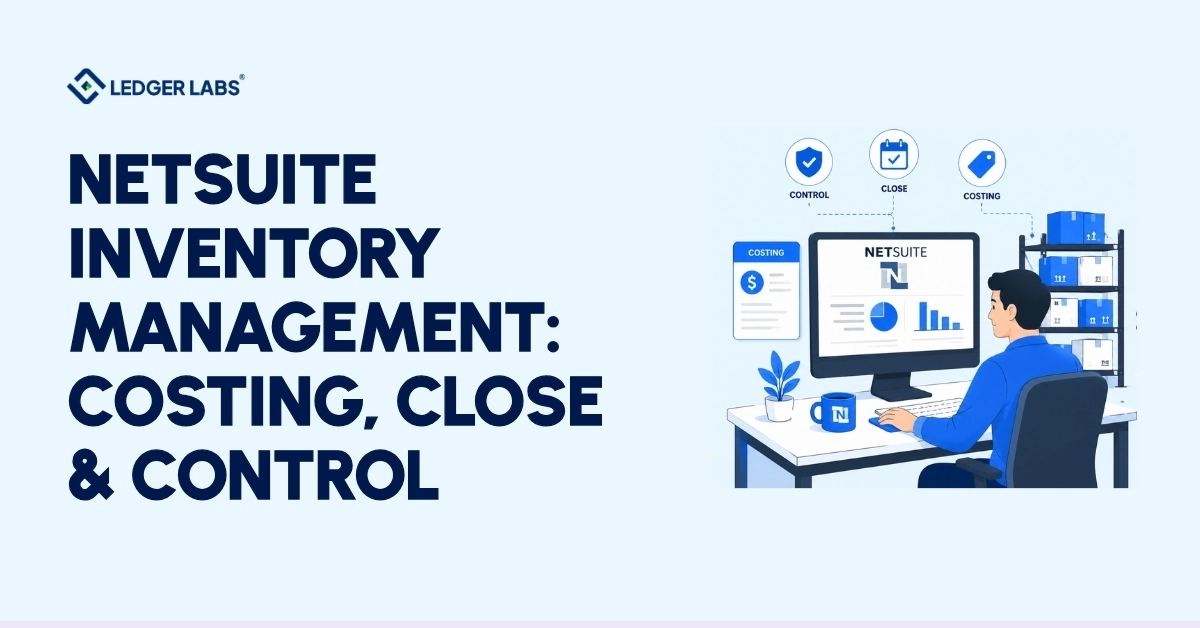
The reason your NetSuite inventory numbers don’t tie isn’t NetSuite. It’s the costing method someone selected during implementation and never revisited. That’s a CPA’s read, not a vendor’s; this guide comes from the team that manages NetSuite inventory accounting and month-end close for clients, not from a reseller selling implementations.
NetSuite inventory management is genuinely strong software: real-time visibility, multi-location, lot, and serial tracking. But the questions that decide whether your books are right are accounting questions: how inventory is valued, how landed cost is allocated, and how and when it becomes COGS. When those run on autopilot, the damage stays invisible until it isn’t: misstated margins, a balance sheet that won’t reconcile, and a close that drags every month.
This guide covers how NetSuite values inventory, how to choose a costing method, how landed cost and adjustments flow to your financials, and how to run a month-end inventory close that actually ties out.
We’ll start with what NetSuite inventory management does, then where the accounting sits on top of it.
Key Takeaways
- The costing method set at implementation, not NetSuite itself, usually breaks your inventory numbers.
- NetSuite values inventory based on your chosen costing method, which affects your margins and taxable income.
- Landed cost must sit inside COGS, or your gross margins look better than reality.
- A month-end close reconciles inventory to the general ledger before you lock the period.
- Negative inventory and missing write-offs distort COGS; both are timing problems you can prevent.
- Audit-ready NetSuite inventory comes from correct configuration and monthly discipline, not the software alone.
What NetSuite Inventory Management Actually Does?
NetSuite inventory management is the built-in module that tracks what you hold, where it sits, and what it’s worth, across every location and channel, in real time. It does two jobs at once. Operationally, it records quantities and movements, and financially, it values that inventory and records it in your cost of goods sold and on your balance sheet.
The operational job is the one every guide covers, and NetSuite handles it well: live stock counts, multi-location visibility, and the depth you’d expect from advanced inventory management built into a full NetSuite ERP rather than bolted on.
The accounting job is the one that almost no one explains. NetSuite is good at telling you what you have.
Whether it tells you what that inventory is worth is a decision you make, not a setting that’s correct by default.
The costing method is crucial for reporting inventory numbers. Choosing the right method ensures your operational features work correctly, while the wrong one gives inaccurate numbers.
Consider NetSuite inventory management to have two layers: an operational layer for tracking and an accounting layer for valuation, which you set up intentionally. This guide focuses on the accounting layer, where issues like margin errors and audits arise. That accounting layer, from the costing method to the month-end close, is the work our NetSuite accountants run for ecommerce, manufacturing and wholesale distribution clients.
The Inventory Features That Actually Move Your Financials
The features that matter most for your books are the ones that change how, when, and where cost attaches to a unit.
Four do most of the work:
- Multiple inventory locations mean that stock and its value are split across different warehouses. This way, the same item can have different costs depending on where it is located.
- Lot and serial tracking links specific costs to specific batches, which becomes important when prices change.
- Demand planning and reorder points inform purchasing decisions, which in turn affect the cost layers used later.
- Cycle counting ensures that recorded quantities are accurate, so your valuation reflects reality.
Each is useful operationally. Each also quietly shapes your cost of goods sold.
How NetSuite Calculates Inventory Cost: Costing Methods Explained
NetSuite calculates inventory cost using the costing method you assign to each item: Average, FIFO, LIFO, Standard, Group Average, or Specific (NetSuite documentation). That method decides which cost flows into COGS when you sell a unit. And that one choice changes your gross margin, your ending inventory value, and your taxable income.
Here’s the thing most guides miss: NetSuite doesn’t pick the right method for you. It applies the one that was set, correctly or not, on the item record.
Let me break down the ones that matter:
- Average (weighted average) calculates a new running average cost each time you get new stock. This method smooths out price changes, which many businesses prefer. If your costs are constantly changing and you want to avoid sudden fluctuations in profit, this is usually the best choice.
- FIFO (first-in, first-out) uses your oldest costs for the cost of goods sold (COGS) first. In a time of rising costs, this results in lower COGS, higher reported profits, and a bigger tax bill. FIFO reflects how most physical inventory actually moves, making it easy to understand and audit-friendly.
- LIFO (last-in, first-out) applies your newest costs to COGS first. Many people misunderstand this: LIFO is allowed under US GAAP and tax rules, but it is not allowed under IFRS. Keep in mind the LIFO conformity rule: if you choose LIFO for tax purposes on IRS Form 970, you generally have to use it in your financial statements as well.
- Standard costing assigns a set cost for each item and tracks any differences between this standard cost and the actual cost as a variance. Manufacturers often use this because it helps them predict costs. However, you need to monitor these variance accounts closely, as they can distort your COGS if left unchecked.
- Specific (lot/serial) costing records the actual cost of each item sold. This method is the most precise and works best for high-value items or those with serial numbers.
Here is the same list side by side:
| Method | Which cost reaches COGS | Best fit | Watch for |
|---|---|---|---|
| Average (weighted) | A running average, recalculated each time stock is received | Costs that change often | NetSuite’s default method; smooths out price swings |
| FIFO | Oldest cost first | Stock that moves in order; easy to audit | When costs rise: lower COGS, higher reported profit, bigger tax bill |
| LIFO | Newest cost first | US GAAP and tax reporting only | Not allowed under IFRS; the LIFO conformity rule applies |
| Standard | A preset cost per item, with variances tracked | Manufacturers that need predictable costs | Unreviewed variance accounts can distort COGS |
| Group Average | One average cost for an item across the locations in a defined group | Multi-location inventory | One blended cost across the group |
| Specific (lot/serial) | The actual cost of each unit sold | High-value or serialized items | Requires lot or serial tracking; the most precise method |
The method you choose isn’t a preference; it’s a financial-reporting decision with a tax consequence attached. For a plain-English refresher on FIFO, LIFO and average cost outside NetSuite, see our inventory valuation guide.
Inventory Valuation and How It Flows to Your P&L and Balance Sheet
NetSuite values your on-hand inventory at quantity × unit cost and carries it as an asset on your balance sheet.
When you sell an item, its cost moves from your inventory to the cost of goods sold on your profit and loss statement. NetSuite does this automatically. It updates your records in real time whenever you receive or sell inventory, making it a continuous inventory system.
Why does that matter to you? Because your inventory asset and your COGS are only ever as accurate as the costs sitting on your items. Garbage cost in, garbage margin out.
Here’s the flow in plain terms:
- You receive stock → inventory asset goes up (balance sheet)
- You sell stock → cost moves to COGS (P&L), inventory asset goes down
- Your gross margin = revenue minus that COGS
Your gross margin is only as trustworthy as the costing method feeding it.
The conversation method discussed earlier isn’t academic. Changing the sale method from FIFO to average costing affects the COGS figure, which in turn impacts your gross margin, net income, and profit. These numbers influence your hiring and pricing decisions.
NetSuite uses a perpetual inventory system, so you don’t update inventory values based on a count at the end of each period, like in a periodic system. However, “real-time” data can still be incorrect. If receipts are posted late, costs are incorrect, or inventory is negative, the perpetual data can be confidently wrong. This is why the month-end close is still important. Keeping receipts posted on time and the inventory subledger tied to the general ledger is daily work, and it is what our NetSuite bookkeeping team does inside your NetSuite account.
Think of valuation as the link between your operations and financial statements. Quantity comes from the warehouse; cost comes from your selected method. Together, they determine your inventory asset and COGS. If you get either one wrong, every report that follows, such as margin, profitability, and taxes, will also be incorrect.
Getting Landed Cost Right in NetSuite
Landed cost is the true, all-in cost of getting a product onto your shelf, the item price plus freight, duty, insurance, and handling.
NetSuite’s landed cost feature spreads those extra charges across the items in a shipment by weight, value, or quantity (NetSuite documentation), so each unit reflects its true cost.
Here’s why this one quietly costs businesses money. If you book freight and duty as separate operating expenses instead of rolling them into item cost, your COGS looks artificially low, and your gross margin looks artificially good. You feel profitable on products that are barely breaking even.
Picture importing a container where freight and duty add a meaningful percentage to each unit. Booked as a period expense, your product margin looks healthy. Allocated on a landed-cost basis, the same product might be your worst performer. Same data, opposite decision.
The margin you trust is only real if the landed cost is inside it.
For ecommerce and wholesale distribution businesses that import goods, this is one of the highest-leverage fixes we make. It doesn’t change what you paid; it changes whether your reports tell you the truth about which products make money.
Configure landed cost so freight, duty, and handling attach to the unit, not the month. It’s the difference between a gross margin that guides pricing and one that flatters it.
Month-End Inventory Close: Reconciliation, Adjustments, and Journal Entries
A clean NetSuite month-end inventory close comes down to four moves: reconcile the subledger to the GL, investigate and post adjustments, clear negative inventory, and confirm COGS posted correctly, then lock the period.
NetSuite posts most of the journal entries for you. Your job is to verify they’re right and explain anything that isn’t.
Let me walk the sequence:
Step 1: Reconcile Inventory
- Ensure the Inventory Valuation report matches your GL inventory account exactly.
- Investigate any discrepancies, as they may indicate timing issues, misposted transactions, or costing problems. It’s important to identify these now, rather than during an audit.
Step 2: Investigate Variances
- Look into any differences in inventory and post necessary adjustments.
- If stock is damaged, lost, or needs to be recounted, make the appropriate inventory adjustments in NetSuite.
- Document the reason for each adjustment you make.
Step 3: Clear Negative Inventory
- Address any negative on-hand quantities, as this indicates items were sold before they were received.
- Understand that until receipts are posted, NetSuite estimates the cost.
- Resolve these issues before closing to ensure your Cost of Goods Sold (COGS) is accurate.
Step 4: Confirm COGS and Lock the Period
- Verify that all fulfillments have posted COGS accurately.
- Review any variance accounts, especially if you are using standard costing.
- Lock the period to prevent any future changes to the numbers.
Here are the entries NetSuite posts behind the scenes, so you can sanity-check them:
- Receipt: debit Inventory, credit your received-not-billed or AP account
- Sale/fulfillment: debit COGS, credit Inventory
- Adjustment: debit or credit Inventory against your adjustment/write-off account
The close isn’t where you record inventory; it’s where you prove the records are true.
In the closes we run, the same two items account for most of the cleanup: late receipts and unreviewed standard-cost variances. Build your checklist around those, and you’ll close stops slipping.
Fixing the Inventory Problems That Break Your Books: Negative Inventory and Write-Offs
If your inventory account doesn’t match up at the end of the period, two main reasons usually cause this: negative inventory and stock that you should have written down but didn’t.
Negative inventory means NetSuite lets you sell something before its receipt is recorded, so it estimates the cost. A missing write-off means you’re still valuing stock at more than it’s worth. Both misstate your COGS, and both come down to recording things in the right period.
Imagine this scenario: you make a sale that ships on Friday, but the purchase receipt isn’t entered until Monday. NetSuite allows the shipment to go through without waiting for the receipt. It records an estimated cost for now and corrects it later when the receipt arrives. This difference creates a cost variance you’ll have to deal with at the end of the month.
To fix this issue, focus on the order of operations rather than just software solutions. Ensure receipts come in before shipments, regularly check your negative-inventory report, and reconcile any items that went below zero during the month.
Ignoring this problem can make it worse. When you estimate costs and then adjust them, you may understate your Cost of Goods Sold (COGS) one month and overstate it the next. One late receipt can distort your margins for two months.
If this becomes a regular issue, examine the process between your warehouse and accounting team. That’s where the timing often fails, not with NetSuite itself.
Another issue is holding inventory that has lost value. This could be due to obsolescence, damage, or slow sales. If it’s worth less than what you paid, GAAP requires you to report it at the lower of cost or net realizable value. In NetSuite, this means making an inventory adjustment: the loss is recorded to either a write-off or an obsolescence expense account, and the inventory value decreases.
It’s important to distinguish between a write-down and a write-off. A write-down reduces the value of an item to what you can still sell; a write-off removes the item completely when it’s considered dead stock.
Holding onto inventory that can’t be sold at cost doesn’t protect your balance sheet; it only postpones a loss you’ve already incurred. Record the adjustment when the item’s value drops and add a brief reason for each adjustment. This note costs you nothing now but proves valuable later if an auditor asks why the numbers changed.
Timing matters for both transactions: enter receipts before shipping and make write-downs in the month they happen. This approach helps keep your inventory account accurate and prevents conflicts. That consistency is crucial for the reporting we will discuss next.
NetSuite Inventory Reporting: Your Accountant and CFO Rely On
Once your inventory account reconciles, the reports built on it finally mean something.
Three NetSuite inventory reports do the heavy lifting for financial decisions: the Inventory Valuation report (what your stock is worth and where it is), Inventory Turnover (how quickly it converts to cash), and COGS-by-item (which products actually make money).
Together, they turn a raw stock count into pricing, purchasing, and write-down decisions.
- The Inventory Valuation report is essential. It shows which items you have, where they are located, and their current cost. This report should match the general ledger at the end of each period. If the valuation and the general ledger don’t match, you need to investigate before anyone trusts your other reports.
- Inventory Turnover measures how quickly your stock is converted to cash. Low turnover and high days-in-inventory mean that your working capital is tied up in stock. This can also indicate a risk of obsolescence, which shows up before you need to lower prices.
- COGS-by-item reveals which products are worth keeping based on actual costs, including landed costs. Use this information to make pricing changes or decide whether to discontinue an SKU, rather than relying on instinct.
Operational reports tell you what you have; financial reports tell you whether it’s working for you.
For ecommerce businesses, turnover and COGS-by-item surface dead SKUs and hero products fast. For manufacturers, the valuation and variance reports keep standard costing honest. Same data, different lens, set by how your business makes money.
Build your monthly reporting around three questions: what’s it worth, how fast does it move, and which items actually profit. Answer those, and your NetSuite inventory data stops being a stock count and starts driving the decisions that move your margin.
The Bottom Line
NetSuite inventory management serves two main purposes: it tracks stock effectively and values it for accounting. While the features grab attention, accurate accounting is crucial for keeping your financial records correct.
Common problems, such as fluctuating profit margins and balance sheet discrepancies, often stem from a few key decisions. These include the costing method for your items, whether landed cost is included in your Cost of Goods Sold (COGS), and whether your month-end close matches up.
Get these choices right, and NetSuite will perform as you intended when you purchased it.
We run NetSuite inventory accounting and month-end close for ecommerce, manufacturing and wholesale distribution businesses. In our NetSuite engagements we check the costing method and landed-cost setup first, then reconcile the inventory subledger to the general ledger at each month-end close before the financial statements go out. See our NetSuite accounting support, or go straight to the page for your model: ecommerce accounting, manufacturing accounting or NetSuite for wholesale distribution.
If you’re not sure which costing method is set on your items, whether landed cost is configured, or why your inventory won’t reconcile, book a free 30-minute NetSuite inventory-accounting review
FAQs
How do I manage inventory in NetSuite?
You manage inventory in NetSuite through its built-in module: track quantities and locations operationally, assign a costing method to value each item, and let NetSuite post inventory and COGS entries as you receive and sell. The accounting work, costing, landed cost, and month-end reconciliation are what keep those numbers accurate.
What inventory costing methods does NetSuite support?
NetSuite supports Average (weighted), FIFO, LIFO, Standard, Group Average, and Specific (lot/serial) costing. You assign a method per item. The right choice depends on how your costs move and how you’re taxed, and once it’s set, changing it mid-year creates accounting and tax complications.
How does NetSuite calculate inventory value and COGS?
NetSuite values on-hand inventory at quantity × unit cost and carries it as a balance-sheet asset. When you sell, the item’s cost moves into COGS on your P&L. Because NetSuite is perpetual, both update with every transaction, so your margin is only as accurate as your item costs.
Can NetSuite track inventory across multiple locations?
Yes. NetSuite tracks quantities and values by location, and the same item can have different costs across warehouses depending on what you paid. That’s powerful — but your aggregate inventory value is only right if per-location costing is configured correctly.
How do I reconcile NetSuite inventory at month-end?
Tie the Inventory Valuation report to your GL inventory account, investigate any variance, post documented adjustments, clear negative inventory, and confirm COGS posted before locking the period. The two numbers should match to the dollar; if they don’t, you’ve found something worth fixing now rather than at audit.
What's the difference between NetSuite inventory and warehouse management?
Inventory management values and accounts for stock costing, COGS, and valuation. Warehouse management (WMS) handles the physical operations, bin locations, picking, packing, and scanning. You need accurate inventory accounting regardless; WMS adds operational control on top once volume justifies it.
Is NetSuite inventory management GAAP-compliant and audit-ready?
It can be, but compliance depends on how you configure and run it, not on the software alone. Correct costing methods, landed cost, timely write-downs to net realizable value, and a documented month-end close are what make your inventory audit-ready. NetSuite gives you the tools; the accounting discipline makes them defensible.