
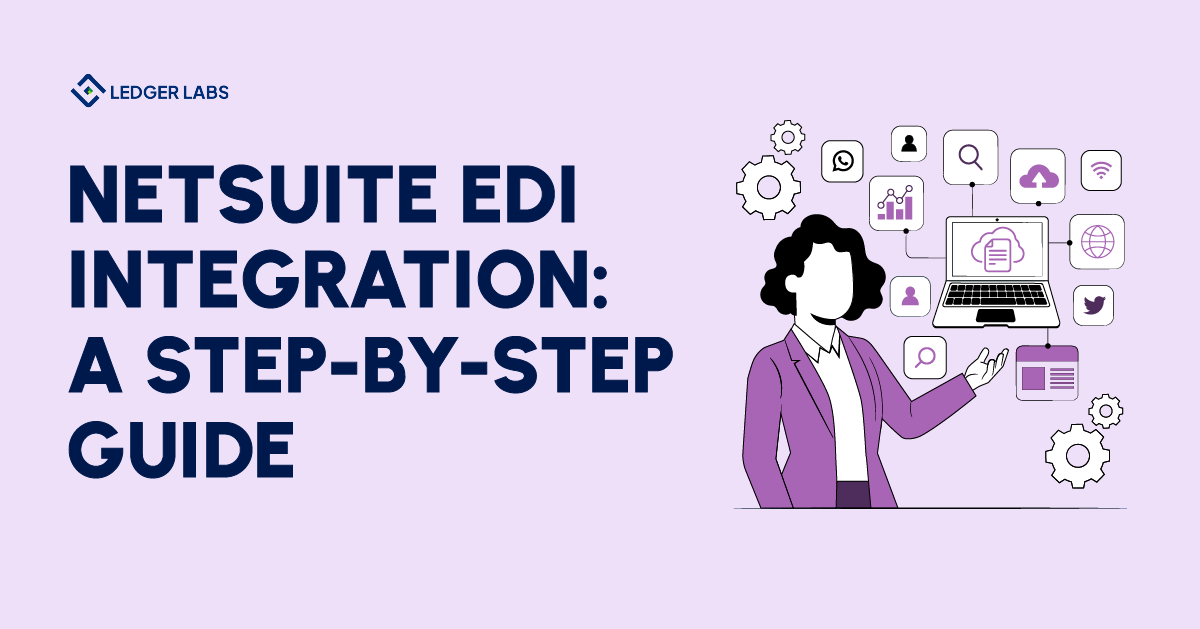
NetSuite EDI integration links NetSuite to an external EDI provider, enabling it to automatically send and receive standard trading documents such as purchase orders, invoices, and shipping notices. Since NetSuite does not have built-in EDI, it’s crucial to set it up correctly. When done right, orders, shipments, and invoices process automatically. If done poorly, your accounting team will face a messy stream of entries to fix.
Many buyers get caught off guard by this requirement. When a big retailer asks for “EDI-compliance” in 60 days, you might search for a setting in NetSuite to enable, but you won’t find it. Instead, you need to pick a provider, set up the required documents, and ensure the data matches your financial records. The technical part moves the data, while the accounting part determines if it goes to the right accounts. This second part is where integrations often fail.
We bridge that gap. Our finance team is based in the US and led by qualified accountants. We don’t sell EDI software. Instead, we help you select the right provider, manage the setup, and ensure every transaction fits neatly into the general ledger, with no vendor bias from start to finish.
The benefit is an integration that meets your retailer’s needs and withstands audits, unlike one that may pass technical tests but fails at month-end. This guide explains how NetSuite EDI works, compares connectors, and reviews top providers, all from the perspective of our outsourced NetSuite accounting team, so your financial close stays clean from the first transaction onward.
Key Takeaways
- NetSuite has no built-in EDI, so choosing an external provider or middleware is always your first real decision.
- Every EDI document posts to your books, which makes accounting accuracy, not just data flow, the true measure of success.
- The 850, 856, and 810 each hit different accounts, so a single mapping error becomes a month-end reconciliation problem.
- An incorrect or missing 856 ASN is a leading cause of retailer chargebacks that quietly erode your margins.
- The best provider depends on your partner count, deadline, and the demands of your accounting close.
- As an accounting firm, we stay vendor-neutral and own the accounting outcome, not only the integration itself.
What is NetSuite EDI integration?
NetSuite EDI integration lets your business automatically exchange documents with trading partners through an external EDI provider. EDI, or Electronic Data Interchange, involves the computer-to-computer transfer of documents like purchase orders and invoices in a standard format. Instead of sending a PDF to be retyped, your system sends a structured file that the receiving system can read directly.
Here’s the part every buyer needs up front: NetSuite gives you the hooks to connect, SuiteTalk web services and REST APIs, but it does not translate EDI or hold partner connections itself. An external provider or middleware platform does that work.
A working setup has three main parts: NetSuite as your central system, the EDI provider that translates documents and manages partners, and the mapping that converts incoming documents into NetSuite transactions. Get the mapping right for smooth operation; get it wrong, and mistakes may multiply.
We focus on mapping to ensure it meets your accounting needs, so incoming orders record revenue accurately, and shipments adjust inventory correctly. An accounting-first approach helps create an integration that saves time rather than creating extra work.
Native NetSuite EDI vs third-party providers
Since NetSuite has no native EDI, the real question isn’t “native or third-party”; it’s how much of the work you hand off. You pick from three routes, and each one carries a different accounting trade-off.
Built-in connectors / SuiteApps
Some providers publish “Built for NetSuite” connectors that install directly and carry SuiteCloud certification. These feel the most native and stand up quickly for common trading partners. They fit smaller operations running a handful of partners and standard document sets.
Full-service EDI providers
Here, the provider handles partner connections, mapping, testing, and ongoing compliance updates for you. This route suits businesses onboarding many retailers, or anyone staring down a deadline they can’t staff internally.
iPaaS / middleware
Integration platforms connect NetSuite to EDI, and everything else, with the most flexibility and control. They assume you have, or will hire, the technical capacity to own the workflows.
The trade-off that matters most isn’t speed or price. It’s control over how transactions post. A lightweight connector might drop an incoming invoice into a default account that doesn’t match how you recognize revenue. A full-service setup might need explicit direction to ensure an 856 ASN adjusts inventory in the way your COGS method demands. No route wins outright.
We help you choose the right route based on three important factors: how many partners you have, your deadline, and your closing process. We focus on these rather than just which demo looks the best. This approach ensures your decision remains solid even after the sales call ends.
NetSuite EDI transaction types
NetSuite EDI runs on standardized X12 transaction codes, and the handful that drive your order-to-cash and procure-to-pay cycles each map to a specific entry in your books.
You don’t need to memorize them, but you should know what each one does to your financials, the touchpoint a technical integrator routinely misses.
| Code | Document | Direction | What It Does in NetSuite | Accounting Touchpoint |
|---|---|---|---|---|
| 850 | Purchase Order | Inbound (from customer) | Creates a sales order | Sets up the receivable and revenue you'll recognize |
| 855 | PO Acknowledgment | Outbound | Confirms or adjusts the order | Prevents mismatched fulfillment and disputed invoices |
| 856 | Advance Ship Notice (ASN) | Outbound | Signals shipment and contents | Drives inventory relief and COGS timing |
| 810 | Invoice | Outbound | Bills the customer | Posts revenue and the receivable |
| 820 | Payment / Remittance | Inbound | Records payment detail | Speeds cash application and AR reconciliation |
| 846 | Inventory Advice | Either | Communicates stock levels | Keeps inventory valuation aligned |
| 997 | Functional Acknowledgment | Either | Confirms receipt of a document | Creates an audit trail of the exchange |
Check the far-right column again; it shifts how we view the project. An EDI rollout isn’t just a warehouse task affecting accounting; it’s an accounting process linked to the warehouse. When you send an 856, inventory and COGS change. When an 810 goes out, revenue is recorded. When you receive an 850, you recognize a receivable.
If the mappings are incorrect, errors won’t show on the EDI dashboard but will appear in your month-end variance after your financial reports are done. We ensure the mapping is accurate and test it before you rely on it.
NetSuite EDI providers compared
The best NetSuite EDI provider for you depends on your partner network, your deadlines, and the strictness of your closing process.
Here is an unbiased overview of five top options and where they might fit your needs. We don’t sell any of these, so use this information to create a shortlist and test it against your own partners.
| Provider | Type | Tends to Fit | Strengths | Watch-outs |
|---|---|---|---|---|
| SPS Commerce | Full-service | Retail-heavy businesses with many trading partners | Large retail partner network and managed compliance | Full-service model can feel less flexible for custom flows |
| Celigo | iPaaS / connector | Teams wanting one platform for EDI and other integrations | Flexible with broad integration scope | More configuration ownership on your side |
| TrueCommerce | Full-service + network | Businesses scaling their trading-partner count | Large trading-partner network and NetSuite certification | Confirm depth on your specific document sets |
| Cleo | Integration platform | Complex, higher-volume operations | Strong control and error handling | Heavier lift; better suited to technical teams |
| Orderful | Modern API-first EDI | Businesses seeking faster onboarding and developer-friendly workflows | Quick trading-partner onboarding | Confirm coverage for your exact partner list |
A comparison like this shouldn’t crown a winner. It should match a provider’s model to your reality: how many partners you onboard, how hard your deadline bites, whether you have technical staff, and how unforgiving your accounting close is. That last factor rarely appears on a vendor’s own page, yet it usually determines whether the integration feels like relief or becomes a recurring cleanup. We weigh it first, because we’re the ones who see the month-end result.
How to choose a NetSuite EDI partner?
Choose a NetSuite EDI partner by weighing six factors: expertise, scalability, methodology, support, future-readiness, and accounting impact, with that last one carrying the most weight, because it’s the factor that lands directly on your finance team.
Apply all six whether you’re picking a provider or the firm overseeing the project.
- Relevant expertise: Look for a real track record across NetSuite and EDI, plus B2B integrations generally. Reviews, certifications, and case studies tell you far more than any feature list.
- Customization and scalability: The setup should meet your partners’ specific EDI mandates today and absorb new partners tomorrow, without forcing a rebuild each time.
- A proven methodology: Insist on clear phases, timelines, and communication. Ad-hoc EDI projects are exactly where deadlines slip.
- Support and training: Retailers constantly change their specs. You want a partner who supports you afterward, not one who hands off and disappears.
- Future-readiness: A partner who tracks NetSuite releases and EDI standards keeps your integration from aging into a liability you’ll have to fix later.
- The accounting lens: Ask whether they understand what each document does to your books, or only how to move it. A setup that ignores revenue recognition, inventory valuation, and AP integrity passes every technical test, only to generate work at close.
We focus on the sixth factor in our practice. We evaluate each provider based on how their work affects accounting. If data flows are messy and create problems in your financials, that’s not a win; it just delays issues.
This is what sets integrators apart from the accountants who supervise them. When you choose partners, ask each one how they will keep your books accurate, not just how they will keep your data moving. The answers will quickly show who the true specialists are and who are just order-takers.
Reducing retail chargebacks and meeting compliance deadlines
You can reduce chargebacks from retailers and meet deadlines by making sure your EDI documents, especially the 856 ASN, are accurate before going live. It’s important to prepare your NetSuite data early. Retailers often issue chargebacks that anchor your pay if documents are late, incorrect, or don’t meet specifications. A wrong or missing ASN leads to more chargebacks than anything else.
You protect your profit in two ways: by ensuring accurate documents and creating a realistic onboarding plan. A focused rollout for one retailer can take a few weeks to a couple of months, depending on document complexity and your NetSuite data readiness. This approach is better than a full multi-partner setup, but only if you do the prep work.
Before onboarding starts, gather four key items: your trading partner’s EDI specifications, cleaned-up NetSuite items and locations, a defined fulfillment workflow, and a decision on how ASN-driven inventory movements should post. If you handle these early, you can keep deadlines manageable. If you wait until testing week, chargebacks will start on day one.
We prioritize this preparation to ensure compliance and accurate accounts are ready together. We also monitor the accounting side to catch mapping issues before they lead to chargebacks and reconciliation problems. Meeting the retailer’s deadline is a clear win; maintaining your profit while doing so is the benefit that funds the project.
NetSuite EDI implementation timeline: what to expect
Integrating EDI with NetSuite usually takes one to two months and has five phases. A complete NetSuite setup can take six months to a year. If you work on both simultaneously, include EDI in the NetSuite rollout. This way, you won’t have to adjust connections later.
Here’s how a managed rollout looks in practice:
- Planning and discovery: Confirm stakeholders, trading-partner requirements, and document sets, and decide, up front, how each document should post to the ledger.
- NetSuite readiness: Configure items, locations, and workflows so incoming documents have a clean place to land, rather than forcing corrections after go-live.
- Provider setup and mapping: The provider builds the partner connections and maps the documents; we review that mapping against your accounting treatment before anything goes live.
- Testing and validation: Pilot with one partner, send test transactions, and confirm both the data and the resulting journal entries post correctly before you scale to the rest.
- Go-live and monitoring: Launch, then watch closely as you add partners and retailers shift their specs.
Across all phases, we perform oversight and reconciliation rather than hands-on configuration. We don’t touch the provider’s config screens; we make sure the build they deliver actually serves your financials. That split keeps the project fast on the technical side and safe on the accounting side, so you hit your date without discovering surprises at your first close.
A quick note: the hands-on NetSuite WMS steps to activate the Generate EDI 856 outbound ASNs rule are covered in Oracle’s official NetSuite EDI documentation, so this page focuses on the decision rather than the config screens.
How Ledger Labs sets up and manages NetSuite EDI
Ledger Labs helps you set up and manage NetSuite EDI as accountants, not as software vendors. We work with you to choose the right provider, oversee the build, and ensure that every document posts correctly to your ledger.
Unlike most NetSuite EDI content, which comes from the platform’s sellers, our focus is different. This difference helps us optimize your experience better.
When we oversee a setup, we watch the ledger, not just the integration dashboard.
Concretely:
- On the 850 (order), we confirm each order creates the right receivable and revenue setup, so what you promise matches what you bill.
- On the 856 (ASN), we confirm shipments relieve inventory and time COGS to your valuation method, the single biggest source of month-end inventory variance in EDI-connected businesses.
- On the 810 (invoice), we confirm revenue posts correctly and the receivable ties out, so EDI never quietly distorts your top line.
- On the 820 (remittance), we streamline cash application so AR reconciles faster.
We stay vendor-neutral the whole way. You get an independent recommendation on which provider fits, oversight through setup and testing, and a finance team that owns whether the entire thing reconciles.
As an accountant-led firm, we answer for the accounting outcome, not merely the data flow. That’s the line between hiring an integrator who moves your documents and hiring accountants who make sure those documents keep your books right.
Conclusion
NetSuite EDI integration looks like a technical project, but it’s a financial one in a technical costume; every document you exchange becomes an entry in your books, and the gap between a clean integration and a messy one shows up at month-end.
Because NetSuite has no native EDI, you’ll work with a provider either way. The real question is whether anyone watches the accounting side while the data moves.
That’s the gap we fill: vendor-neutral advice on which provider fits, oversight through setup, and a commitment to keeping your financials audit-ready as transactions start flowing.
Facing an EDI mandate, or cleaning up an integration that won’t reconcile? Book a no-obligation NetSuite EDI review, and we’ll tell you exactly what you need.
FAQ
1. Does NetSuite have native EDI?
No, NetSuite has no built-in EDI. It connects to trading partners through an external provider or middleware using SuiteTalk web services or REST APIs, so provider selection is your first decision on any NetSuite EDI project.
2. How long does NetSuite EDI setup take?
A focused rollout for one trading partner usually takes a few weeks to a couple of months; multi-partner builds take longer. The biggest variable is the cleanliness of your NetSuite data and workflows before onboarding begins.
3. What does NetSuite EDI cost for a small business?
Cost depends on your provider model (connector, full-service, or iPaaS), partner count, and document volume. Because we don’t sell EDI software, we help you scope realistic numbers for your situation instead of quoting a platform.
4. Which EDI provider is best for NetSuite?
No single provider wins for everyone. The right fit depends on your partner network, deadline, technical capacity, and close. Full-service options suit retail-heavy, deadline-driven setups; iPaaS suits teams wanting flexibility across many integrations.
5. Should I use a native connector or a managed EDI service?
A built-in connector moves faster for a few standard partners. A managed service fits businesses onboarding many retailers or facing a mandate without internal capacity. The deciding factor is usually how much control you need over how transactions post.
6. What EDI documents does NetSuite support?
Through a provider, NetSuite handles the standard X12 set, including the 850 (PO), 855 (acknowledgment), 856 (ASN), 810 (invoice), 820 (remittance), 846 (inventory), and 997 (acknowledgment).