
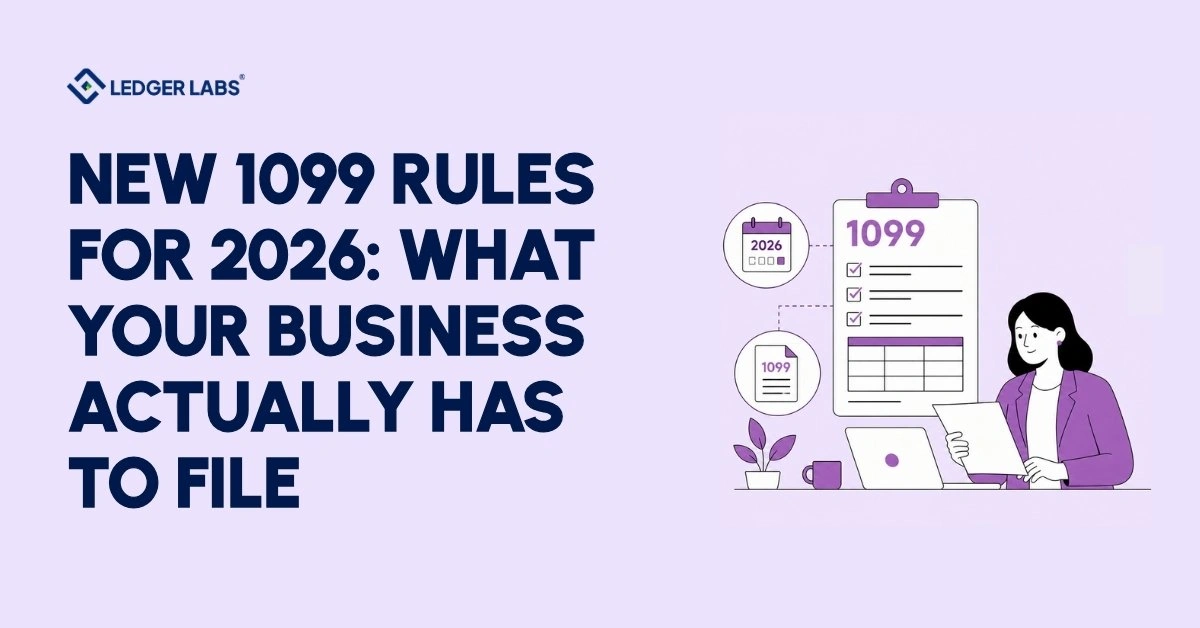
You might have heard that the $600 1099 rule is no longer in effect, which might lead you to think you can stop tracking small payments to contractors and platform payouts. However, that’s only partly true. Missing the complete picture could lead to penalty notices from the IRS.
Here’s what many business owners don’t realize: the One Big Beautiful Bill Act (OBBBA) changed the rules on two different timelines. The forms you submit in early 2026 will have different rules than those submitted a year later.
The new 1099 rules for 2026 will be simpler overall, but the transition year can be tricky. Many businesses are confused by these changes and think that “the rules got easier.”
If you file a contractor 1099 that you shouldn’t have, or miss one that you should have, you could face IRS penalties, backup-withholding issues, and a stressful cleanup during your busiest filing weeks.
This is the kind of situation we help clients with every January, not a vendor selling filing software, but a CPA and EA team that actually signs off on the returns.
Key Takeaways
- The OBBBA changed two 1099 rules on different timelines, so the forms you file in 2026 don’t follow identical thresholds.
- Form 1099-K reverted to $20,000 and 200 transactions, retroactive to 2022; both conditions must be met to trigger reporting.
- The 1099-NEC/1099-MISC threshold rises from $600 to $2,000, but only for payments made after December 31, 2025.
- For 2025 contractor payments filed in early 2026, the old $600 threshold still applies; skipping small forms can result in penalties.
- Payment cards have no minimum, so you can still receive a 1099-K even below the $20,000 platform threshold.
- State rules may set lower thresholds, so meeting the federal limit doesn’t clear your state filing obligations.
- Collect W-9s before paying and track payee totals year-round to make either threshold easy to apply.
What changed for 1099 reporting in 2026?
Two important changes have occurred regarding tax forms, and both relate to payment thresholds, but they apply differently.
First, the OBBBA has restored the old limit for Form 1099-K, meaning third-party platforms will report only if a payee earns more than $20,000 and has more than 200 transactions.
Second, the limit for Forms 1099-NEC and 1099-MISC will rise from $600 to $2,000 for payments made after December 31, 2025.
These two changes take effect at different times. The 1099-K change is retroactive, while the 1099-NEC change will apply to payments starting in 2026. Depending on which form you are using and when the payment was made, you might need to follow either the old or the new threshold. Keep this distinction in mind, as it will help you understand the information that follows.
The new Form 1099-K threshold: $20,000 and 200 transactions
If you sell through platforms like Stripe, PayPal, Shopify Payments, Etsy, or Amazon, the rules for 1099-K reporting have changed, and reconciling marketplace and payment-processor income across those platforms can get messy. Now, you only need to worry about it if you earn more than $20,000 and have more than 200 transactions in a year. This change is retroactive to 2022 and replaces the earlier planned rule that would have set the threshold at $600 by 2026.
It’s important to note that both conditions must be met: the dollar amount and the number of transactions. If you fail to recognize this, you may expect forms that you won’t actually receive.
Be aware that payment cards work differently. There is no minimum limit for credit or debit card transactions. If a customer pays you by card, the card processor reports the amount to the IRS, regardless of how small it is.
This means you can still receive a 1099-K even if your total from third-party sales is below $20,000. Many business owners mistakenly think that the $20,000 rule applies to all their income from card and app sales; it does not.
The key takeaway is that even if you get a 1099-K in the mail, it doesn’t automatically mean you’ve crossed the federal threshold for reporting. Always check your records against any 1099-K forms you receive before reporting the amounts.
The new 1099-NEC and 1099-MISC threshold: $600 to $2,000
If you pay contractors, freelancers, or vendors, the reporting limit for Form 1099-NEC and 1099-MISC will increase from $600 to $2,000. This change takes effect for payments made after December 31, 2025. The $2,000 limit will also increase each year to keep up with inflation.
This change is important. The previous $600 limit had been in place since the 1950s, so many routine payments to contractors had to be reported. With the new $2,000 limit, many one-time or smaller vendor payments won’t need to be reported anymore. For example, if you paid a graphic designer $1,400 or a consultant $1,800, you won’t need to report those payments.
It’s also essential to remember that this new limit won’t apply to your 2025 reports. It will begin with payments in 2026, which you will report in early 2027. For the 1099-NEC forms due in January 2026, you will still use the old $600 limit. We will explain this timing in more detail next, as it’s a common mistake we are seeing this year.
The 2026 timing trap: which threshold applies to which year
Read this section carefully. The two thresholds changed on different dates, so the rules for the forms you submit in early 2026 will be different from those for the forms you submit in early 2027.
| Form | Payments for Tax Year 2025 (Filed Jan/Feb 2026) | Payments for Tax Year 2026 (Filed Early 2027) |
|---|---|---|
| 1099-K (platforms) | More than $20,000 and 200 transactions | More than $20,000 and 200 transactions |
| 1099-NEC / 1099-MISC (contractors, vendors) | $600 (old threshold still applies) | $2,000 (new threshold) |
For your 2025 contractor payments, the threshold remains $600. The new $2,000 rule does not apply yet. This means that if you’re a business owner and you stop issuing 1099-NECs for contractor payments under $2,000 this year, you are not reporting correctly. Each missed form can lead to penalties.
Here’s a common scenario: an owner pays a freelancer $1,500 in 2025, hears that the threshold is now $2,000, and skips the form. That’s a mistake. You still need to file a 1099-NEC for the $1,500 payment in 2025. However, if you pay the same freelancer $1,500 in 2026, you won’t need a form.
The key point is this: the 1099-K rule has changed for everything, but the 1099-NEC rule only changes for payments made in 2026 and beyond. Keep this in mind, and most confusion will go away.
What does your business need to do before the 2026 deadlines?
The good news is that the preparation is the same; no matter which threshold applies, having clean records makes it easier to determine which threshold applies.
Here’s a short list we follow for our clients:
- Collect W-9s before payment: Get W-9 forms from contractors before you make any payments. You need a valid taxpayer ID to issue a correct 1099 or apply backup withholding if necessary. Waiting until January to collect W-9s is the main reason for late filings. So, get the form before the first payment goes out.
- Track totals throughout 2025: Since the $600 threshold applies for payments made in 2025, keep track of the total payments made to each payee during the current filing season. Don’t rely on one large invoice to remember; it’s the small payments that add up to $600.
- Reconcile each 1099-K you receive: Make sure to match these forms to your own sales records before you include them in your tax return. Some platforms might send you forms even if you haven’t reached the federal threshold, so the amount on the form may not accurately reflect your taxable income.
- Update your accounting system’s thresholds: If your accounting software still uses the $600 threshold or older amounts, correct them now for each form and year.
If you handle these four tasks, filing will be easy. If you skip them, you’ll be scrambling to piece together a year’s worth of payments under pressure.
State 1099 rules: why a lower threshold may still apply
Federal guidelines aren’t the only rules you need to consider. The OBBBA changed federal thresholds, but each state can have its own requirements, which might be lower or stricter. So, even if you meet the federal threshold, you might still need to file a state information return.
States handle this differently. Some, like California, automatically follow the federal rules, including the updated thresholds. Others set their own limits or join the IRS’s Combined Federal/State Filing program, which can have different requirements. There isn’t one single rule that applies everywhere.
If you pay contractors or sell products in multiple states, don’t assume that meeting the federal threshold means you’re clear in all states. It’s important to check the filing rules for each state where you do business. This is a common issue we find during clients’ year-end reviews.
The open questions still unresolved for 2026
Not everything is settled, and pretending otherwise would be a disservice. Two items are still in motion as of this cycle.
First, backup withholding. Treasury and the IRS issued proposed regulations (REG-112829-25) on January 9, 2026, to align the backup-withholding trigger under Section 3406 with the new 1099-K thresholds, and the comment period closed on March 10, 2026. Until those are finalized, platforms and payors are operating on proposed rules, worth watching if backup withholding touches your payees.
Second, transition relief for tips and overtime reporting. The IRS made 2025 a transition year under Notice 2025-62, with no penalties for 1099-NEC or 1099-K forms filed without the separate accounting of cash tips, recipient occupation, or qualified overtime that the new rules will eventually require. That relief is temporary, and the full requirements are coming.
I’ve written a deeper analysis of the statutory mechanics and the unresolved reporting questions for the 2026 cycle [link to guest post once live]. If you want the practitioner-level detail, that’s the place. For running your business, the summary above is what you need to act on.
How does Ledger Labs handle 1099 compliance?
Most of the errors above stem from the same root cause: treating 1099 filing as a January task rather than a year-round record-keeping discipline. By the time you’re issuing forms, the threshold question is already decided by how well you tracked payments and collected W-9s months earlier.
That’s the part we own for clients, as part of our outsourced accounting and bookkeeping service. We keep contractor and vendor totals current through the year, collect and validate W-9s before payments go out, apply the correct threshold to each form and each payment year, and handle the actual filing, federal and state. When a 1099-K shows up that doesn’t match the books, we reconcile it before it ever touches a return.
You get a CPA and IRS Enrolled Agent standing behind the filing, not a software subscription that leaves the judgment calls to you.
FAQs
1. What is the 1099-K threshold for 2026?
For 2026, a third-party platform must issue Form 1099-K only when a payee receives more than $20,000 and more than 200 transactions in the year. The OBBBA restored this pre-2022 threshold, replacing the $600 rule that was scheduled to take effect. Payment card transactions have no minimum and are reported regardless of the amount.
2. Did the $600 1099 rule get repealed?
Yes, for Form 1099-K, the OBBBA restored the $20,000-and-200-transaction threshold, so the $600 platform rule never fully took effect. For 1099-NEC and 1099-MISC, the old $600 threshold still applies to 2025 payments and only rises to $2,000 for payments made after December 31, 2025. So “repealed” is true for one form and “delayed” for the other.
3. Do I still need to file 1099-NEC for contractor payments under $2,000?
For 2025 payments, yes. The $2,000 threshold applies only to payments made after December 31, 2025, so any 2025 contractor payment of $600 or more still requires a 1099-NEC filed in early 2026. The $2,000 threshold first affects your 2026 payments, reported in 2027.
4. When does the $2,000 1099 threshold take effect?
The $2,000 threshold for Forms 1099-NEC and 1099-MISC applies to payments made after December 31, 2025, meaning your 2026 payments will be reported on forms filed in early 2027. It’s also indexed for inflation for years after 2026, so the figure will rise over time.
5. Do I need to file a 1099 for a contractor I paid $1,500?
It depends on the year. If you paid the $1,500 in 2025, yes, it exceeds the $600 threshold still in effect for 2025 payments. If you paid it in 2026, no, it falls under the new $2,000 threshold. The payment year, not the amount alone, decides it.
6. Are the new 1099 thresholds indexed for inflation?
The $2,000 threshold for 1099-NEC and 1099-MISC is indexed for inflation for years after 2026, so it will adjust upward over time. The 1099-K threshold of $20,000 and 200 transactions is a fixed statutory figure and is not inflation-indexed.
7. Do state 1099 rules follow the new federal thresholds?
Not always. Some states conform automatically to the federal thresholds, while others set their own dollar limits or stricter reporting rules. You can be below the federal threshold and still owe a state information return, so check each state where you have a filing obligation rather than assuming federal clears you everywhere.
The bottom line on the new 1099 rules for 2026
The main point is clear: the OBBBA made Form 1099 reporting easier, but it affects two different sets of rules. Form 1099-K returns to the limits of $20,000 and 200 transactions, retroactively. However, the new $2,000 threshold for Forms 1099-NEC and 1099-MISC starts only with payments made in 2026. This means the forms you file this January still follow the old $600 rule.
You might think the rules got easier, but if you pay a contractor under $2,000 in 2025, you still need to file a form. Skipping this will lead to a penalty. This detail can make a big difference in your filing season.
If you’re unsure about your payments or want someone else to handle it, we offer a filing review. [Book a 1099 filing review →] We’ll match your payments to the right thresholds, point out state requirements, and manage the filing for you.
The rules are simpler, but the transition year is tricky. Get the year right, and the rest is just basic math.