
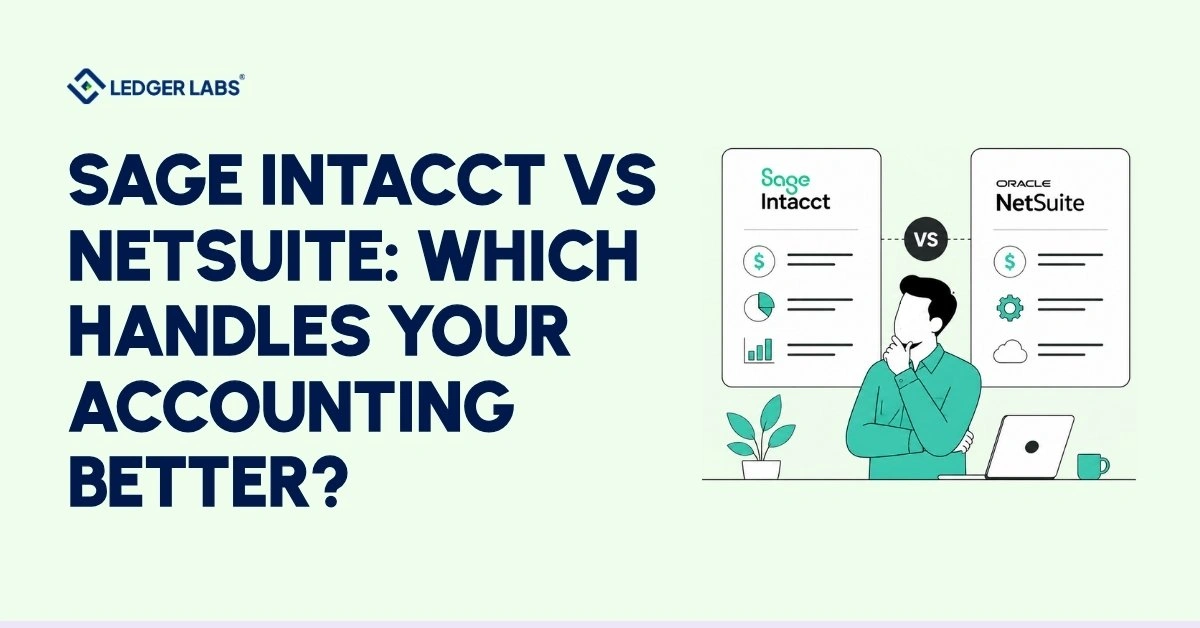
Sage Intacct is a strong accounting system for service-based businesses, nonprofits, and finance teams with multiple locations. It focuses on accounting, features a detailed general ledger, and allows for faster monthly closes. NetSuite is better for businesses dealing with products, inventory, and e-commerce. It integrates accounting with operations. Neither system is overall better; the right one depends on how your team works.
We manage the financial records in both Sage Intacct and NetSuite for our clients every day. This includes closing, consolidating, and auditing. However, these two systems view your finances differently. One system sees the general ledger as the most important part, while the other views it as just one part of a much bigger system.
Choose the wrong accounting system, and you’ll deal with issues every month-end. You’ll have to find workarounds and make manual journal entries, which can make the closing process take a week longer than it should.
This comparison will help you understand how each system handles the accounting tasks that take up your team’s time, the costs over three years, and which system is the best fit for your business.
Key Takeaways
- Sage Intacct is designed for finance teams, offering a dimensional general ledger and faster month-end closures.
- NetSuite focuses on being an ERP system, with accounting as one part of a platform that also includes inventory, orders, CRM, and ecommerce.
- When choosing a system, consider how your team operates, not just the features.
- Intacct is usually faster for multi-entity financial consolidation.
- NetSuite’s OneWorld is better for consolidating operations across subsidiaries.
- Choose Intacct for services, SaaS, nonprofits, and recurring revenue.
- Choose NetSuite for product, inventory, and ecommerce businesses.
- Consider the total cost of ownership over three years, including subscription costs, implementation, and ongoing administration, not just the first-year license fee.
Sage Intacct vs NetSuite at a Glance
Sage Intacct focuses specifically on accounting, while NetSuite covers a wider range of business functions. This key difference affects all comparisons we make below.
Here’s an overview of the decision before we look at the details:
| Factor | Sage Intacct | NetSuite |
|---|---|---|
| What it is | Accounting-first financial platform | Full ERP suite (accounting is one module) |
| General ledger | Dimensional (tag transactions, no segment bloat) | Segment-based COA |
| Best-fit profile | Services, SaaS, nonprofits, multi-entity | Product/inventory, ecommerce, operations-heavy |
| Month-end close | Fast native close, strong multi-entity automation | Capable, often configured to match |
| Beyond accounting | Integrates best-of-breed tools | Native CRM, inventory, orders, ecommerce |
| Pricing model | Modular subscription, quote-based | Modular subscription + user licensing, quote-based |
| Implementation | Faster, accounting-scoped | Longer, broader scope |
How Does Accounting Work in Sage Intacct?
In Sage Intacct, your accounting team uses a system that matches their way of thinking. The general ledger is at the center of the system rather than added on later. This setup helps with your close by having a clear chart of accounts and a dimensional GL. You can consolidate multiple entities without relying on spreadsheets, and you won’t need to manually reconcile ASC 606 revenue recognition.
So what does that mean for the people doing the work?
The day-to-day feels native, not worked around. When we run a client’s books in Intacct, the reporting starts from financial data, and the close tools are right where a controller expects them. If your team’s month is the GL, the close, and management reporting, they rarely fight the system to get there.
You will see the limits of this system outside of finance. It won’t manage your warehouse or handle your orders; you will need to connect those tools separately.
We help clients by providing full accounting support while recommending they rely on integrations for everything else.
How Does Accounting Work in NetSuite?
NetSuite accounting integrates directly with your business operations. This means that a sale instantly updates inventory, orders, customer records, and journal entries without waiting for overnight syncing. However, since accounting is part of a larger system, some setup may be needed to ensure smooth financial operations.
What does that mean for the people doing the work?
When we run a client’s books in NetSuite, the strength shows up fastest for product and ecommerce businesses; your financials reflect what’s actually happening in operations, in real time. That single source of truth is hard to replicate when accounting lives in its own separate tool.
The cost becomes clear at the end of the process. Since finance shares the platform with other teams, we often configure the system to deliver the closing experience the finance team expects, as they do in other areas.
That’s the trade we weigh for clients: accounting that’s wired straight into operations, in exchange for more setup to make the month-end feel finance-first. If you choose NetSuite, a NetSuite accounting firm can supply that setup knowledge and run the monthly close, so your team does not have to build the expertise first.
How Does Each System Handle Your Accounting?
Sage Intacct handles the finance-heavy work best: the general ledger, multi-entity consolidation, the close, and revenue recognition. NetSuite handles accounting better when it needs to keep pace with your operations, such as order and inventory management.
Here’s how each plays out across the seven functions your team uses most, and getting this match wrong is the difference between a three-day close and a three-week one you’ll be paying for every month.
Chart of Accounts & the General Ledger
Sage Intacct keeps your chart of accounts lean by tagging transactions with dimensions; NetSuite builds those tracking categories into the accounts themselves. This is the difference your team feels first.
Here’s why it matters.
In NetSuite, to track by department, location, and class, you build those into your accounts, and the list grows. A complex business can end up with a long, branching chart of accounts that takes real discipline to keep clean.
In Intacct, you keep the account list short and tag each transaction instead: entity, department, location, project, customer. You’re not adding accounts to slice the data; you’re attaching labels and slicing later in reporting.
What that looks like in practice: in Intacct, your team can pull project profitability by location across three entities without having pre-built an account for every combination. In NetSuite, you can get there too, but the structure has to be planned for in advance.
If your reporting questions grow faster than your account list should, that’s the case for Intacct in one line.
Multi-Entity & Consolidations
For consolidating financials across entities, Sage Intacct is usually faster; inter-entity transactions, eliminations, and multi-currency consolidation are built in. For consolidating an entire operation across subsidiaries, NetSuite does what a pure accounting tool can’t.
If you run more than one entity, this may decide it for you.
We’ve watched Intacct turn a multi-day, spreadsheet-heavy consolidation into a same-day close. For a business with several legal entities, that’s the single most common reason our clients land on it.
NetSuite earns its place when you need to consolidate more than just the books, inventory, and orders across subsidiaries. If that’s your reality, its reach is the advantage.
It all depends on what you need to consolidate. If you are looking to consolidate financials, Intacct is the best option. However, if you want to consolidate an entire operation, go with NetSuite. That covers consolidation.
Next, there’s the monthly task you have to do, regardless of how many entities you manage.
The Month-End Close
Both systems can help close the books quickly and efficiently, but Sage Intacct usually works better right away, whereas NetSuite often requires configuration to achieve the same results. Intacct has built-in closing tools. In contrast, NetSuite’s accounting features are part of a larger system.
Finance leaders often ask the same questions at the start of the month: How quickly can we close? How much manual work is involved?
In Intacct, tools for closing, reconciliations, recurring entries, roll-ups, and allocations are easy to find. Clients switching from older systems often reduce their closing time by several days.
NetSuite can also reach the same goal, but it usually requires more setup. Close speed also depends on the daily work underneath: transactions left uncoded and accounts left unreconciled slow the close in any system, and keeping them current is the job of NetSuite bookkeeping.
From experience with both systems, I can honestly say that software is rarely the main issue once they are properly set up. The slow closings we are called to fix usually stem from problems with the system’s design, such as a chart of accounts that conflicts with reporting, integrations that don’t align, or a process that wasn’t designed for the system.
Revenue Recognition
For businesses that rely on contracts and subscriptions, Sage Intacct offers better automation for ASC 606 compliance. On the other hand, for revenue linked to fulfilled orders and inventory, NetSuite’s revenue management, integrated with operations, is more effective. This distinction can be key for SaaS and service-based companies.
Intacct streamlines the management of contract schedules, multi-element arrangements, and subscription billing. This means less manual work with spreadsheets for subscription businesses.
NetSuite also performs well, especially when revenue is tied to fulfillment and inventory, as it operates within the same system as other business functions.
So, consider this question: is your revenue based on contracts or orders? This will help you choose the right system.
AP / AR & Transaction Workflows
In Sage Intacct, accounts payable (AP) and accounts receivable (AR) stay within the finance team. In contrast, NetSuite connects them to other business areas. For example, a vendor bill links to a purchase order and inventory receipt, while a customer invoice connects to a sales order and fulfillment.
Your team works with these systems daily. Intacct keeps AP and AR processes, like approval routing, payments, and collections, entirely in finance. NetSuite integrates these workflows across the entire business. This setup is beneficial for product companies, while pure service firms may not need it as much.
Neither system is better; it depends on whether you prefer AP/AR to remain within finance or be part of wider operations.
Financial Reporting & Dashboards
Sage Intacct lets you analyze financial data in detail. You can break down financials by any tags you’ve used without needing to create new reports. NetSuite provides a broader view by combining sales, inventory, and finance on a single dashboard, since all the data is stored together.
The goal of keeping clean financial records is to get useful insights. With Intacct, if you tag transactions by project, location, and entity, your team can easily report on any combination of these factors. The dashboards display the financial key performance indicators (KPIs) that a CFO monitors.
NetSuite offers a broader perspective, showing both operational and financial health on a single screen because all modules share the same database.
In summary, Intacct provides detailed insights, while NetSuite offers a broad overview.
Audit Trail, Controls & Compliance
Both systems regularly pass external audits and provide features such as audit trails, role-based permissions, and proper control of duties, things auditors look for. Intacct focuses its controls on financial governance, while NetSuite applies them across all its modules.
If you are preparing for an audit, seeking a raise, or need stricter governance, this is important information.
Intacct’s controls are well-regarded in fields such as nonprofits and professional services, which often undergo audits. NetSuite’s broad coverage is useful when your audit examines inventory, revenue, and operations, not just financial records.
Here’s something many people overlook: both systems usually pass audits. What often fails is how the system is set up and used, permissions that are never tightened, a chart of accounts that obscures information, and missed reconciliations.
The software supports good controls. It does not create them on its own.
So Which One Fits Your Books?
If you know whether you focus more on finance or operations after reading those seven functions, you have your answer. Now, make sure your system supports that choice.
Most finance leaders don’t fit neatly into one category. For instance, you might run a services firm with inventory or an e-commerce brand with new entities. If you’re already using a system, its problems may come from the setup, not the software. This can lead to lengthy reconciliations and slow closings.
Getting a second opinion can save you money. We run live books on Sage Intacct and NetSuite and can help you find the right accounting model for your needs.
If you’re already using one system and still struggle with closings, we can help identify whether the issue is with the software or its setup.
Pricing & Total Cost of Ownership
Both systems provide quotes, so they don’t have a standard price list. However, their pricing structures differ to meet your accounting needs. Sage Intacct focuses on financial modules, making it a cost-effective choice for finance-first setups. In contrast, NetSuite is designed as a full ERP system with costs based on user licenses.
This means that even if you mainly need accounting features, you’ll still pay for additional functionalities. If your accounting needs are more advanced and extend beyond basic finance, NetSuite’s pricing model might be a better fit. But if your needs are confined to finance, Sage Intacct is likely the better option.
Here’s how the cost lines up function by function:
Sage Intacct's cost increases with the number of modules
Start with basic financial features, then add more options, such as multi-entity management and revenue recognition, as needed. The cost depends on the accounting features you activate, not the number of users. For a small finance team managing complex accounts, this approach usually keeps costs low.
NetSuite's cost increases with user count and breadth
Because it’s licensed per user on a full ERP, your cost climbs as your team grows and as you light up modules beyond accounting. For an accounting-only need, you’re still carrying the pricing weight of a platform built to run the whole business.
So the accounting-cost question comes down to shape, not a sticker price. Lean finance team, complex books, mostly inside finance → Intacct usually prices better. Bigger team, accounting wired into operations and inventory → NetSuite’s model earns the spend.
Note: The price isn’t the total cost; the main expense is monthly management time. A better setup reduces both time and costs.
Pros & Cons for Your Accounting Team
Sage Intacct’s edge is accounting depth; its limit is that it isn’t an operations system. NetSuite’s edge is being a unified platform; its limitation is that accounting is one module among many and often needs configuration to feel finance-first.
Here’s the balanced view, for the people who’ll actually use it.
Sage Intacct — strengths: accounting-first design, dimensional GL with low maintenance, fast native close, excellent multi-entity consolidation, strong ASC 606, finance-oriented reporting. Watch-outs: not an inventory/operations system — you’ll integrate other tools; weaker fit for product businesses wanting one platform.
NetSuite — strengths: true single-platform ERP, real-time link between operations and accounting, strong for inventory/ecommerce, OneWorld for operational consolidation, reporting across the whole business. Watch-outs: accounting is one module, so the close often needs configuration; broader, longer implementations; more ongoing admin.
Notice the cons aren’t flaws. They’re the cost of each system’s core strength. That’s why this comes down to profile.
Which Should You Choose? (By Company Profile)
Choose Sage Intacct if accounting is your operation, services, SaaS, nonprofit, multi-entity, or recurring revenue. Choose NetSuite if your business runs on inventory, orders, and ecommerce and you want finance on the same platform as operations.
Strip away the feature lists, and the decision is just about how your business runs.
Sage Intacct's accounting suits you if…
- You’re a services, SaaS, nonprofit, or professional-services business where accounting is the operation
- You run multiple entities and consolidation speed is a recurring pain
- You report along many dimensions, and your COA keeps growing to keep up
- Recurring-revenue / ASC 606 work eats your team’s time today
- You want best-of-breed tools elsewhere and a finance system that integrates cleanly
NetSuite's accounting suits you if…
- You’re a product, inventory, ecommerce, or operations-heavy business
- You want one platform for finance, inventory, orders, CRM, and commerce
- Your accounting must reflect operational events in real time
- You’re consolidating operations, not just financials, across subsidiaries
- You’re ready to invest in implementation to get a unified system
If you’re running a fast-growing ecommerce brand with different sections, it’s wise to get a second opinion before making a decision. Choosing the wrong path can be costly to fix later.
How Ledger Labs Helps You Decide & Implement
Ledger Labs is an accounting firm led by qualified accountants. We provide live accounting services using both Sage Intacct and NetSuite. Since we don’t sell either platform, we focus on what works best for your finance team.
Most comparison articles are biased because they are written by people who sell one of these systems. This one is different.
We handle monthly closes, consolidations, revenue recognition, and audit preparation on both platforms. This experience lets us see where each system helps and where it can cause difficulties for your team. That’s why we don’t have a preferred choice.
We successfully moved a multi-entity service firm to Intacct, reducing their consolidation time from several days to one day. We also continue to support a growing ecommerce business on NetSuite because switching systems would have created more issues.
Are you choosing between the two systems, or is your current software slowing down your close process? Schedule a free consultation with us. We’ll review how your finance team operates, suggest the best accounting model, and, if you’re already set up, help you determine whether your challenges stem from the software or its configuration.
No sales incentives here, just honest advice as if it were our own finances.
Conclusion
The best accounting system is one that fits how your team works. For in-depth accounting, choose Intacct. For broader operational needs, go with NetSuite. Neither option is better overall.
When we come in to help with difficult month-end closes, it often comes down to one issue: the accounting system does not align with how the team operates.
You wanted to choose between two products. Instead, think about this question: which accounting model suits how my team manages the books? This question is key to ensuring your month-end process runs smoothly instead of being a struggle.
Want a second opinion from people who run accounting on a daily basis? Book a free consultation, and we’ll tell you which one fits and why.
The best accounting system isn’t the one with the most features. It’s the one your team never has to fight.
Where we stand
Ledger Labs provides accounting services on both Sage Intacct and NetSuite, so we have a commercial interest in this comparison.
Who we are the right fit for, and what each monthly plan includes, are on our pricing page.
FAQs
1. Is Sage Intacct an ERP or just accounting software?
Sage Intacct is an accounting-first cloud financial management platform, broader than basic accounting software but not a full operational ERP suite like NetSuite. It covers core financials, multi-entity consolidation, revenue recognition, and reporting deeply, and integrates with best-of-breed tools for inventory, CRM, and payroll. It’s best described as ERP-adjacent.
2. How does Sage Intacct vs NetSuite pricing compare?
Both are quote-based, modular subscriptions with no publicly listed pricing. Costs depend on the modules you enable, and NetSuite also factors in user licensing. The bigger cost driver is usually implementation and ongoing administration; NetSuite’s broader scope means a longer implementation, while Intacct’s accounting focus enables faster deployment. Compare three-year total cost of ownership, not first-year license fees.
3. Which is better for multi-entity accounting?
For consolidating financials across entities, Sage Intacct is usually better: native inter-entity transactions, automatic eliminations, and multi-currency consolidation make it fast. For consolidating an entire multi-subsidiary operation, including inventory and orders, NetSuite’s OneWorld does what a pure accounting tool can’t.
4. Is migrating from Sage Intacct to NetSuite (or the other way) difficult?
It’s a meaningful project, not a software swap, and the hard part is the financial architecture, not the data transfer. The chart of accounts, dimension/segment mapping, opening balances, and historical comparability must be designed before go-live. Sequenced right, a migration is straightforward; skipped, it creates months of post-migration reconciliation.