
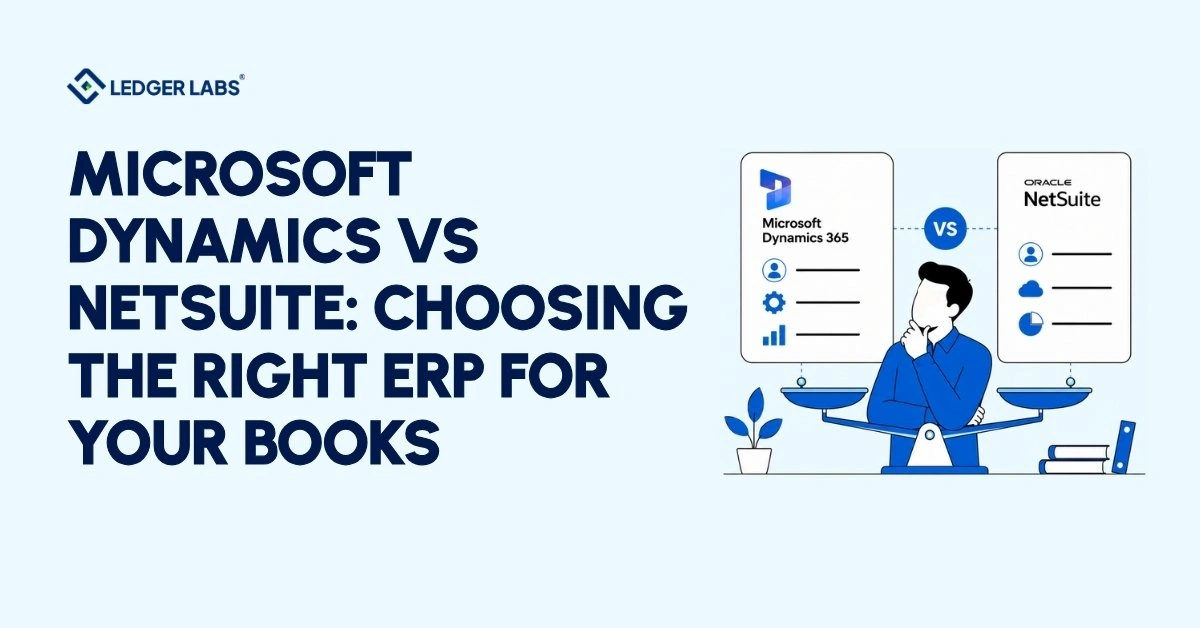
When choosing between Microsoft Dynamics and NetSuite, the key question is which one better manages your accounting. As a CPA who has worked with ERPs for finance teams, I can tell you this isn’t a simple “it depends” answer. The best choice depends on the specific Dynamics product you’re looking at, how your books are set up, and if you are already using Microsoft products.
In short, for most mid-sized finance teams that need solid accounting from the start, NetSuite is usually the better option. It was designed first as a cloud financials tool, so features like multi-entity consolidation, revenue recognition, and financial close are built in rather than added later.
On the other hand, Microsoft Dynamics 365 Business Central is a great fit if you’re already using Microsoft services, want seamless integration with Office, Teams, and Power Platform, and have the resources to tailor your financials to your needs.
This guide helps you decide which ERP to choose based on your own accounting situation. We will compare the two systems in terms of accounting details, pricing and total costs, implementation, and suitability for companies of different sizes.
Key Takeaways
- NetSuite suits mid-market teams needing native multi-entity consolidation, revenue recognition, and close tooling without heavy customization or add-ons.
- Business Central wins for Microsoft-stack organizations wanting native Office, Teams, and Power BI integration with configurable, partner-led deployment.
- “Microsoft Dynamics” isn’t one product; Business Central competes with NetSuite; Finance & Operations targets enterprises; GP is legacy.
- Compare five-year total cost of ownership, not sticker price; implementation and add-ons drive real cost more than licensing.
- Fit depends on size, industry, and entity complexity; multi-entity and audit-bound teams typically lean toward NetSuite.
- For teams already on Dynamics, model switch-versus-stay: switching pays off once native financial gaps force manual workarounds.
The Quick-Glance Comparison:
| Factor | NetSuite | Dynamics 365 Business Central |
|---|---|---|
| Built for | Cloud financials/suite | ERP within Microsoft ecosystem |
| Native multi-entity consolidation | Strong | Configurable |
| Revenue recognition | Native, mature | Requires configuration/add-ons |
| Best-fit company size | Mid-market to upper-mid | SMB to mid-market |
| Microsoft 365 / Power Platform | Via integration | Native |
| Implementation style | Suite rollout | Modular, partner-led |
| Reporting | Native dashboards + SuiteAnalytics | Power BI-native |
Which Microsoft Dynamics Product Actually Competes with NetSuite?
The most common mistake in this comparison is treating “Microsoft Dynamics” as one product. It isn’t, and picking the wrong reference point makes the entire comparison misleading.
When people search “Microsoft Dynamics vs NetSuite,” they’re almost always comparing one of three very different products.
Dynamics 365 Business Central (the real NetSuite competitor)
Business Central is Microsoft’s cloud ERP for small and mid-sized businesses, and it’s the product that genuinely goes head-to-head with NetSuite. It covers financials, sales, purchasing, inventory, and operations in a single cloud application, and it’s the version most SMB and mid-market finance teams should be evaluating. If you’re comparing NetSuite to “Dynamics” for a growing company, this is your matchup, and it’s why the rest of this guide focuses here.
Dynamics 365 Finance & Operations (enterprise)
Finance & Operations (now often split into Dynamics 365 Finance and Dynamics 365 Supply Chain Management) targets large enterprises with complex, global operations. It overlaps more with NetSuite’s enterprise tier and large-scale Oracle deployments than with the mid-market. If your revenue and complexity push you here, your comparison set is broader than just NetSuite.
Dynamics GP / Great Plains (legacy)
Dynamics GP (Great Plains) is Microsoft’s legacy on-premises accounting product. Microsoft has signaled the end of new GP sales and is steering customers toward Business Central. If you’re on GP today, your real decision isn’t “GP vs NetSuite”; it’s “where do we migrate,” and both Business Central and NetSuite are on the table. That makes this comparison directly relevant to a large group of finance teams currently on aging systems.
Microsoft Dynamics vs NetSuite: Accounting & Financials Compared
NetSuite and Business Central both handle core accounting, but they differ in approach. NetSuite accounting includes more built-in financial features, while Business Central accounting has solid basics that often require additional setup to match NetSuite.
Here’s how they compare for your accounting needs:
General Ledger & Chart of Accounts
Both offer a flexible, dimension-based general ledger. NetSuite uses a segment/classification model (subsidiary, department, class, location) that scales well for multi-entity reporting. Business Central uses dimensions to tag transactions for analysis, which is powerful and flexible, particularly for teams comfortable building their own reporting logic. For a finance team that wants structured, consolidation-ready segmentation without heavy setup, NetSuite tends to require less upfront design work.
Financial Close & Consolidation
This is where NetSuite’s origins as a financials-first platform show. Native multi-subsidiary consolidation, intercompany eliminations, and period close management are core NetSuite strengths.
Business Central supports consolidation, but in multi-entity and intercompany scenarios, it often relies on configuration, add-ons, or partner solutions as complexity grows. If you close books across multiple entities every month, this difference is material.
Multi-Entity & Multi-Currency
Both handle multiple currencies. The gap widens with the number of entities: NetSuite’s OneWorld is purpose-built for managing many subsidiaries, currencies, and tax jurisdictions from a single instance. Business Central handles multi-currency well and multi-entity adequately, with the caveat that scaling to many entities can mean additional configuration or third-party tooling.
Financial Reporting & Dashboards
NetSuite ships with native financial reporting, saved searches, and SuiteAnalytics dashboards that finance teams can use without a separate BI tool. Business Central’s reporting advantage is Power BI; if your organization already uses Power BI, the native connection is genuinely excellent and gives analysts deep, familiar tooling. The trade-off: NetSuite gives you strong reporting inside the platform; Business Central gives you strong reporting if you invest in the Microsoft BI layer.
NetSuite vs Dynamics 365 Business Central: The Core Comparison
For most mid-market teams, the important comparison is simple: NetSuite offers more financial features, while Business Central provides better Microsoft integration. Neither option is better for everyone.
Each one is designed for different types of users, so the best choice depends on which strength matters more for your financial needs.
| Decision Factor | NetSuite | Dynamics 365 Business Central |
|---|---|---|
| Native financial depth | Consolidation, rev-rec, close built in | Strong basics; complex financials need configuration |
| System architecture | Single unified suite | Modular, app-extended (AppSource) |
| Multi-entity scale | OneWorld handles complex structures cleanly | Adequate; scales via configuration/add-ons |
| Microsoft ecosystem | Via connectors/API | Native (Excel, Teams, Outlook, Power BI) |
| Workflow automation | SuiteFlow | Power Automate / Power Apps (native) |
| Add-on dependence | Lower - more native out of the box | Higher - partner/app ecosystem fills gaps |
| Best fit | Multi-entity, finance-first, audit-bound teams | Microsoft-centric teams wanting configurability |
Pricing & Total Cost of Ownership
It’s important to focus on the total cost of ownership over three to five years, rather than just the sticker price, when evaluating an ERP system.
Many finance teams underestimate these costs. NetSuite and Business Central offer subscription-based licensing, but their pricing and hidden costs differ significantly.
Licensing Models Compared
NetSuite is typically priced as an annual subscription that includes the core platform, modules, and user licenses, and pricing is quote-based rather than list-based. Business Central is published per user per month, with Essentials and Premium tiers, and pricing is often more transparent up front, particularly when bundled into a Microsoft agreement. Do not compare these on headline user cost alone; the module and add-on picture changes the math.
Implementation & Onboarding Costs
Implementation is frequently the largest first-year line item for both platforms and often rivals or exceeds the annual licensing cost. NetSuite implementations are usually suite rollouts; Business Central implementations are usually partner-led and modular. Budget realistically for data migration, configuration, integration, and training, not just licenses.
Hidden Costs to Budget For (CPA POV)
The costs finance teams miss most often:
- Add-on modules – functionality you assumed was included may be a separately licensed module.
- Integration and middleware – connecting your ERP to other systems has real recurring cost.
- Partner/consultant retainers – especially relevant for Business Central, where ongoing configuration often means a partner relationship.
- User license creep – costs scale with headcount and roles.
- Sandbox, storage, and transaction tiers – usage-based costs that grow with your business.
A clean TCO model over five years, not year one, is the only fair way to compare these two.
Feature & Module Comparison
Both platforms offer comprehensive ERP functions, with the main difference being the level of out-of-the-box features. NetSuite offers more built-in financial features, whereas Business Central excels at the basics and offers extensive options through Microsoft’s ecosystem and AppSource marketplace.
This impacts key finance modules as follows:
Core financials (GL, AP, AR)
Both systems perform effectively in this area, which is essential for any organization. NetSuite offers a full general ledger, as well as accounts payable and receivable features that are ready for consolidation right out of the box.
On the other hand, Business Central provides strong capabilities for single-entity accounting and can handle straightforward multi-entity accounting seamlessly.
Multi-entity consolidation
NetSuite’s OneWorld is built to manage multiple subsidiaries, currencies, and tax jurisdictions in a single system.
On the other hand, Business Central can also handle consolidation but becomes more complex as the number of entities and intercompany transactions increases. It often requires extra configuration or add-ons. If you need to close accounts for multiple entities each month, this difference matters.
Revenue recognition
NetSuite provides a robust, mature revenue recognition feature, a significant advantage for SaaS and subscription-based businesses.
In contrast, Business Central often requires additional configuration or third-party applications for more complex revenue recognition scenarios.
Inventory & order management
Both systems effectively manage inventory and orders. NetSuite is a great choice for businesses with large inventory or those in eCommerce because it offers a wide range of tools. Business Central is better suited for distribution and manufacturing, especially for companies that use Microsoft products.
Fixed assets and multi-currency
Both fixed asset management and multi-currency features work well. It’s important to check if NetSuite offers fixed assets as a built-in feature or as an add-on module.
While both systems provide good multi-currency support, NetSuite has a bigger advantage when dealing with multiple currencies and many entities. Its design performs better in this area.
CRM
NetSuite includes Customer Relationship Management (CRM) as a part of its main software package. Business Central connects to Dynamics 365 Sales for CRM, which works well if you already use Microsoft products. However, this means you need to purchase an additional product rather than relying on a built-in solution.
Reporting and BI
NetSuite provides built-in reporting tools, such as saved searches and SuiteAnalytics dashboards, that you can use without any extra software. Business Central’s strength lies in its integration with Power BI, which is great if your organization already uses it. However, keep in mind that the reporting work is done through the Microsoft BI layer, not entirely within Business Central itself.
Ecommerce and workflow automation
NetSuite has integrated tools called SuiteCommerce and SuiteFlow to enable e-commerce and workflow automation on a single platform. Business Central handles e-commerce through various integrations and uses Power Automate and Power Apps for automation. This shows that NetSuite combines its features into one suite, while Business Central adds its tools through the Microsoft ecosystem.
NetSuite offers an all-in-one suite with integrated features, while Business Central provides core functionality with flexibility through Microsoft and partner apps. Choose based on whether you want deep, built-in features or adaptable solutions.
Implementation - Time, Cost & Risk
An ERP decision is really two decisions: which platform, and whether you can implement it without derailing your finance operations. Both platforms carry real implementation risk, and both reward teams that plan migration carefully.
Typical Implementation Timelines
Mid-market implementations on either platform typically take several months from kickoff to go-live, depending on scope, entity count, integrations, and data quality. Simpler single-entity Business Central rollouts can be faster; complex multi-entity NetSuite OneWorld deployments take longer. Anyone promising a few weeks for a full finance migration is underselling the complexity.
Common Migration Pitfalls
From the implementation seat, the failures are almost always the same:
- Dirty source data migrated as-is instead of cleaned first.
- Underscoped chart of accounts/dimension design that has to be reworked post-go-live.
- Skipped parallel testing before cutover.
- Underinvestment in training, which shows up as adoption problems in month one.
- No clear owner on the finance side driving the project.
The platform matters less than the plan. A well-run Business Central implementation beats a poorly run NetSuite one, and vice versa.
Which ERP Fits Your Business?
There is no one-size-fits-all answer; the right choice depends on your size, industry, and goals. Here’s how to understand the fit.
By Company Size
- Small business / early-stage: Business Central often serves as a better entry point, especially under a Microsoft agreement.
- Mid-market: Genuine coin-flip – decided by ecosystem, entity complexity, and native-financials needs.
- Upper-mid / multi-entity: NetSuite’s consolidation and OneWorld depth tend to pull ahead.
By Industry
- Ecommerce / retail / inventory-heavy: NetSuite’s native commerce and inventory suite is a strong fit.
- Professional services / project-based: Both work; evaluate project accounting depth for your model.
- Manufacturing/distribution: Both are capable; weigh Business Central’s Microsoft-stack fit against NetSuite’s breadth of native suites.
By Growth Stage
If your business is growing quickly or preparing for an audit or fundraising, NetSuite can simplify your finances and reduce extra work. If you’re improving a Microsoft-based operation, Business Central can help with minimal disruption.
Choosing: Microsoft vs. NetSuite
When selecting an enterprise resource planning (ERP) solution, businesses often face a critical decision between Microsoft and NetSuite.
Both platforms offer strong features and can cater to a variety of industries, but they differ significantly in functionality, integration capabilities, pricing, and deployment options.
When Staying in Dynamics Makes Sense
- Your current Dynamics deployment meets your accounting needs, and your team is productive in it.
- You’re deeply invested in Microsoft 365 and Power Platform workflows.
- Your entity structure is simple enough that Business Central’s financials are sufficient.
- The switching costs (implementation, migration, retraining) outweigh the marginal gains.
When Switching to NetSuite Pays Off
- You’ve outgrown your current system’s multi-entity or consolidation capabilities.
- You’re stacking third-party add-ons to fill native financial gaps.
- You’re preparing for audit, fundraising, or acquisition and need stronger native controls and reporting.
- Manual close work is consuming your team because the system can’t consolidate cleanly.
The switch-vs-stay decision should be modeled rather than assumed. A five-year TCO comparison against the cost of your current system’s limitations usually makes the answer clear.
The Bottom Line
If you need efficient accounting for multiple entities, NetSuite is typically the better option, offering clear consolidation, reliable revenue recognition, and audit-ready reporting without extra add-ons. If you prefer Microsoft 365 and want integration with Power Platform and Power BI, consider Dynamics 365 Business Central.
Don’t choose based solely on price or brand; think about the total cost of ownership and how each platform meets your finance team’s needs.
As an accountant with experience on both platforms, I advise you to make a thoughtful decision. Choosing the wrong ERP can lead to ongoing costs during monthly closes.
If you need assistance, Ledger Labs can help you analyze the total cost and find the right fit. Book a consultation for guidance.
FAQs
1. Is NetSuite better than Microsoft Dynamics for accounting?
For teams needing deep native financials, multi-entity consolidation, revenue recognition, and close management out of the box, NetSuite generally has the edge. Microsoft Dynamics 365 Business Central is strongly competitive, especially for Microsoft-centric organizations, but often relies more on configuration or add-ons to match NetSuite’s native financial depth.
2. Which Microsoft Dynamics product competes with NetSuite?
Dynamics 365 Business Central is the product that competes most directly with NetSuite for SMB and mid-market companies. Dynamics 365 Finance & Operations targets large enterprises, while Dynamics GP (Great Plains) is a legacy on-premises product that Microsoft is phasing out.
3. Is NetSuite or Business Central more expensive?
It depends on scope. Business Central often has a more accessible per-user entry price, especially within a Microsoft agreement, while NetSuite is quote-based and scales with modules and users. The bigger cost driver for both is implementation and add-ons, not headline licensing, so compare five-year total cost of ownership, not sticker price.
4. How long does it take to implement NetSuite or Dynamics?
Mid-market implementations of either platform commonly take several months, depending on entity count, integrations, and data quality. Simpler single-entity Business Central rollouts can be faster; complex multi-entity NetSuite deployments take longer.
5. Can I migrate from Dynamics GP to NetSuite?
Yes. Because Microsoft is steering GP customers toward Business Central, GP users are effectively facing a migration decision anyway, and NetSuite is a legitimate alternative to evaluate alongside Business Central, particularly if multi-entity consolidation is a priority.
6. Does NetSuite integrate with Microsoft 365?
NetSuite integrates with Microsoft tools through connectors and APIs rather than the native ties Business Central offers. If native, seamless integration with Microsoft 365 and Power BI is a top priority, Business Central has the structural advantage.