
Accounting plays a role, in the functioning of any business. It serves as a pillar, for running a business and achieving success.
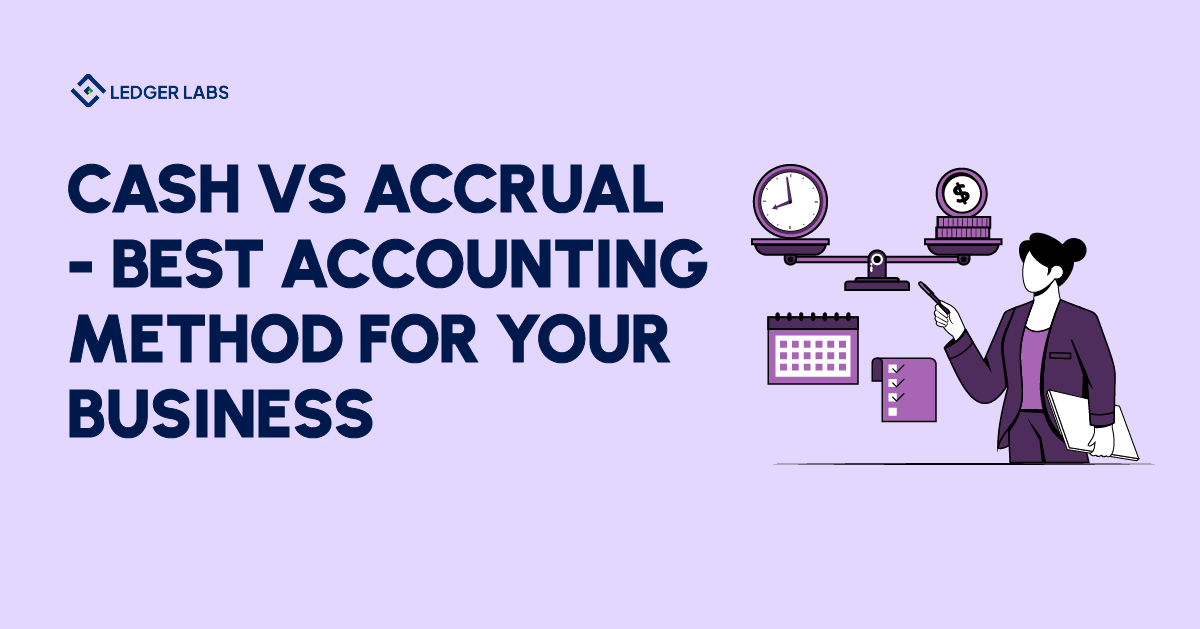
Yet, every business requires different accounting methods. The accounting style you choose affects how you handle each transaction. Whether it is for bookkeeping, accounting, and reporting purposes. this is where the question of which cash vs accrual accounting method to adopt comes from.
In my experience, I have seen that one wrong decision has led to many things. This includes poor cash flow management, increased tax burden for tax purposes, and even failed audits. Hence, for our clients, I conduct thorough research into their business models. According to my analysis, I suggest the best accounting method for our clients.
In this blog post I aim to delve into the intricacies of each approach. Additionally I will equip you with all the details required for making a informed choice.
“Accounting does not make corporate earnings or balance sheets more volatile. Accounting just increases the transparency of volatility in earnings.”
—Diane Garnick, Chief Income Strategist, TIAA
- You must document payments when you make and receive them in cash accounting. We note revenue when we credit money. The same holds true for costs. This remains true regardless of when you rendered or used the service or product.
- Accrual accounting records revenues and costs when they generate or spend them, regardless of when they collect or pay the money.
- The Modified Accrual approach is a compromise between cash basis and accrual accounting, combining simplicity with a comprehensive financial view. The Modified Accrual method takes into account both basic and in-depth analyses of a company’s finances.
- Businesses with revenue of 200k USD or less should adopt for cash basis accounting.
- Businesses with revenue between 200k USD to 5 million USD, should adopt for Modified Accrual method.
- Businesses with revenue of more than 5 Million USD should opt for the Accrual accounting method.
Cash Versus Accrual Accounting Explained
“According to a study by the National Association of State Boards of Accountancy, 78% of small businesses use cash basis accounting. The remaining 22% of small businesses use accrual basis accounting”
When looking at cash basis, you track the money as it comes and goes from your bank account.
Get a payment? Revenue is counted at that time. Pay a bill? That’s when the expense hits.
Simple, Right?
It gives you a pretty accurate picture of your immediate financial situation.
On the flip side, accrual accounting is more intricate. You’re logging income and expenses as they happen, not when the cash shows up or leaves your account.
Say you send an invoice; count that as income before seeing a dime. When you receive bills it’s important to record them as expenses regardless of whether or not you have made the payment
What makes it crucial?
Timing.
You’re noting down things based on actual cash movement on a cash basis. Accrual focuses on economic events, such as selling or receiving a bill, regardless of when money is exchanged.
So you must be wondering why this matters.
Because it does matter!
Each method has its pros and cons. Depending on your business type, one might suit you better. The software tool designs for each method, making your life a tad easier.
Let’s understand each of them:
“72% of small businesses use cash basis accounting.”
-National Federation of Independent Business
Cash accounting records payments as they come and go. The company marks revenue when it credits cash. The same goes for expenses. The timing of the delivery or consumption of the service or product does not matter.
Pros of Cash Basis Accounting
1. Simplicity: It’s easy to understand. You record money when it comes in or goes out.
2. Immediate Cash Flow View: Having an immediate view of your cash flow is crucial for small businesses that operate on thin margins.
3. Less Time-Consuming: Because it’s so straightforward, you don’t need to spend as much time on bookkeeping.
4. Easy to Implement: You don’t need a degree in accounting to get it set up. A simple spreadsheet might be all you need.
Cons of Cash Basis Accounting
1. Lacks Long-Term Perspective: You only see your finances in the here and now, so it can be tough to plan for the future.
2. Not GAAP Compliant: If you want to go public or need to adhere to Generally Accepted Accounting Principles (GAAP) for other reasons, a cash basis won’t be compliant with GAAP.
3. Potential for Revenue Mismatch: You could deliver a service this month and get paid next month, making it tricky to match revenues with expenses accurately.
Accrual Accounting
“In the United States, over 90% of public companies use accrual accounting.”
In accrual accounting, revenues and expenses gets recorded when earned or incurred, regardless of when the cash is received or paid.
Pros:
1. Comprehensive View: A more complete view of your business health is provided, taking into account money owed to you and bills that will need to be paid in the future.
2. GAAP Compliant: If you’re aiming to grow big or already are, this method aligns with what’s generally required for public companies.
3. Better for Planning: Because you’re logging incomes and expenses as they happen, it’s easier to make long-term financial plans and budgets.
4. More Accurate Profit Margins: Accurate recording of revenue and expenses allows for more precise profitability calculation over specific time frames.
Disadvantages of Cash Basis Accounting
1. Complexity: There are more moving parts, like accounts payable and receivable, deferred revenue, etc. That means more time spent on bookkeeping.
2. Potential for Cash Flow Misread: You might see a healthy revenue stream on paper and think you’re doing great, but your actual cash could be low if clients are slow to pay.
3. Resource-Intensive: Typically, you’ll need more sophisticated accounting software or professional help, which could be an issue for a small business.
But what if none of these methods suit your business model?
If none of the above-stated methods suits you, then In this situation, we recommend our client’s Modified Accrual Method of Accounting.
Now you must be wondering:
What is a Modified Accrual method of accounting?
“A study by the Association of Chartered Certified Accountants (ACCA) found that 30% of businesses in the UK use Modified Accrual accounting.”
The Modified Accrual method came about as a compromise between the simplicity of the cash basis and the detailed picture of finances provided by accrual accounting. The Modified Accrual approach considers simple and detailed views of a company’s finances.
How does the Modified Accrual Method of accounting work?
The Modified Accrual method came about as a compromise between the simplicity of the cash basis and the detailed picture of finances provided by accrual accounting. The Modified Accrual approach considers simple and detailed views of a company’s finances.In a Modified Accrual system, the main difference lies in the usage of cash accounting for day-to-day operational expenses, such as utility bills or immediate income like point-of-sale transactions.
You could use accrual accounting for recording revenues and expenses associated with long-term projects or contracts, providing a complete picture of a business’s finances. These are the situations where the cash isn’t received or paid immediately.
This Modified Accrual method also allows for the tracking of accounts receivable, which refers to customer sales made on credit that have yet to be paid.
Who Uses Modified Accrual method of accounting?
Businesses with both types of transactions — immediate and deferred — often find the Modified Accrual method beneficial.
Certain industry practices or regulations sometimes steer a business towards using a Modified Accrual system. Modified Accrual is not accepted under GAAP or for traded companies.
Now let’s understand the pros and cons of Modified Accrual accounting.
Pros and Cons of Modified Accrual Accounting
Pros:
1. Flexibility: Allows you to use cash accounting for some items and accrual for others, giving you the best of both worlds.
2.Tailored Approach: This can be customized to match your business operations better.
3. Moderate Complexity: Easier than full accrual but offers more insight than pure cash accounting.
Cons:
1. Regulatory Hurdles: This may not be allowed for all types of businesses, especially those needing GAAP compliance.
2. Potential for Confusion: Juggling two methods can be confusing and might lead to errors.
3. Increased Bookkeeping: More complex to maintain than either method individually.
But this is individual data; let’s compare all three in a tabular form to understand it better.
Related Articles:
- Accounting Manual: Accounting Policies and Procedures, Best Practices To Consider
- Daily Accounting Tasks – A Must For Every Business
- How to Collect Accounts Receivable Sooner? Let’s Check
- How to Develop a Reliable Cash Flow Projection?
- How to Read a Profit and Loss Statement?
- Overview of eCommerce Accounting – The Small Business Owner’s Guide
What is the best accounting method for a small business?
Determining the accounting method, for a business involves considering several factors, including the business nature, size and financial objectives. However many small businesses often prefer using the cash accounting method as it offers simplicity and suitability by recording income and expenses when they are received or paid.
Comparing Cash vs. Accrual vs. Modified Accrual Method of Accounting
Here’s a detailed comparison of Cash and Accrual accounting methods, complete with examples for each:
Transaction Examples:
- Sale of $500 worth of goods:
- Cash Accounting: Record revenue when $500 is received.
- Accrual Accounting: Record revenue when the goods are sold, even if payment comes later.
- Modified Accrual Accounting: Could choose either based on chosen criteria for revenue recording.
- Purchase $200 in supplies:
- Cash Accounting: Record expense when $200 is paid.
- Accrual Accounting: Record expenses when supplies are received, even if payment comes later.
- Modified Accrual Accounting: Could choose either based on chosen criteria for expense recording.
Now let’s understand it with an example
How cash, accrual & Modified Accrual affect the bottom line
Below is a case study that outlines the financial transactions of a hypothetical company, “TechSolutions LLC,” which offers IT services to clients. We’ll use 15 transactions to highlight how these would be recorded under cash-basis and accrual-basis accounting methods.
Transactions for TechSolutions LLC (Over 2 Months)
- January 1: Secured a contract with Client A for services, invoicing them $10,000 payable within 30 days.
- January 5: Received $5,000 for a different completed project from Client B.
- January 8: Purchased office furniture for $1,500 (paid immediately).
- January 10: Paid monthly rent of $1,200.
- January 15: Completed the services for Client A.
- January 20: Received a $500 electricity bill payable by February 15.
- January 22: Paid employees’ salaries totaling $3,000.
- January 30: Received $10,000 from Client A.
- February 1: Provided services to Client C but have not invoiced them yet; the services are worth $8,000.
- February 5: Spent $2,000 on promoting the business.
- February 10: Paid the $500 electricity bill received in January.
- February 15: Purchased computer equipment for $2,000, payment due in 30 days.
- February 17: Paid phone bill of $100.
- February 20: Invoiced Client C for $8,000, payable within 30 days.
- February 28: Received $8,000 from Client C.
What is the Best Accounting Method for your business?
“Small businesses thrive on simplicity, but complexity sometimes holds the key to growth – that’s where Modified Accrual accounting comes in.”
- Businesses with revenue less than 200K USD annually shall use the cash method of accounting.
- Businesses with sizes 200K– 5M USD shall use the modified accrual accounting mode.
- Additionally, Businesses over 5M USD shall use an Accrual basis of accounting.
- When payment is received on Jan 31 and dispatch occurs on Feb 1, it is important to account for that sale in February, not January (Deflated Sales).
- If you receive money on Feb 28 but dispatch on March 1, that’s a March sale (Inflated Sales).
- These mistakes usually offset each other but should be corrected for accurate accounting.
How do you choose the best accounting method for your business?
“Remember, the right accounting method isn’t just about compliance; it’s about optimizing your financial strategy.”
Which should you choose? Choose cash accounting if you run a small business with few employees and value simplicity. Choose accrual if you want to go public, need GAAP compliance, or are aiming to grow big.
When it comes to selecting the best accounting method for your business there are factors to consider. These include the size of your business the industry you operate in and your financial objectives. It is crucial to seek guidance, from an accountant or financial advisor who can evaluate your requirements and assist you in making the choice, for your business. Understanding these factors can help businesses choose the method that best reflects their financial health and aids in decision-making. Here are the key factors affecting the selection:1. Business Size and Complexity: Smaller businesses, particularly sole proprietorships or businesses with few employees, might opt for cash accounting due to its simplicity. Larger businesses with more transactions, especially those on credit, often use accrual accounting for a more accurate financial picture.2. Regulatory Requirements: Some regulatory bodies or taxation authorities mandate businesses of a certain size or type to use the accrual method. For instance, the IRS requires businesses with annual sales exceeding a particular threshold to use accrual accounting.3. Stakeholder Expectations: External stakeholders, such as investors or lenders, may prefer the accrual method because it provides a clearer long-term view of a company’s financial health.4. Nature of Transactions: Businesses that deal primarily in cash transactions (like certain retail businesses) might lean towards cash accounting.Those with a significant amount of credit transactions or long-term contracts may prefer accrual accounting to match revenues and expenses effectively.5. Financial Goals and Planning: If a business aims for short-term financial tracking and cash flow management, cash accounting might be preferable. Accrual accounting is often the choice for a more comprehensive view of profitability over longer periods.6. Resource Availability: Cash accounting can be less resource-intensive regarding time and expertise. Accrual accounting often requires more sophisticated accounting systems and potentially professional accountants.7. Tax Considerations: Cash accounting allows businesses to report taxes on received income and deduct expenses when paid. This can delay tax liability. Accrual accounting might lead to paying taxes on revenues that have been earned but not yet received.8. Cash Flow Visibility: Cash accounting provides a clear picture since it reflects actual cash flow for businesses wanting direct visibility into cash on hand. Accrual accounting, while offering a comprehensive look at financial health, might not always provide immediate insights into cash flow.9. Flexibility in Recognizing Revenue and Expenses: Accrual accounting provides flexibility in recognizing revenues and expenses, which can be essential for businesses with seasonal operations or cyclical sales.10. Industry Norms: In some industries, it’s standard practice to use one method over the other. Conforming to industry norms can make it easier to compare financials with peers.11. Long-Term Business Goals: Businesses widely accept accrual accounting if they want to grow or become publicly traded.Conclusion
While both methods have merits, the selection typically depends on regulatory requirements, business needs, and financial goals. It’s always a good idea for businesses to seek guidance, from advisors or accountants when making decisions, about the most suitable approach.Ready to Choose the Right Accounting Method for Your Business?
“Almost 72% small businesses uses cash basis accounting whereas, 28% small businesses use Accrual basis accounting”
Choosing the accounting method is a critical decision that can have a significant impact, on your financial prosperity. Don’t go through this journey by yourself! Me and my team is here to assist you every step of the way and ensure that you make the choice for your business requirements.
Frequently Asked Questions
When you make an accrual, you record the money spent as an expense. You also record the amount owed as a liability on the balance sheet.
It depends on what kind of financial needs you have. I personally prefer the accrual accounting method.
A company can use the cash method instead of the accrual method when reporting income for its tax return. It can only have a statement showing the changes in income and costs because of the technique differences.
To make a decision about the most suitable accounting method, for your business it would be advisable to seek guidance from an accountant or a financial advisor. They possess the expertise to evaluate your requirements and recommend the method for you.
Absolutely! You have the flexibility to utilize an accounting method, for your business. It can be a choice when you come across transactions that’re more suitable, for cash accounting and others that align better with accrual accounting principles.
Certainly! You have the flexibility to transition, between cash and accrual accounting methods. However it’s crucial to be mindful of tax implications. It would be wise to seek advice, from an accountant before proceeding with any changes.
Accrual accounting is necessary, in the following scenarios;
1. If your business is publicly traded.
2. If you are obligated to submit GAAP statements for any other purpose.