
You’ve invested in NetSuite, or you’re about to, but suddenly realize you’re staring at a system so complex that one wrong move could cost you thousands.
We’re here to help you avoid that expensive mistake and get your ERP working for your business, not against it.
Did you know that according to Gartner, approximately 70% of ERP implementations fail to meet their stated objectives?
That’s a staggering failure rate, and most of it comes down to one thing: choosing the wrong NetSuite consulting services partner.
In this guide, we’ll walk you through exactly what to look for, what to avoid, and how to make your NetSuite investment pay off.
Key Takeaways
- What NetSuite consulting firms actually do (and which type you need).
- The 5 critical questions to ask before hiring any consultant
- Real cost breakdowns so you can budget accurately
- Red flags that signal a consultant will burn your money
- When your small business should, and shouldn’t, hire help
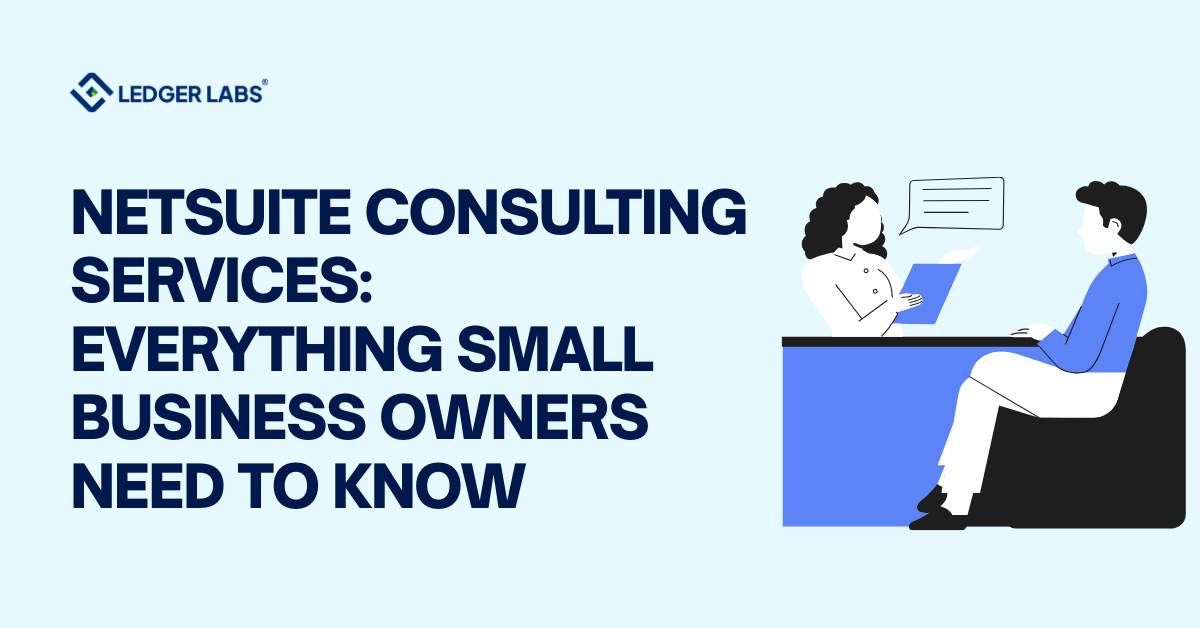
What Are NetSuite Consulting Services and Why Do Small Businesses Need Them?
NetSuite consulting services help businesses implement, configure, customize, and support Oracle NetSuite ERP. A certified consultant guides you through setup, data migration, integrations, and training, ensuring your investment delivers results instead of becoming a six-figure headache.
So why can’t you just do it yourself?
Here’s the hard truth: NetSuite isn’t plug-and-play software. It’s a full-scale ERP system that touches every corner of your business, accounting, inventory, sales, purchasing, and more.
Most small business owners vastly underestimate the complexity involved. You’re not just “setting up software.” You’re redesigning how your entire operation flows. That means mapping business processes, migrating years of data, connecting third-party apps, training your team, and troubleshooting issues that pop up at the worst possible times.
Without expert guidance, here’s what typically happens: you spend months configuring settings you don’t fully understand, migrate dirty data that corrupts reports, and end up with a system your team refuses to use because nobody trained them properly.
A NetSuite consulting firm prevents these disasters. They’ve done this hundreds of times. They know the shortcuts, the pitfalls, and the configurations that actually work for businesses like yours.
What Does a NetSuite Consulting Firm Actually Do?
A NetSuite consulting firm handles everything from analyzing your business needs to supporting you long after go-live. Core services include NetSuite ERP implementation, system configuration, data migration, third-party integrations, user training, and ongoing optimization
Core Services You Should Expect
Here’s what a quality NetSuite implementation consultant delivers:
- Discovery & Requirements Gathering – They analyze your current processes, identify gaps, and document exactly what you need NetSuite to accomplish.
- System Configuration – They set up your chart of accounts, workflows, forms, dashboards, and user roles based on your specific business needs.
- Data Migration – They clean, map, and import your historical data from QuickBooks, spreadsheets, or legacy systems.
- Customization & Development – When standard features don’t fit, they build custom fields, scripts (SuiteScript), and workflows.
- Third-Party Integrations – They connect NetSuite to your existing tools: Shopify, Amazon, Salesforce, payment gateways, and more.
- Training – They teach your team how to actually use the system—not just click buttons, but understand why.
- Post-Go-Live Support – They stick around to fix bugs, answer questions, and optimize performance.
Functional vs. Technical Consultants: What’s the Difference?
| Consultant Type | Focus Area | Skills | When You Need Them |
|---|---|---|---|
| Functional Consultant | Business processes, workflows | Accounting, operations expertise | Requirements gathering, training, process design |
| Technical Consultant | Customization, scripting | SuiteScript, API integration, SuiteFlow | Custom development, complex integrations |
Most small businesses need both. A functional consultant ensures NetSuite fits your operations. A technical consultant builds what doesn’t exist out of the box.
What Services Should You Expect From a NetSuite Consulting Partner?
A reliable NetSuite consulting partner should offer end-to-end services: implementation, configuration, customization, integration, training, and ongoing support. Avoid firms that handle only one phase and leave you stranded.
Implementation & Deployment
NetSuite deployment services cover everything from initial setup to your go-live date. For most small businesses, expect an 8–16 week timeline.
This includes:
- Environment setup and configuration
- Workflow design and automation
- User roles and permission structures
- Testing and validation
Warning: If a consultant promises implementation in less than 6 weeks, ask questions. Rushed implementations breed problems.
Customization & Configuration
NetSuite customization services should focus on adapting the system to your needs rather than over-engineering it. Here’s a critical distinction:
Configuration = Using NetSuite’s built-in tools to adjust settings, fields, and workflows.
Customization = Writing custom code (SuiteScript) when native features can’t do the job.
Over-customization is the number one cause of failed NetSuite implementations. Every custom script needs maintenance. Every custom workflow breaks during upgrades. A good consultant says “no” more often than “yes” because they know that native features require less ongoing work.
Integration Services
NetSuite API integration connects your ERP to the tools you already use. Common integrations include:
- E-commerce: Shopify, WooCommerce, Amazon, BigCommerce
- CRM: Salesforce, HubSpot
- Payments: Stripe, PayPal, Authorize.net
- Shipping: ShipStation, FedEx, UPS
Your consultant should provide a checklist of third-party integrations for NetSuite before starting work.
Training & Ongoing Support
NetSuite support services are important because implementation is just the beginning, not the end.
“Hypercare” refers to the intensive support you get right after going live with the system. This period lasts 30 to 60 days and is when most problems show up. Your team might find gaps in training, discover that reports don’t meet expectations, or see integrations fail when they are used at scale.
A good partner includes hypercare in their quote, while a bad partner says goodbye on launch day.
How Do NetSuite Consulting Services Help E-Commerce and Small Businesses?
For e-commerce and small businesses, NetSuite consulting services automate inventory management, unify sales channels, streamline financial reporting, and eliminate the manual data entry that’s eating your margins.
E-Commerce Businesses
If you’re selling on multiple platforms, Shopify, Amazon, and your own website, you already know the chaos of managing inventory, orders, and fulfillment across disconnected systems.
NetSuite for e-commerce solves this by:
- Centralizing inventory across all channels in real-time
- Automating order management from purchase to shipment
- Syncing financial data so you stop reconciling spreadsheets
A skilled consultant configures these integrations properly the first time. They prevent duplicate orders, oversold inventory, and mismatched records that plague DIY setups.
Manufacturing & Wholesale
NetSuite inventory management handles complexities that QuickBooks simply can’t touch:
- Work orders and assemblies
- Multi-location warehouse tracking
- Demand planning and forecasting
- Lot tracking and serial number management
For manufacturers, a consultant ensures your bill of materials, production workflows, and inventory costing methods are configured correctly from day one.
Service-Based Businesses
Even if you don’t sell physical products, NetSuite CRM consulting helps service businesses:
- Track client relationships and communications
- Manage projects and timelines
- Recognize revenue according to ASC 606 standards
- Generate accurate profitability reports by client or project
Financial Management for All
At its core, NetSuite financial management gives you what every business owner wants: real-time visibility into cash flow.
- General ledger with multi-currency support
- Accounts receivable and payable automation
- Cash flow forecasting dashboards
- One-click financial statements
No more waiting until month-end to know if you’re profitable.
How Do You Choose the Right NetSuite Consulting Company?
Choose a NetSuite consulting company based on five criteria: certifications, industry experience, post-implementation support, transparent pricing, and verifiable client references. Avoid firms that say “yes” to everything; they’re building technical debt, not solutions.
5 Questions to Ask Before Hiring
Before you sign any contract, get answers to these:
Q1. Are you a certified NetSuite consultant or solution provider?
Certification proves baseline competency. Ask for proof.
Q2. Do you have experience in my industry?
A consultant who’s implemented NetSuite for 50 manufacturing companies will solve your problems faster than a generalist learning on your dime.
Q3. What’s included in post-go-live support?
If the answer is vague, walk away. You need specifics: hours, response times, duration.
Q4. Can you provide client references I can actually contact?
Not testimonials on their website. Real phone numbers.
Q5. How do you handle scope changes and budget overruns?
Every project has surprises. You need to know how they bill for them.
Red Flags to Watch For
These warning signs predict disaster:
- High consultant turnover – If your project manager changes every month, nobody owns your success.
- No documentation – If they can’t show you a Solution Design Document (SDD), they’re winging it.
- “Yes” to everything – Good consultants push back. If they agree to every request, they’re building a monster that will collapse under its own complexity.
- No industry expertise – A consultant who’s never worked with e-commerce businesses doesn’t understand your integration needs.
- Vague pricing – If they can’t give you a range, expect scope creep and surprise invoices.
Certifications That Matter
NetSuite Solution Provider vs. Alliance Partner:
- A Solution Provider can sell NetSuite licenses AND provide implementation. One-stop shop.
- An Alliance Partner provides implementation but can’t sell licenses directly.
Both are certified by Oracle. The difference is in the business model, not competency.
Individual consultants should hold certifications like SuiteFoundation, ERP Consultant, or Administrator.
How Much Do NetSuite Consulting Services Cost?
NetSuite consulting services typically cost $150–$250 per hour for US-based firms, with full implementations ranging from $25,000 to $100,000+, depending on complexity. Offshore consultants charge $40–$80 per hour but often require more oversight.
| Service | Typical Cost Range | What’s Included |
|---|---|---|
| Small Business Implementation | $25,000–$50,000 | Configuration, data migration, basic training |
| Mid-Market Implementation | $50,000–$150,000 | Custom development, multiple integrations, advanced training |
| Hourly Consulting (US-Based) | $150–$250/hour | On-demand support, optimization, and troubleshooting |
| Hourly Consulting (Offshore) | $40–$80/hour | Development work, admin tasks (may require more oversight) |
| Managed Services (Monthly) | $2,000–$10,000/month | Ongoing support, maintenance, optimization |
Hidden Costs Nobody Tells You About
Watch out for these budget-busters:
- Scope creep and change orders: Every “small” request adds up. Get clear documentation on what’s included upfront.
- Over-customization maintenance: Custom scripts break during NetSuite’s biannual upgrades. Budget $5,000–$20,000 annually for maintenance if you’ve made significant customizations.
- Rescue projects: If your first implementation failed, fixing it costs 50%–150% of what you originally paid. Doing it right the first time is always cheaper.
- Training cuts: Consultants often reduce training to hit budget targets. Then your team doesn’t use the system correctly, and you pay for remediation later.
Calculating Your ROI
Here’s a simple formula:
ROI = (Time Saved × Hourly Cost) + (Errors Avoided × Cost Per Error) – Total Investment
Example: A $50,000 implementation that saves 20 hours weekly at $50/hour = $52,000 annual savings. Add avoided errors from manual data entry (let’s say $10,000 in prevented mistakes), and your first-year ROI exceeds 20%.
Most well-implemented NetSuite deployments pay for themselves within 12–18 months.
What Does the NetSuite Consulting and Implementation Process Look Like?
The NetSuite implementation process follows five phases: Discovery, Design, Build, Test, and Deploy. Most small business implementations take 8–16 weeks from kickoff to go-live.
Step-by-Step Implementation Process
Step 1: Discovery & Requirements (Weeks 1–2)
Your consultant conducts intensive interviews with stakeholders across departments. They document:
- Current business processes and pain points
- System requirements and must-have features
- Data sources and migration needs
- Integration requirements
Deliverable: A Requirements Document that serves as your project blueprint.
Step 2: Solution Design (Weeks 3–4)
Based on discovery, your consultant creates:
- System configuration specifications
- Custom development scope (if needed)
- Integration architecture
- Data migration plan
Deliverable: Solution Design Document (SDD) that you approve before building begins.
Step 3: Build & Configure (Weeks 5–10)
This is where the real work happens:
- NetSuite system configuration (chart of accounts, workflows, forms)
- Custom fields and scripts development
- Integration connections built and tested
- Data cleansing and staging for migration
Step 4: Testing & Validation (Weeks 11–13)
Your team gets hands-on:
- User Acceptance Testing (UAT) involves your staff testing real-life scenarios.
- Data migration testing verifies that historical data is imported correctly
- Integration testing confirms third-party systems sync properly
- Performance testing ensures speed meets expectations
Step 5: Go-Live & Hypercare (Weeks 14–16)
The big moment:
- Final data migration (cutover)
- System goes live for daily operations
- Intensive user training
- Hypercare period: 30–60 days of high-touch support
If issues emerge (they will), your consultant is on call to resolve them immediately.
When Should Your Small Business Hire a NetSuite Consultant?
Hire a NetSuite consultant when you’re outgrowing QuickBooks, implementing NetSuite for the first time, recovering from a failed implementation, or need to integrate multiple sales channels without breaking your existing operations.
Signs You Need a NetSuite Consultant
If any of these sound familiar, it’s time to call for backup:
- You’re spending 20+ hours monthly on manual workarounds – Copying data between systems, reconciling spreadsheets, and fixing sync errors.
- Your current system can’t handle multi-channel inventory – Selling on Amazon, Shopify, and wholesale? QuickBooks wasn’t built for that.
- You’re preparing for an audit, acquisition, or funding round – Investors and acquirers expect clean financials in a real ERP system.
- Your implementation partner disappeared post-go-live – You went live six months ago, and now you’re drowning in issues with nobody to call.
- You’re experiencing data silos across departments – Sales can’t see inventory. Finance can’t see project costs. Everyone’s working from different numbers.
Conclusion
Implementing NetSuite without expert help is risky for small businesses. Half of all ERP projects fail to achieve their goals, mainly because businesses pick the wrong consulting partner or don’t hire one at all.
This guide explains what you need to know: NetSuite consulting firms provide implementation, configuration, customization, integration, training, and ongoing support. For e-commerce and small businesses, the right consultant helps eliminate manual tasks, unifies sales channels, and provides real-time financial insights. You should expect to invest between $25,000 and $75,000 for a quality implementation, which usually takes 8 to 16 weeks.
Before hiring a consultant, ask about their certifications, industry experience, post-launch support, and client references you can contact. Be cautious of warning signs like frequent consultant changes, unclear pricing, and a “yes to everything” attitude; these can indicate future problems.
At The Ledger Labs, we focus on NetSuite implementations for e-commerce and small businesses. We help you avoid costly mistakes and create a system that gives you measurable returns on your investment.
Schedule a free NetSuite consultation today and get our Consultant Vetting Checklist, no obligation, just honest advice.
FAQs
Q: How much do NetSuite consulting services cost for small businesses?
NetSuite consulting services for small businesses typically range from $25,000 to $75,000 for full implementation. Hourly rates run $150–$250 for US-based consultants and $40–$80 for offshore teams. Costs vary based on complexity, customization needs, and integration requirements.
Q: How long does a NetSuite implementation take?
Most small business NetSuite implementations take 8–16 weeks from kickoff to go-live. Complex implementations with multiple integrations or heavy customization can extend to 6–9 months. Projects exceeding 12 months typically indicate scope creep or planning failures.
Q: What’s the difference between a NetSuite Solution Provider and Alliance Partner?
A NetSuite Solution Provider can sell licenses AND provide implementation services. An Alliance Partner provides consulting but can’t sell licenses directly. Both are certified by Oracle—the difference is business model, not expertise level.
Q: Can I implement NetSuite without a consultant?
While technically possible for very simple setups, implementing without a consultant is not recommended. According to Gartner, roughly 50% of ERP implementations fail to meet objectives, and a lack of expertise is a leading cause. The cost of fixing a failed implementation typically exceeds the cost of hiring a consultant upfront.
Q: What should I do if my NetSuite implementation failed?
If your implementation failed, consider hiring a different firm specializing in “NetSuite rescue” projects. These specialists audit your setup, identify issues, and create a remediation plan. Expect rescue projects to cost 50%–150% of your original implementation budget.