
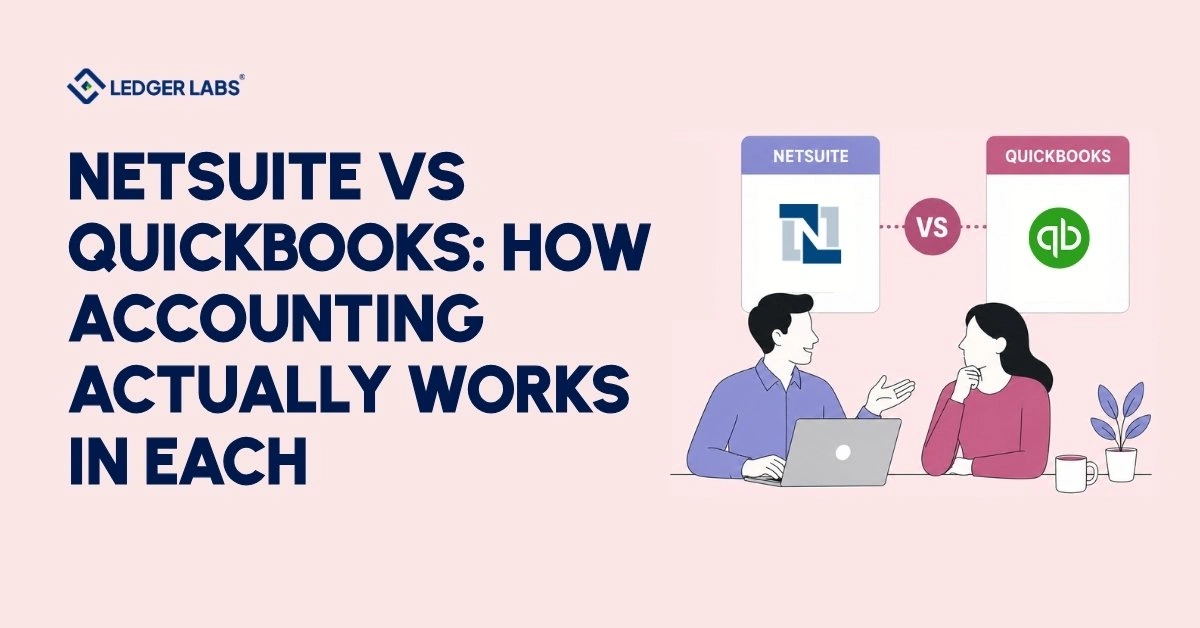
QuickBooks and NetSuite are not two sizes of one system. QuickBooks keeps each business in its own company file and lets posted history be edited; NetSuite consolidates entities, runs revenue recognition on a schedule, and records every change to a posted transaction in its audit trail. The choice is an accounting decision (how many entities you close, how fast you close them, what controls you need), not a feature comparison.
If you are exporting to spreadsheets to consolidate, re-cutting revenue schedules by hand, or waiting into the second week of the month for numbers you would stake a decision on, that is the QuickBooks ceiling, not a setting you have missed.
This page sets out what each edition does at the ledger level, what QuickBooks Enterprise does and does not remove, what the move actually costs, and the five signs that decide it.
By the end, you will know which system fits your entity count, your close and your controls today.
Key Takeaways
- It’s an accounting decision, not a software one; the right choice depends on your entities, close speed, and controls, not features.
- QuickBooks is right until it isn’t, for a single entity under ~$1M with clean books, switching early just wastes money.
- The ceiling is structural, not fixable, manual consolidation, manual rev-rec, and editable history are limitations that no QuickBooks edition, including Enterprise, removes.
- NetSuite is a different engine, not a bigger QuickBooks. Native multi-entity consolidation, automated revenue recognition, and a real-time ledger are what you’re buying.
- The real cost is staying too long. QuickBooks gets pricier as you grow; NetSuite costs more upfront, less per dollar at scale.
- If three of the five signs fit, the decision is made: multiple entities, slow close, Excel exports, manual rev-rec, or upcoming diligence.
NetSuite vs QuickBooks accounting: the decision table
Here’s what you are really deciding between. This is based on the accounting functions that matter, not just on surface features.
| Accounting Function | QuickBooks Online | QuickBooks Enterprise | NetSuite |
|---|---|---|---|
| Best for | Single entity, <$1M, simple books | Single entity, inventory-heavy, <~$10M | Multi-entity, $2M–$50M+, scaling fast |
| Chart of accounts | Capped account/class limits | Higher limits | Unlimited + custom segments/dimensions |
| Multi-entity & consolidation | Not native (manual/spreadsheet) | Not native | Native, automated |
| Revenue recognition (ASC 606) | Manual | Manual / add-on | Native, automated |
| Month-end close | Days, manual | Days, manual | Hours, automated workflows |
| Audit trail & controls | Limited, editable history | Moderate | Full, role-based, immutable |
| Financial reporting | Standard reports | Standard + some custom | Real-time, multi-dimensional |
| Pricing (verify) | ~$35–$235/mo | ~$1,900+/yr | Custom quote, typically $10K+/yr all-in |
The table shows which option to choose. This guide explains why staying on the wrong system can cost you.
Where does QuickBooks accounting stop?
QuickBooks isn’t a single product, and treating it as such is how companies end up on the wrong tier. Here’s where each edition’s accounting hits a ceiling for a growing business.
QuickBooks Online
QBO is designed for simple bookkeeping for a single business. It works well for invoicing, tracking expenses, handling bank feeds, and standard financial reports. For most companies earning under $1 million, this is usually sufficient.
Problems arise when you add a second legal entity, need more detailed reporting, or want a closing process that doesn’t rely on one person remembering each step. Limits on accounts and classes, no built-in consolidation, and the ability to edit transaction history mean that as things get more complex, your team may start creating workarounds outside the system. This can lead to your financial data ending up in spreadsheets.
QuickBooks Desktop
Desktop software offers better depth but is becoming outdated. It has limitations, such as no built-in way to combine data from multiple entities and controls that don’t support the finance team’s need for separating duties. If your accountants work remotely or you need immediate visibility, using Desktop may create more challenges.
QuickBooks Enterprise
Enterprise offers higher limits, more accounts, more users, and a larger inventory. For businesses with significant inventory needs, QuickBooks Online (QBO) may be less beneficial than QuickBooks Online (QBO). However, it does not address key issues that lead companies to switch to NetSuite.
You still have to manually consolidate data, find workarounds for revenue recognition, and go through a manual closing process. Enterprise gives you some extra space, but not a better accounting system. Many businesses pay extra for Enterprise to delay making a final decision, only to switch to NetSuite after about 18 months, ultimately paying for both systems.
What does NetSuite's accounting give you that QuickBooks can't?
NetSuite is not just “QuickBooks with more features.” It works on a different accounting system, which is what you are paying for.
With NetSuite, you get a real-time general ledger. This means every transaction is recorded and reported immediately, so there’s no waiting for batches or syncing. It also supports multiple entities, handling subsidiaries, intercompany eliminations, and consolidated financials within the system, rather than using a separate spreadsheet.
You benefit from role-based controls and a complete audit trail that shows who made changes, when they were made, and the permissions that ensure tasks are properly separated. Plus, it offers multi-dimensional reporting, allowing you to view the same financials by entity, department, location, product line, or any custom category without needing to recreate the report.
For growing companies, this means you can close your books faster, trust your numbers when presenting to a board or lender, and scale your finance function without needing to hire extra staff for each new entity. Our NetSuite accounting team implements and manages this process for growing clients.
The accounting gaps that cost you as you scale
This is where we get into specifics. Below are the areas where QuickBooks can cost you money, time, or increase your risk as your business grows. In these areas, NetSuite offers better solutions.
Chart of accounts & dimensions - the reporting you can't get
QuickBooks can generate reports by account, class, and location. In contrast, NetSuite offers account-level reports and unlimited segments, including department, product, region, and project. The limitations of QuickBooks become clear when a board member requests profit margins by product line, as you need to export the data to Excel to generate this report.
Journal entries & automation - the hours your team loses
Recurring accruals, allocations, and intercompany entries are manual in QuickBooks. NetSuite automates them with schedules and rules. Multiply a few hours per close across twelve months and a growing entity count, and the labor cost alone starts to rival the software difference.
Multi-entity & consolidation - the spreadsheet that breaks
This is the single most common reason our clients leave QuickBooks. Each entity is a separate QuickBooks file; consolidation happens in a spreadsheet that one person owns and everyone fears. NetSuite consolidates natively with automated intercompany eliminations. The spreadsheet doesn’t just cost time; it’s a material misstatement waiting to happen.
AP / AR workflows - the cash you collect late
QuickBooks handles basic AP/AR. NetSuite adds approval routing, automated dunning, and real-time aging across entities. Faster, more disciplined collections pull cash forward, which, for a growing company, is often worth more than the cost of software.
Revenue recognition - the compliance exposure
If you have subscriptions, contracts, or multi-element deals, ASC 606 compliance in QuickBooks is manual and error-prone. NetSuite automates recognition schedules. The cost of getting this wrong isn’t hours; it’s a restatement or a failed audit.
Month-end close - the days you can't afford
A QuickBooks close for a multi-entity company commonly runs a week or two of manual work. NetSuite’s automated close workflows pull that to days or less. Every day of delay is a day you’re steering the business on last month’s numbers.
Audit trail & controls - the risk in your numbers
The QuickBooks transaction history is editable, and its permissions are coarse-grained. NetSuite gives you an immutable audit trail and granular, role-based access, the controls a lender, investor, or auditor expects to see. As you raise capital or prepare for diligence, this stops being optional.
Reporting & visibility - decisions made blind
QuickBooks reporting is periodic and flat. NetSuite is real-time and multi-dimensional. The cost of flat reporting is that every decision you make is a few weeks late or a layer too shallow.
5 signs your accounting has already outgrown QuickBooks
You don’t need all five. If three of these apply to your situation this month, you’re already paying a price for staying. This can show up as time spent on finances, late payments, or hidden risks.
- You manage more than one business, and “consolidation” means creating a spreadsheet. Each QuickBooks file is separate, and someone on your team manually combines them every month. This spreadsheet is not only slow; it also has the highest chance of being incorrect when you present it to a lender.
- Your close takes more than five business days, or lives in one person’s head. If month-end depends on a single controller remembering the sequence, you don’t have a process; you have a key-person risk steering the business on stale numbers.
- You export to Excel to get the reports leadership actually asks for. Margin by product line, revenue by region, and spend by department are all real questions that require a manual export. QuickBooks has stopped reporting for you and started reporting against you.
- Revenue recognition, inventory, or multi-currency is handled manually. Manual ASC 606 schedules and workaround inventory valuation aren’t sustainable; they’re a restatement waiting for the wrong quarter.
- You’re heading into a raise, an audit, or a sale, and your controls won’t survive due diligence. Editable transaction history and coarse permissions are fine until an investor or auditor looks closely. Then they’re a problem you can’t fix retroactively.
QuickBooks can help you save money, but it may end up costing you. If your business has this problem, the issue is not if you should switch, but when.
What does each ERP actually cost you?
The sticker price is the smallest number in this decision, and it’s the one most comparisons end with.
QuickBooks looks cheap, and at the license level, it is. QBO runs roughly per month; Enterprise is a few thousand a year. But the license was never the real cost. The real cost is everything QuickBooks makes you do by hand as you grow:
- Finance labor, the close hours, the consolidation spreadsheet, the manual journal entries, someone rebuilds every month
- Delayed cash, invoices that age because there’s no automated AR follow-up
- Risk, uncontrolled, editable books that won’t survive an audit or diligence
- The eventual migration, which gets bigger and more expensive the longer you wait
Each of those grows with your revenue and the number of entities you have. A “$200-a-month” system that costs your controller two weeks a month and delays a raise is not cheap.
NetSuite is a larger, custom-quoted investment, all-in, including implementation. But the honest comparison isn’t license-to-license. Its total cost of ownership:
| Factor | QuickBooks (True Cost) | NetSuite (True Cost) |
|---|---|---|
| Software | Low | Higher |
| Finance labor at scale | High (manual close, consolidation) | Lower (automated) |
| Cash flow impact | Slower collections | Faster collections |
| Compliance/audit risk | Rising with complexity | Controlled |
| Cost trajectory | Climbs as you grow | Flattens as you scale |
QuickBooks is cheap to start, but it becomes more expensive as your business grows. In contrast, NetSuite requires a higher upfront cost but becomes more affordable per dollar of revenue as you scale. The turning point is where the five signs mentioned earlier apply to your situation.
The key question is not “Which is more expensive?” but rather “What is it costing me to stay on QuickBooks too long?”
For many companies that have passed the turning point, it makes financial sense to switch. Waiting only increases costs now with workarounds and later with a more complex migration. Our breakdown of NetSuite implementation costs shows the actual numbers.
When is QuickBooks still the smarter spend?
We migrate companies to NetSuite for a living, and we’ll still tell you to stay on QuickBooks if:
- You’re a single entity with ~$1M or less and straightforward books.
- Your close already runs smoothly in a few days.
- You don’t have multi-entity, revenue recognition, or heavy inventory complexity.
- You’re not heading into a raise, audit, or acquisition.
If that’s you, NetSuite is more system than you need today, and the spend won’t earn its return yet. The right move is keeping QuickBooks clean and well-run, which our QuickBooks bookkeeping team does for growing companies until the day the switch makes sense.
Switching your accounting to NetSuite
Most owners worry about the migration process, but it becomes easier when accountants handle it instead of just software implementers.
To ensure a smooth migration, follow these steps:
- Start with a clean slate: Revise the chart of accounts based on the dimensions you will actually use for reporting, rather than migrating it as is. This step is crucial for avoiding problems later.
- Migrate continuously: Transfer historical balances and open transactions on a timeline that allows you to keep closing the books throughout the process. There should be no blackout periods.
- Go live with an experienced team: Make sure configuration, controls, and training are in place before going live, so your finance team can learn the system without the pressure of closing the month.
Most problems stem from two main mistakes: either moving a disorganized chart of accounts without making changes, or choosing a partner who lacks accounting knowledge, even if they know the software.
To make sure your migration is well-planned and successful, avoid these pitfalls. Migrations can be costly, so it’s important to get it right. This is the difference between a service provider and a CPA firm handling the migration: we make sure the books are accurate, not just moved.
Conclusion
Which should you choose? Choose NetSuite if you have added a second legal entity, need more detailed reporting, or want a close that does not depend on one person remembering each step. Choose QuickBooks if your business is small and has a single entity, where it is a cost-effective solution.
When choosing between NetSuite and QuickBooks, it’s not just about features; it’s about your accounting needs. QuickBooks works well for simple, low-cost bookkeeping for a single entity. However, if your business grows and adds more entities, month-end closings can take over a week, leading to increased manual work and unreliable numbers.
NetSuite may seem costly, but it can save you money as your business grows by reducing manual tasks and risks. Delaying the switch could mean paying twice: once for inefficiencies now and again for a complicated migration later.
If you see issues in your month-end process, you’ve likely made your decision; it’s just a matter of timing. A CPA can provide insights that matter more than a software demo since the right choice depends on your specific situation.
Our accounting firm works with both QuickBooks and NetSuite. We can help you find the best fit for your business and explain what switching involves if the time is right.
Book a free consultation with us to make this decision together.
Where we stand
Ledger Labs provides accounting services on both NetSuite and QuickBooks, so we have a commercial interest in this comparison.
Who we are the right fit for, and what each monthly plan includes, are on our pricing page.
FAQ
Is NetSuite's accounting worth the cost over QuickBooks?
If your business is small and has a single entity, QuickBooks is a cost-effective solution. For companies managing multiple entities or dealing with slow, manual financial processes, investing in a more advanced system can be worthwhile. The savings in finance staff time, faster cash collection, and lower compliance risks generally offset the extra cost.
What's the real difference between NetSuite and QuickBooks accounting?
QuickBooks is a bookkeeping system for one business, while NetSuite is an accounting system for multiple businesses. NetSuite enables easy consolidation of financials, automates revenue recognition, provides real-time reporting, and offers robust control features. The differences are especially clear during the month-end close and when creating consolidated reports.
How much does each actually cost?
QuickBooks runs from a low monthly subscription (Online) to a few thousand a year (Enterprise). NetSuite is custom-quoted, all-in. The higher cost is usually due to workarounds for staying on the wrong system, not the license.
Can a CPA firm run our NetSuite for us?
Yes. We implement NetSuite and then run the accounting on it — close, consolidation, reporting, and controls — as your outsourced finance team, so you get the platform and the people who know how to use it.