
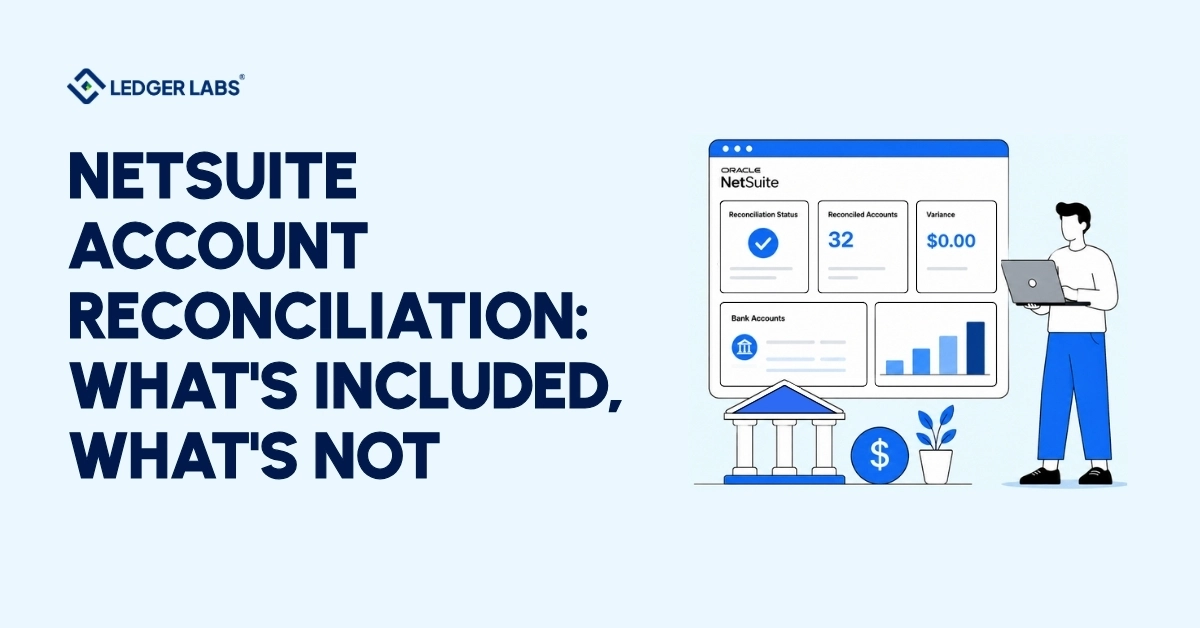
NetSuite automatically reconciles cash for you. It matches bank and credit card transactions at no extra cost. However, the other five areas of your balance sheet, including receivables, payables, inventory, intercompany, and accruals, are reconciled manually by someone using a spreadsheet. NetSuite Account Reconciliation (NSAR) is the separately licensed product that brings those five inside the system.
This impacts finance teams. You can close your books on time because the bank account reconciles easily, leading you to assume the rest of the balance sheet is also accurate. But then discrepancies may arise, like an accrual carried over for three quarters or an unapproved intercompany balance, forcing you to trace back eighteen months of activity while your auditor waits.
To fix this, start by writing down every balance sheet account. Identify the source for each reconciliation and assign two people: one to prepare and one to review. This list forms your reconciliation function. Everything else, like native matching, NSAR, or spreadsheets, just supports that function.
By getting this list right, you can avoid surprises in your close. You’ll understand which accounts are risky, which have clear sources, and which need attention.
This clarity will help you decide if a licensed module solves your problem or just automates a gap. Start by figuring out why your close keeps getting delayed.
Key Takeaways
- NetSuite reconciles cash automatically; receivables, payables, inventory, intercompany, and accruals depend entirely on someone remembering to do them.
- Account reconciliation covers six categories, and each one agrees to a different supporting source you have to name yourself.
- A reconciliation nobody reviewed is documentation, not a control, no matter which NetSuite product produced it.
- NetSuite’s reconciliation reports update after the fact, so a close you signed in October can quietly change by February.
- Review capacity breaks before reconciliation volume does, and buying software will not create a second qualified reviewer.
- Payment processor settlements need a clearing account you reconcile monthly, not a matching rule at the bank line.
Why Your NetSuite Close Keeps Slipping on Reconciliations?
Your NetSuite close slips because you formalized cash reconciliation and left the rest to memory. The bank account has a statement, a deadline, and an assigned person, but receivables, payables, inventory, intercompany, and accruals lack these. This leads to unnoticed differences that eventually affect your profit and loss statement.
When you ask your controller why last month took longer, you may get an account name. Ask again in three months, and you might hear a different name. The account changes, but the issue stays the same.
NetSuite is trickier than other systems because its reconciliation reports update continuously. If you edit, void, or add a transaction in a closed period, the historical reconciliation changes without you knowing. The close approved in October might look different in February. If no one saved the reconciliation summary, you won’t have a reference to check when your opening balance doesn’t match, making it hard to identify which month caused the issue.
Another problem is that teams reconcile accounts but often can’t explain what each one was reconciled against. Receivables might match the aging report, payables might agree with the vendor subledger, and inventory might align with the physical count. Skipping this step means your reconciliation relies on two numbers that someone decided were “close enough,” which can cause issues when an auditor asks for proof.
You notice the close-cycle days, but the real issue is that you treat reconciliation as a cash task instead of a balance sheet task, with no clear source for most accounts.
So, what is this costing you?
What Unreconciled Accounts Actually Cost You?
Unresolved accounts cost you in three measurable ways: the hours your team spends figuring out ongoing differences, the extra days those investigations add to each closing period, and the professional fees you pay when an auditor or buyer discovers what you missed. The first two costs happen every month, while the third is a one-time expense that can hit you hard.
To better understand the impact of reconciliation issues, take a moment to calculate your own numbers. It only takes two minutes.
First, evaluate the time spent on investigating discrepancies. If you spot a difference within the same month, resolving it takes one to two hours, as the details are fresh. However, if you find the same issue four months later, expect to spend more time sifting through archived emails and contacting a vendor likely lacking records. Count how many stale discrepancies your team addressed last quarter and multiply that by the hours spent on each.
Next, examine costs during the closing cycle. Any reconciliation not completed by the close date delays the process. If these unscheduled reconciliations add even two days to each close, that totals 24 lost days annually for your controller, who should focus on forecasting instead. This also means your management accounts will be 48 hours late each month.
Lastly, consider unexpected expenses. If an auditor finds unsupported accounts during reviews, it extends the audit process and raises costs. Unclear items during due diligence can lead to purchase-price adjustments that negatively affect you.
Add these three costs together to see how much your team spends on informal reconciliations each year. Many teams find this number surprising, not because it’s high, but because it reveals unexamined decisions.
What Account Reconciliation in NetSuite Actually Covers?
Account reconciliation in NetSuite involves six categories: bank, receivables, payables, inventory, intercompany, and accruals or prepaids.
Each category corresponds to a specific source: bank statements for bank reconciliation, aging reports for receivables, vendor subledgers for payables, physical counts for inventory, counterparty entities for intercompany, and underlying schedules for accruals or prepaids.
NetSuite handles bank reconciliation, while you manage the other five categories using a spreadsheet.
If you would rather not reconcile receivables, payables and inventory by spreadsheet, our NetSuite bookkeeping services tie them to NetSuite on a fixed calendar and document open items.
For the bank and credit-card side on its own — matching imported lines on Match Bank Data and finalising the period on Reconcile Account Statement — see NetSuite bank reconciliation: how to set it up right and close faster.
| Category | Agrees To | How Often | Where It Happens |
|---|---|---|---|
| Bank & Credit Card | Bank statement or feed | Monthly, daily with Bank Feeds | Inside NetSuite |
| Receivables | AR aging report | Monthly | Spreadsheet |
| Payables | Vendor subledger or supplier statements | Monthly | Spreadsheet |
| Inventory | Physical count or inventory subledger | Monthly or quarterly | Spreadsheet |
| Intercompany | Counterparty entity balance | Monthly | Spreadsheet |
| Accruals & Prepaids | Supporting schedule | Monthly | Spreadsheet |
Look at the second column; one thing is clear. Your bank statement comes automatically on a predictable date, while other sources require someone to fetch the information. This difference is why you reconcile your bank account every month, but not the other five accounts.
Now, check the fourth column, where the risk lies. When you reconcile accounts in a spreadsheet, your ledger doesn’t reflect that action. There’s no due date or status update to show if a comparison was made. The period closes whether you reviewed, quickly checked, or skipped the accounts receivable reconciliation. The outcome relies on someone’s memory.
That’s also how the adjusting entry ends up orphaned. You may find a $6,200 difference in Excel and then enter it in NetSuite. The entry is in your ledger, but the justification is in a folder. There’s no connection between them, so if someone asks why that journal entry exists, you’ll be searching through a shared drive.
Bringing those five categories into NetSuite is what NSAR is for, and it requires a separate license. The following sections will cover whether you need it. First, we’ll discuss what doesn’t require a license.
Three Decisions No Software Makes for You
Reconciliation involves three key decisions that NetSuite does not handle: which accounts to include, what each balance should match, and who can review it. The software automates comparisons, but you must decide what to compare, what it compares against, and who will do the comparing.
Get these decisions right, and the native NetSuite tools are sufficient for most companies. Get them wrong, and NSAR will only speed up the same problems.
Which accounts belong on your reconciliation list?
Choosing which accounts to reconcile is about evaluating risk, not just following a system. Accounts that have a significant chance of misstatement need to be reconciled every month. Those that don’t need that level of attention can be reconciled less often.
At most companies, this decision isn’t written down, so the reconciliation process often defaults to what the previous controller did. This means it’s based on their habits instead of your identified risks.
Start with every account on the balance sheet, then remove the ones you can justify excluding. This process will take about an afternoon, but it’s the most valuable time you’ll spend in this whole process.
What does each balance agree to?
Every account needs a named source to support it, and someone must keep it updated. An accrued liability follows a specific schedule. If nobody owns that schedule, automating the comparison just gives you a workflow for reconciling a number to nothing.
Takeovers often reveal significant issues here. The reconciliation is done, filed, and appears complete. However, it may only match a spreadsheet someone created in 2023 that has not been updated since.
Who is qualified to review it?
A system can require a second person to approve. However, it can’t guarantee that this person will notice a mistake in the inventory balance. Approval is just a click. A review involves judgment, and judgment needs someone who understands what the numbers should look like.
Most teams of your size have only one person with that understanding, and that same person often prepares the reconciliation. Adding a second qualified reviewer is a hiring decision, not a software one, which is why some teams bring in an outsourced NetSuite accountant for the review layer instead of expanding headcount.
Write down all three answers before you assess any software. If you can’t, then the software isn’t your issue.
Do You Need NetSuite Reconciliation Automation?
You need reconciliation automation when your workload exceeds what a manual process can handle reliably. Look for five signs that indicate it’s time for automation. If you’re not at that point yet, native matching and a written checklist can offer the same control for free. The license adds to your existing NetSuite costs and scales with your users and entities. The key question is not Run your own count as you read. If four of the five sit on the manual side, software isn’t your answer.
Reconciliation count is the obvious measure and the least decisive. Forty accounts on a schedule is a workload you can staff. Forty accounts nobody scheduled is a risk, and no module fixes that until you’ve built the list.
Entity count moves the needle faster than anything else here. You can’t reconcile an intercompany balance from inside one subsidiary’s view. Every entity you add multiplies the pairings somebody has to agree, and that arithmetic breaks a manual process long before account volume does.
Close-cycle length matters because compression removes your slack. A ten-day close absorbs a late reconciliation. A four-day close doesn’t. When you shorten your close for a lender or a board, the days come out of reconciliations first.
Review capacity is the measure teams get wrong. Two people can prepare forty reconciliations. Those same two cannot have one prepare while the other meaningfully reviews all forty inside a four-day close.
Buying software doesn’t fix that. It enforces that a second person clicks approve; it has no opinion on whether they looked. Teams that automate before they have review capacity reach unreviewed reconciliations faster.
An audit or lender requirement overrides the other four. Once someone outside your business tests whether reconciliations were completed, reviewed, and kept, central evidence stops being a convenience.
Count yours. If four of the five sit on the manual side, you don’t have a software problem – you have a process nobody has written down, and nobody owns.
Reconciling Stripe, PayPal, and Amazon Settlements in NetSuite
To reconcile payment processor deposits, use a clearing account instead of matching transactions on your bank statement. Processors deposit a net amount: total sales minus fees, refunds, chargebacks, and reserves.
This amount won’t match any single entry in your records. You record sales in the clearing account, then transfer the net deposit out. You reconcile the clearing account balance each period. If you run ecommerce on NetSuite, this reconciliation often causes issues.
Why does a settlement deposit never match a GL transaction?
A settlement deposit never matches because it nets several days of orders against four categories of deduction before it reaches your bank. Say $51,200 in orders settles down to roughly $47,000 after processing fees, refunds, and a rolling reserve, illustrative figures. Nothing in your ledger equals $47,000.
So teams do one of three things, and all three come back later. They exclude the bank line. They plug the difference. Or they route it to a suspense account that grows every month and shows up in diligence as an unexplained balance.
What should your clearing account balance be?
Your clearing account balance should equal what the processor is holding for you at period end, orders captured but not yet settled, plus any reserve. That figure comes from the processor’s settlement or reserve report, and that report is your supporting source. Not your bank statement.
Reconcile against it monthly, and most differences resolve themselves within days as timing items.
Watch for one pattern: a clearing balance that grows every period instead of turning over. That means fees or refunds are posting somewhere the settlement report doesn’t expect, and no amount of matching at the bank line will surface it.
When we take on an ecommerce NetSuite client, we configure clearing accounts for Stripe, PayPal, and Amazon before the first close runs. Retrofitting them six months in means unwinding six months of forced matches.
Who Prepares and Who Approves Your Reconciliations?
Every reconciliation needs two people: one to do the work and another to check it. The person who prepares the reconciliation shouldn’t also approve it. When you review your own work, you often miss mistakes that you would catch the first time. This is true whether you’re using native NetSuite or NSAR. The software maintains this separation; it doesn’t create it.
If your finance team has two or three people, you know this can be a problem. Your controller prepares the reconciliation because no one else is available, then approves it for the same reason.
What fails first isn’t the preparation. Even if you have enough time for forty reconciliations, reviewing them with care needs someone who recognizes a wrong receivables balance. Most teams of your size usually have only one person like that.
Three arrangements work at that size:
- Split by seniority. Your staff accountant prepares, your controller reviews, and your controller stops preparing.
- Rotate. Whoever prepared last period reviews this one, with the pairing documented so it’s visible.
- Move review outside. An external reviewer signs off on work your team prepares.
Whichever you pick, write down who holds each role for each account before the close starts. Name a reviewer during the close, and you’ve named somebody who approves whatever lands in front of them.
Who reviews intercompany balances across subsidiaries?
Intercompany reconciliations need a reviewer in each entity, not one reviewer covering both sides. A balance confirmed by one subsidiary’s accountant, against a figure the counterparty never agreed to, has been prepared twice and never reviewed.
In OneWorld, name the person who agrees the balance in each entity before the period closes. That agreement is the review.
How Do We Run NetSuite Reconciliation for Clients?
We run your reconciliations in five steps across two phases. Month one is diagnostic; we build your account list, name every supporting source, and find what’s been carrying forward.
From month two, it’s a fixed schedule with a named preparer, a named reviewer, and a due date on every account. You keep the accounts you already handle well. That monthly cycle is the work a NetSuite bookkeeper on our team handles inside your NetSuite account, with the books closed one week after month end.
Step 1 – Build the account list
We go through every balance sheet account and decide which carries enough risk to justify monthly reconciliation. Most clients have never had this written down, so the list they’ve been working from reflects a previous controller’s habits rather than their current risk.
Step 2 – Name the supporting source for each one
Receivables to the aging report, accruals to a schedule somebody owns, inventory to the count. Where no source exists, we say so rather than reconciling a number to nothing.
Step 3 – Export a clean baseline
We pull a reconciliation summary at a fixed point and store it outside NetSuite. Since NetSuite’s reports update after the fact, this is the only way to prove later what a period looked like when you closed it.
Step 4 – Work through what’s carried forward
Every unresolved difference from prior periods gets investigated, explained, or written off with documentation. This step takes the longest and is where the surprises live.
Step 5 – Run the monthly schedule
Each account gets a preparer, a reviewer, and a due date. You see the status of all of them before your close, not after.
You will always approve any adjustments we make. We will identify and document the necessary changes, but you will decide what gets posted. You will also continue to handle the accounts that your team already reconciles correctly. There’s no advantage for us to take over a bank reconciliation that closes smoothly each month, and we will let you know.
Most clients end up with a more limited arrangement than they initially thought. As your team grows, the accounts will return to you.
Conclusion
You calculated the costs a few sections ago: how many hours you spend on investigations, how many days it takes to close, and what auditors or buyers find when nobody names a source. Take that number and multiply it by twelve.
That’s how much informal reconciliations cost you every year. It’s not zero; it adds up every month you delay the decision, and no one made that choice on purpose.
Most teams already have what they need from NetSuite Account Reconciliation for cash. What they lack is a written list of every balance sheet account, the source it matches, and the two people responsible for it.
Start by building that list. If it’s short and your closing process is smooth, regular reconciliation is enough. If the list is long, covers different entities, and nobody has time to check it, that’s when discussing the module becomes important.
Get a free NetSuite close review Thirty minutes, no pitch. If your reconciliations are clean, we’ll say so, and you’ll owe us nothing.
FAQs
1. Is account reconciliation included in NetSuite, or is it a paid add-on?
Both, depending on which you mean. Bank and credit card reconciliation comes with every NetSuite account at no extra cost. NSAR, the product covering receivables, payables, inventory, intercompany, and accruals with enforced sign-off, is a separate purchase.
2. How much does NetSuite Account Reconciliation cost?
Cost depends on user count, entity structure, and transaction volume, and it sits on top of your existing NetSuite license. Before you request a quote, work out how many accounts you’d actually put through it; most teams overestimate. Our close review gives you that number.
3. Can you reconcile every account in NetSuite without NSAR?
Yes, every balance sheet account reconciles on native NetSuite with a documented process, a named source per account, a preparer and reviewer assigned, and the completed file kept each period. The module enforces that process; it doesn’t replace the need for it.
4. Do I have to reconcile receivables and payables every month?
Yes, if you want financial statements you can rely on. Reconcile receivables to your aging report and payables to your vendor subledger. Skip them, and invoices posted to wrong customers, unapplied credits, and unrecorded liabilities build undetected until the imbalance forces a restatement.
5. How do I know if my reconciliations would survive an audit?
Pick any balance sheet account and answer three questions: what does it agree to, who prepared the last one, and who reviewed it. If you can’t answer all three from memory, an auditor won’t find them either.
6. Can NetSuite reconcile intercompany accounts?
Native NetSuite has no intercompany reconciliation screen; you compare balances manually between subsidiaries. NSAR reconciles them directly and tracks agreement between entities. Either way, both sides need a named owner, and that’s the part software won’t solve for you.