
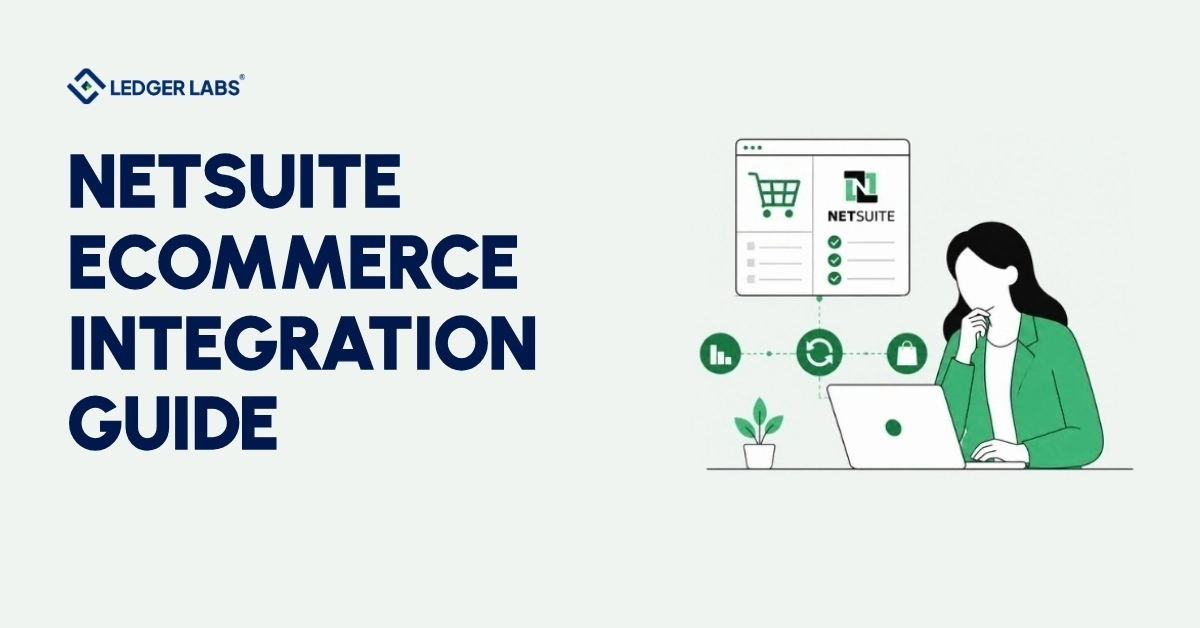
Integrating your ecommerce store, whether it’s Shopify, WooCommerce, Magento, or BigCommerce, with NetSuite ERP allows for automatic syncing of orders, inventory, customer data, and financial information. When done right, this can reduce your month-end financial closing time from two weeks to just two days. However, if done wrong, you could face a situation where your accountant finds 340 unmatched transactions that are hard to explain.
A common issue ecommerce businesses overlook is that connecting two platforms technically and ensuring they work together financially are not the same task. Most tech firms manage the technical aspect but rarely handle the financial side.
That’s where an accounting firm can help. At Ledger Labs, our team of qualified accountants has been supporting ecommerce businesses with NetSuite integrations since 2014. We start by reviewing your chart of accounts, revenue recognition rules, and reconciliation workflows before selecting connectors and field maps. This way, we design the integration to support your financial records, not just to handle orders.
This guide will help you understand what an accounting firm checks before starting integration. You’ll learn the best integration method for your business, potential costs, and accounting risks for Shopify, WooCommerce, Magento, BigCommerce, and Amazon. Spotting these risks early can protect your financial data. It also includes important insights that tech firms often overlook.
Key Takeaways
- NetSuite ecommerce integration syncs your store and ERP automatically, but financial accuracy requires accounting oversight to prevent silent book errors from compounding
- A working integration and a financially sound integration are two different things; tech shops deliver the first, accounting firms focus on the second
- Your chart of accounts, revenue recognition rules, and payout reconciliation structure must all be validated before any connector goes live
- Platform-specific accounting risks, Shopify payout gaps, Magento bundle allocation, and Amazon settlement complexity require accounting expertise, not just technical configuration
- A misconfigured integration can silently add avoidable manual work to every month-end close.
- The accounting firm’s job ends with a clean first month-end close, not with a live connection; that distinction separates recoverable integrations from expensive ones
Why Ecommerce Businesses Hire an Accounting Firm for NetSuite Integration?
Ecommerce businesses hire an accounting firm for NetSuite integration because tech shops configure connections, accounting firms configure books. The technical setup delivers data movement. The financial setup determines whether that data produces reports your business can actually rely on.
Tech shops are good at moving data. They configure the connector, map the fields, verify that orders flow from your storefront into NetSuite, and declare the project complete. That is a legitimate scope of work. The problem is what they leave behind.
What Goes Wrong When a Tech Shop Runs the Integration?
When a tech shop configures a NetSuite ecommerce integration, they verify connectivity, not financial accuracy.
Here is what that means in practice:
- Revenue posts at the wrong amount: Shopify pays you net of processing fees, refunds, and chargebacks. Most integrations sync the gross order amount from your storefront. The result: your NetSuite GL overstates revenue by exactly the amount of your fees and returns every single month, and every month your accountant has to manually unwind the difference before the books can close.
- Sales tax is recognized on your income statement as revenue: Collected sales tax is a liability. It belongs on your balance sheet, not your P&L. In a misconfigured integration, it lands in revenue. Your top line looks healthier than it is; your tax liability calculation is wrong, and if a state tax authority audits you, you will be explaining why your reported revenue includes money that was never yours.
- The chart of accounts was never designed for this data: A tech shop maps fields to the existing account structure in NetSuite. If that structure was not built for ecommerce transaction volume, multiple revenue streams, platform fees, gift card liability, shipping income, every transaction lands somewhere inaccurate. Your P&L becomes a document no one trusts.
The danger is that these issues don’t stop the integration. Data keeps flowing, and errors accumulate unnoticed. This causes a growing gap between your financial records and actual business performance, which is usually noticed by your accountant at closing or by an auditor.
Understanding what NetSuite is used for in ecommerce and what its financial module requires before integration data can post correctly helps explain why these failures occur so consistently when the financial architecture is skipped.
What an Accounting Firm Does Before the Connector Is Even Selected?
Before choosing a connector, an accounting firm analyzes your financial setup, including your chart of accounts, revenue recognition, reconciliation process, and closing timeline. This review influences every decision made later on.
The first question we address is: how should this data be organized in NetSuite so your books close accurately each month?
This answer informs all decisions about field mapping, how often to sync data, and any changes needed in the account structure before the integration begins.
The technical setup follows the financial plan, not the reverse. This means the initial deliverable in every Ledger Labs integration project is a financial data mapping document, not a connector setup. This document shows where each type of ecommerce transaction goes in NetSuite and explains why. It is prepared before we contact any vendors, sign any licenses, or map any fields.
Following this order is what sets apart an integration your accountant can rely on from one your accountant struggles with every month.
If you’d like to see how our outsourced NetSuite accounting services support financial planning beyond just integration setup, that page covers the wider scope.
What an Accounting Firm Checks Before Your Integration Goes Live?
Before your NetSuite ecommerce integration goes live, an accounting firm checks five financial checkpoints: chart of accounts alignment, revenue recognition configuration, payment reconciliation setup, sales tax nexus exposure, and month-end close impact. Skipping any one of them is how you end up with a close that takes three weeks instead of three days.
Chart of Accounts Alignment
Chart of accounts alignment is about making sure your NetSuite account structure can accurately handle and classify all types of ecommerce transactions before you launch the integration. If the structure is incorrect, each transaction will be recorded in the wrong place, leading to inaccurate reports based on those transactions.
We check whether your revenue accounts separate income by sales channel, whether platform fees and processing costs are recorded in specific expense accounts, and whether your liability accounts properly handle sales tax and gift card balances. A chart of accounts that isn’t designed for ecommerce may require your accountant to make decisions about unclear transactions, leading to a profit and loss statement that no one trusts.
Fixing your chart of accounts after you go live costs significantly more than doing it beforehand. We handle this in Phase 1, before configuring any connectors.
Revenue Recognition Configuration
Revenue recognition configuration sets NetSuite to record revenue when a product ships, rather than when an order is placed.
Under ASC 606, revenue is recognized when the performance obligation is fulfilled. Many systems default to using the order date for revenue recognition, which can misstate revenue for businesses with fulfillment delays, such as during high-volume periods or promotional backlogs. This is particularly consequential for businesses with investor reporting requirements or approaching an audit.
We design the revenue recognition rules so revenue is recognized upon shipment confirmation, verify them with your fulfillment process, and test them with historical transactions before go-live. For more details on revenue recognition in NetSuite, the page offers a complete overview of the setup logic and common mistakes.
Payment Reconciliation Setup
Setting up payment reconciliation means configuring NetSuite to match what your payment platform deposits with what your store reports as revenue. These two numbers are often different.
Shopify pays you after deducting processing fees, refunds, and chargebacks. In contrast, NetSuite records each order at its full value. Without a proper clearing account to connect these two, each payout leads to unexplained differences in your bank that your accountant has to resolve every month.
We design a dedicated clearing account structure in NetSuite so that your total order revenue matches each payout, with fees, refunds, and chargebacks recorded in separate accounts.
We’ve seen integrations where this issue went unresolved for over a year. It is the easiest problem to prevent in a NetSuite eCommerce integration, and it’s also quick to fix before you launch.
Sales Tax Nexus Exposure
Sales tax nexus exposure means figuring out every state where your ecommerce activity has crossed or is close to the economic nexus threshold before your integration starts. The date your integration starts is when your new sales activity becomes visible to state tax authorities.
If you exceed thresholds in states where you weren’t collecting tax before, you become liable from that start date, not from when you find out about it.
We review your transaction volume by state, identify any exposures, and check that your integration is set up to collect and remit tax correctly before the first order goes through. We also check that the collected tax is posted to a liability account rather than revenue, which is a common misconfiguration.
Month-End Close Impact
Month-end close impact means outlining how to manage your closing process after integration, what reports to check and in what order, before processing live orders for the first time.
A well-configured integration speeds up closing, while a misconfigured one can add 3 to 5 extra days of reconciliation work. We define each reconciliation step and what success looks like, and we run a test close with real historical data before going live. If the test shows unexpected results, we fix the issue and retest.
Catching errors during testing is much cheaper than fixing them after going live. If you want to know how an accounting firm handles the entire NetSuite ecommerce accounting process, including ongoing close management, that page covers it all.
Now, we need to decide which integration method to configure once we confirm the financial structure.
Which Integration Method Makes Financial Sense for Your Business?
The right way to integrate NetSuite ecommerce depends on your accounting needs, not your tech provider’s preferences. An accounting firm will determine this during the financial planning stage, before any connector demonstrations begin.
There are three options available:
SuiteCommerce: When the Accounting Case Is Strong
SuiteCommerce is NetSuite’s native ecommerce module; your storefront runs directly inside NetSuite, eliminating the payout reconciliation gap and connector licensing costs entirely. The accounting case is strongest when you are building a new storefront from scratch or when your reconciliation overhead exceeds 4 accounting hours per month.
If your existing storefront is functional and your reconciliation overhead is manageable, the migration cost and disruption rarely justify the switch.
Our NetSuite for ecommerce page covers SuiteCommerce’s module structure in full.
iPaaS Middleware: What the Connector Costs Your Books
iPaaS middleware, such as Celigo, Boomi, TrueCommerce, and SPS Commerce, sits between your ecommerce platform and NetSuite, routing data on a configured schedule or in real time. Two accounting considerations belong in your financial model before you select a connector: ongoing licensing costs, which vary by tool, and the fact that financial accuracy depends on the field-mapping configuration.
A connector configured without double-entry accounting knowledge delivers data that arrives in NetSuite technically correct but financially wrong. That is the scenario we inherit most often.
Direct API: When Accounting Complexity Justifies It
Using the Direct API through SuiteTalk allows you to avoid middleware, giving you better control over how data is processed before it enters your accounting books. This approach is particularly useful for handling complex transactions, such as multi-currency, multi-warehouse settings, a mix of B2B and DTC sales, and marketplace settlements.
In these cases, where standard connectors might fail, a direct API ensures accurate financial reporting. The downside is that you’ll need to plan ongoing developer time for maintenance.
Which Method Is Right for You?
Not sure which accounting method is right for your business? This table shows which method works best for different accounting situations.
Start by discussing your needs, not by watching product demos.
| Method | Best Accounting Fit | Key Accounting Advantage | Ongoing Cost |
|---|---|---|---|
| SuiteCommerce | New storefronts or 4+ hours/month reconciliation overhead | No payout gap, no connector licensing | Migration project cost |
| iPaaS (Celigo, Boomi, TrueCommerce) | Established storefronts, standard ecommerce complexity | Flexible mapping, rapid deployment | Licensing fee (varies by tool) |
| Direct API (SuiteTalk) | Multi-currency, multi-warehouse, B2B + DTC combined | Maximum transaction-level accounting control | Developer time for maintenance |
What Affects the Scope of a NetSuite Ecommerce Integration?
The cost of a NetSuite implementation ranges from $8,000 to $50,000+ for the initial integration project. Four factors determine where your project falls within it. Four factors determine where your project falls within it.
What Determines the Scope of the Project
- Number of platforms and channels: Each additional storefront, marketplace, or POS adds complexity to field mapping, reconciliation logic, and testing scope. A single Shopify store is a contained project. A business running Shopify Plus, Amazon, and a B2B portal is a different one entirely.
- Transaction volume and sync requirements: Higher volume operations often require real-time sync rather than batch processing, a configuration difference that affects both connector selection and cost.
- Existing NetSuite configuration: If your chart of accounts was not built for ecommerce, the integration project typically includes a NetSuite cleanup phase before any connector work begins, adding both cost and timeline.
- Customization requirements: Custom workflows, bundled revenue allocation, consignment inventory, subscription billing require configuration beyond what standard connectors cover out of the box.
What Ongoing Costs Look Like
iPaaS connector licensing is an ongoing cost that should be included in your financial model before you select a tool. Direct API integrations avoid licensing costs but require ongoing developer time for maintenance.
The Cost Nobody Talks About
Most integration guides overlook this key point: a misconfigured integration can add hours of manual accounting work to your monthly close, and a properly set-up integration can reduce that work. This is the true cost of a tech shop that provides a working connection but does not check the financial results.
Platform-Specific Accounting Risks in NetSuite Ecommerce Integration
The accounting risks in a NetSuite ecommerce integration are platform-specific. Shopify creates different reconciliation problems than Magento. Amazon creates problems neither of them creates.
Here is what an accounting firm checks for each one:
Shopify + NetSuite: The Payout Reconciliation Gap
The main risk is matching payouts. Shopify deposits a net amount, total sales minus fees, refunds, and chargebacks, while NetSuite records each order at the full sale price. Without a special account to connect the two, each payout results in a bank mismatch.
We define a dedicated Shopify clearing account in NetSuite so that total revenue can be matched to each net payout. Fees and refunds are posted to specific expense accounts.
WooCommerce + NetSuite: Tax Data and Multi-Currency Exposure
The primary risk is tax misclassification. WooCommerce tax plugins apply tax at the order level if the integration does not separate collected tax from revenue before it posts to NetSuite; sales tax hits your income statement as revenue.
Multi-currency stores carry a second risk: exchange rate differences between the order date and the settlement date must be recognized as realized gains or losses, not as revenue.
Magento + NetSuite: Bundle Revenue Allocation
The primary risk is bundle revenue allocation — a GAAP requirement most connectors skip by default. Under ASC 606, a bundle sold for $200 with components priced at $150 and $100 as stand-alone items requires proportional revenue allocation before recognition.
Most connectors post the bundle price as a single revenue line. We define the allocation rules for the connector before any revenue posts to NetSuite.
BigCommerce + NetSuite: B2B Order and AR Treatment
The primary risk is improper revenue recognition for net-terms B2B orders. A net-30 wholesale order becomes revenue and an accounts receivable entry when it ships, not when it is placed or paid. A misconfigured integration posts revenue at the wrong point, which moves it into the wrong period.
Tiered distributor pricing also needs to flow as a price adjustment in NetSuite, not as a discount expense. Our BigCommerce bookkeeping services page covers the B2B accounting complexity in full.
Amazon and Marketplace Integrations: Settlement Reconciliation
The primary risk is settlement complexity. An Amazon bi-weekly settlement contains gross sales, FBA fees, storage fees, advertising charges, refunds, and reimbursements, all in a single deposit.
We design a settlement-based reconciliation rather than an order-based sync: the settlement report drives NetSuite entries, with each fee category posting to a dedicated account for clean P&L visibility into FBA costs. Our Amazon bookkeeping services page covers the settlement reconciliation workflow in detail.
The Integration Process: How Our Accounting Team Runs It
Understanding the accounting risks tells you what can go wrong. Understanding how we run the integration shows what a well-managed project looks like.
Phase 1: Financial Scoping and Chart of Accounts Mapping
Every engagement begins with financial scoping before we choose any connectors. We review your chart of accounts, revenue recognition policies, closing timeline, and reconciliation workflow. We identify every account that needs to be added or changed so that integration data can post correctly.
We also map your revenue streams by channel and product type. The result is a financial data mapping document. This document shows where each ecommerce transaction goes in NetSuite and why. It is not a technical spec, but a clear financial architecture document.
Phase 2: Method Selection, Connector Review, and Revenue Recognition
After confirming the financial setup, we help you choose the integration method and check the connector’s configuration against the data mapping document. We set revenue recognition rules in NetSuite: shipment-triggered for physical goods, including B2B orders, and subscription schedules for recurring revenue. We also review the sales tax collection and nexus settings before any live orders are processed.
Phase 3: Testing Against Your Real Financial Data
We test against your actual historical transactions, not sample data. Every transaction must land in the correct NetSuite account, at the correct amount, on the correct date. We run a full test reconciliation: bank balance against NetSuite GL, revenue against the platform report, and sales tax collected against the liability account. If any test fails, the integration does not go live. We fix the mapping error and retest.
Phase 4:Go-Live and First Close Validation
Go-live is not the finish line; the first month-end close is. We stay engaged through that close, verify the reconciliation outputs, and identify any accounting configuration adjustments that real-world transaction patterns require.
After the first close, we document the workflow so your team can execute it consistently every month. If you would rather not run it in-house, our NetSuite bookkeeping team can handle the daily coding and reconciliations between closes. If you want to understand the full scope of how our NetSuite accounting services support the close beyond go-live, that page covers it.
NetSuite Ecommerce Integration for B2B Businesses
B2B ecommerce integration carries accounting requirements that a standard DTC NetSuite configuration does not address. If your operation includes wholesale accounts, distributor pricing, or a B2B portal, your integration needs a different financial architecture from the start.
How Do Net Terms and Tiered Pricing Change Your Books?
B2B ecommerce introduces accounts receivable management into what is otherwise a cash-upfront transaction model. When a wholesale customer places a net-30 order through your portal, NetSuite should hold it as a sales order, not as revenue. Revenue and the accounts receivable entry post when the goods ship (or are delivered, depending on your terms), not when the order is placed and not when the customer pays.
A misconfigured integration posts revenue at the wrong point, at order or at payment instead of at shipment, which puts it in the wrong period. For businesses with investor reporting or approaching an audit, that is a misstatement that cannot be explained away.
Tiered pricing creates a parallel problem. Distributor pricing needs to flow through NetSuite as a price adjustment rather than a discount expense. Classifying it as an expense overstates your operating costs and understates your gross margin on every wholesale transaction.
What Changes When You Add a B2B Channel to an Existing DTC Integration?
Adding a B2B channel to an existing DTC integration is not a configuration update; it is a change in financial architecture. Here is what that means in practice.
Your chart of accounts needs separate revenue accounts for DTC and wholesale income. Your revenue recognition rules need to be configured independently for net-terms orders. Your customer group structures in NetSuite need to mirror your portal pricing tiers.
Our accounting team treats each addition of a B2B channel as a separate Phase 1 scoping engagement, reviewing all required financial architecture changes before any connector configuration begins. The result is a clean separation between your B2B and DTC books from day one. The accounting design always comes before the technical setup.
Conclusion
Every NetSuite ecommerce integration failure we have seen traces back to the same decision: treating the integration as a technical project and handing it to a tech shop. The connection gets built. The orders flow. Close day arrives, and the books describe a business that does not exist.
Chart of accounts alignment, revenue recognition configuration, payout reconciliation, sales tax nexus- these are not post-implementation tasks. They are the design brief the technical configuration serves. Get them wrong before go-live, and your accountant pays for it every month.
If your integration is live and your close is producing unexplained variances, the architecture is the problem, and it is fixable. If you are planning an integration and want the financial configuration built correctly from the start, book a free 30-minute consultation call to talk through the accounting side of your integration.
Ledger Labs is an accountant-led firm. We do not earn commissions on integration tools. We earn trust by making your books work.
The integration that closes your month correctly is worth more than the one that syncs your orders fastest.
FAQs
1. Do I need an accounting firm or a tech shop for NetSuite ecommerce integration?
Hire an accounting firm if you need the integration to produce data your books can close on, correct revenue recognition, reconcilable payouts, and clean sales tax. A tech shop works if an in-house CPA validates the configuration. Fixing it after go-live costs more than building it right.
2. What affects the scope of a NetSuite ecommerce integration?
The number of platforms, transaction volume, and your existing NetSuite configuration all affect the scope, and iPaaS connector licensing is an ongoing cost to plan for. Book a free 30-minute consultation to talk through where your project falls.
3. How does Shopify payout reconciliation work in NetSuite?
Shopify pays net settlements, gross sales minus fees, refunds, and chargebacks, while NetSuite receives orders at gross value. A correctly configured integration creates a Shopify clearing account: gross revenue posts to it, net payouts are reconciled against it, and fees automatically post to dedicated expense accounts.
4. What is the accounting risk of a misconfigured NetSuite integration?
Revenue in the wrong period creates financial statement misstatements. Sales tax posted as income overstates revenue and understates your tax liability. Gross revenue synced without fee netting makes your P&L unreconcilable to your bank. None of these stop the integration running, which is why they accumulate undetected for months.
5. How long does NetSuite ecommerce integration take with an accounting firm?
A single-platform integration takes six to ten weeks, from financial scoping through first-close validation. Multi-platform integrations, or projects requiring chart of accounts restructuring before connector work begins, typically take 12 to 16 weeks. Timeline depends primarily on the state of your existing NetSuite configuration.