
Most businesses choose the wrong ERP for the right reasons.
They compare features. They run demos. They negotiate the license cost. And then six months after go-live, their accounting team is still closing the books manually because nobody asked what the financial architecture would look like before the first transaction was posted.
That’s the Odoo vs SAP decision most guides don’t cover.
What you actually need is an accountant’s perspective, someone who works inside these systems at month-end, not someone who configures them and walks away.
This comparison is written by Ledger Labs’ accounting team, which manages Odoo and SAP accounting for clients daily. We look for accounting workflow: what works at month-end, what breaks under multi-entity pressure, and what the true cost looks like after implementation.
Key Takeaways
- Odoo costs 3–4x less than SAP Business One over a 3-year ownership period.
- SAP Business One produces cleaner financial reports out of the box with less configuration needed.
- Odoo suits most US businesses between $2M–$50M in ecommerce, SaaS, or manufacturing.
- SAP Business One wins for multi-entity consolidation, regulated manufacturing, and $30M+ growth trajectories.
- The chart of accounts setup determines your close speed more than the ERP software you choose.
- Both platforms need an implementation review, not just a technical implementation partner.
What Is Odoo and What Is SAP?
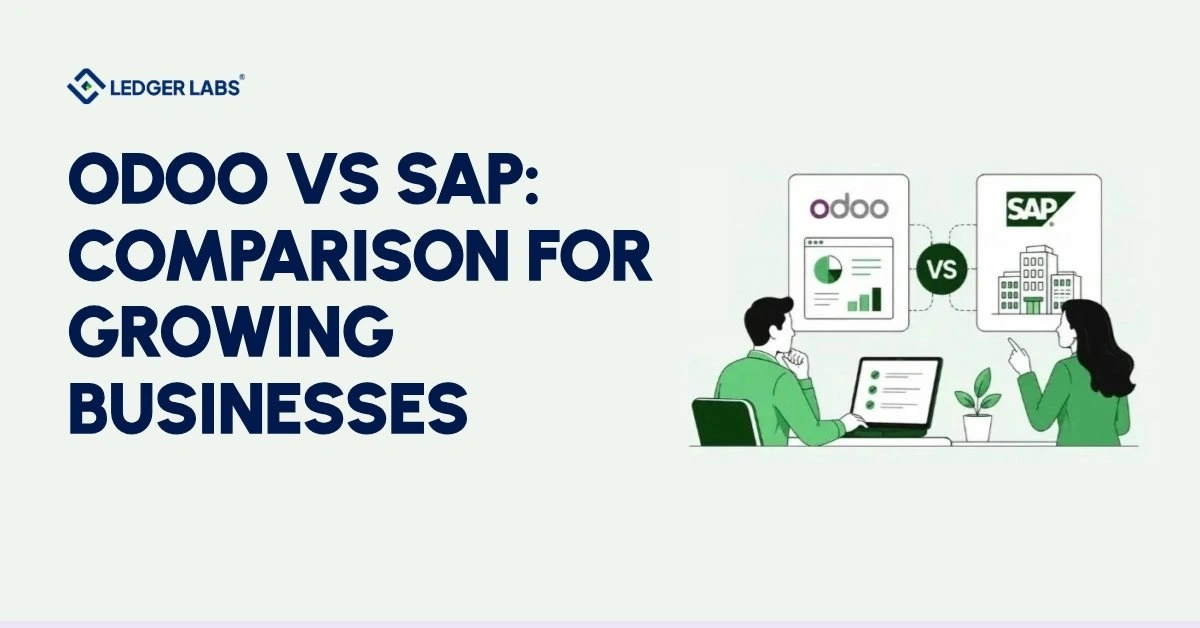
Odoo is an open-source, modular ERP built for SMBs. SAP Business One is a structured, proprietary ERP targeting companies between $1M and $100M in revenue. They serve overlapping markets but operate very differently. Odoo gives you flexibility, SAP gives you structure.
Here’s what you need to know:
Odoo serves more than 12 million users across 160+ countries. The core is free; businesses pay for enterprise features, hosting, and support. You deploy only the modules you need and add more as you grow.
SAP built its reputation on large enterprise ERP. The name “SAP” now covers a product portfolio at very different price points and levels of complexity, and that distinction matters for this comparison.
Which SAP Are We Actually Comparing?
This is the question every “Odoo vs SAP” article skips. Don’t skip it.
SAP Business One targets 10–250 employees, $1M–$100M in revenue. It’s the SMB product. This is almost certainly what you’re evaluating.
SAP S/4HANA is SAP’s enterprise flagship, with dedicated IT teams, seven-figure implementation budgets, and a $50M+ revenue minimum. If you’re under $50M and don’t have an in-house SAP consultant, S/4HANA isn’t the right comparison.
This entire article compares Odoo against SAP Business One. Every pricing figure, every implementation timeline, and every feature note refers to SAP B1. If you’re evaluating S/4HANA, you’re in a different purchasing process.
With that clear, let’s talk about the number most buyers get wrong: the cost.
Odoo vs SAP Pricing: What Does It Actually Cost?
Odoo costs less than SAP Business One at every level, including licenses, implementation, and the total cost over three years. For a US company with 10 employees, Odoo’s total cost over three years ranges from $34,000 to $83,000, while SAP Business One’s total cost ranges from $117,000 to $293,000. The difference increases as the company’s complexity increases.
Here’s the breakdown.
Odoo pricing operates on two tiers:
- Community edition: Free, full accounting, inventory, and CRM, no license cost
- Enterprise edition: ~$24–$44 per user per month, billed annually
For a 10-person team using accounting, inventory, and one additional module: roughly $3,000–$5,000 per year in software.
SAP Business One pricing works differently. Named-user or limited-user licensing, either perpetual or annual subscription. Annual subscription runs ~$150–$300 per user per month. For a 10-person team: $18,000–$36,000 per year in software alone.
On license cost, Odoo wins by a wide margin.
But here’s what nobody tells you: license cost is rarely the biggest line item.
The 3-Year Total Cost of Ownership: A Side-by-Side Estimate
The real number includes implementation partners, data migration, training, and ongoing maintenance.
Here’s what it looks like for a 10-person US company:
| Cost Component | Odoo Enterprise | SAP Business One |
|---|---|---|
| Software license (Year 1) | ~$3,000–$5,000 | ~$18,000–$36,000 |
| Implementation partner | $15,000–$40,000 | $40,000–$120,000 |
| Data migration & setup | $5,000–$15,000 | $10,000–$30,000 |
| Training | $2,000–$5,000 | $5,000–$15,000 |
| Year 2–3 software | ~$6,000–$10,000 | ~$36,000–$72,000 |
| Ongoing support/maintenance | $3,000–$8,000/yr | $8,000–$20,000/yr |
| 3-Year Total (estimated) | $34,000–$83,000 | $117,000–$293,000 |
The gap is real, and it compounds with complexity.
One important caveat: Odoo’s lower cost assumes a well-scoped implementation. Rushed migrations, undefined requirements, and chart-of-accounts problems regularly push Odoo projects to $60,000–$80,000 before go-live. The software is cheaper. The mistakes aren’t.
For most US businesses with $2M–$50M in revenue, Odoo’s 3-year TCO advantage is material. Whether SAP B1’s additional capabilities justify the gap depends on your specific setup, and that answer starts with the feature comparison.
Core Features Compared: Odoo vs SAP Side by Side
Both Odoo and SAP Business One cover the full SMB feature set, accounting, inventory, manufacturing, CRM, and reporting.
The difference is not what they have, but how deeply each module goes and how much configuration it requires to work for your accounting team.
Here’s the honest breakdown:
| Module | Odoo Enterprise | SAP Business One | Our Accounting Take |
|---|---|---|---|
| Accounting & Finance | AP, AR, bank reconciliation, multi-currency, basic consolidation | AP, AR, financial statements, multi-currency, stronger native reporting | SAP B1 produces board-ready reports with less setup. Odoo needs more configuration to match. |
| Inventory Management | Multi-warehouse, FIFO/AVCO, barcode scanning, demand forecasting | Warehouse management, batch tracking, serial numbers, MRP integration | Comparable at SMB scale. SAP B1 edges ahead for complex warehouse operations. |
| CRM | Native, fully integrated, pipeline management | Basic CRM, often supplemented with third-party tools | Odoo's CRM is more developed. SAP B1 CRM is functional, but not its strength. |
| Manufacturing (MRP) | BOMs, work orders, production planning | Production orders, capacity planning, quality management | Both handle SMB manufacturing. SAP B1 is slightly stronger for discrete manufacturing compliance. |
| eCommerce | Native module, Shopify/Amazon integrations | No native eCommerce, third-party connectors only | Odoo has a clear advantage for e-commerce-native businesses. |
| HR & Payroll | Native HR and payroll vary by localization | Native HR, payroll via partner add-ons | Neither is a payroll system. Both rely on integrations. |
| Reporting & Analytics | Standard reports; customizable dashboards | Stronger native reporting; Crystal Reports integration | SAP B1 reporting is a genuine advantage for teams needing board-level output without custom development. |
| Deployment | Cloud or on-premise | Cloud or on-premise | Both support hybrid. SAP B1 on-premise is still common in manufacturing. |
Here’s where the real difference shows up:
SAP B1 is complete but rigid. Deep reporting, mature manufacturing, and less ecommerce flexibility. Odoo is modular and configurable, but configurability without accounting expertise at setup produces a financially imprecise result.
That distinction plays out most clearly in the one area every other comparison ignores.
How Odoo and SAP Handle Accounting - An Accountant's Perspective
Odoo is a good choice for accounting in most small and medium-sized businesses (SMBs) with revenue under $15 million, as long as it is set up correctly. SAP Business One provides clearer financial reports right away and has better audit controls.
The key difference between the two systems is not the software itself, but how each manages your chart of accounts, accounts payable and receivable workflows, and month-end closing under real-world conditions.
Here’s what we see inside these systems:
Chart of accounts: Odoo ships with a default US chart of accounts. It’s a starting point, not a finished structure.
Most companies between $3M and $50M need a modified CoA that reflects their revenue streams, cost centers, and reporting requirements. Get that configuration right, and your reports run cleanly. Let a developer handle it without accounting input, and you end up with transactions recorded correctly, but reports that require manual adjustment every month-end.
SAP B1’s default CoA is more opinionated. It ships oriented toward financial statement production, less flexible, but for a business without a strong accounting infrastructure already in place, that structure acts as a guardrail.
AP/AR Automation: How Each Platform Handles the Day-to-Day
Odoo efficiently manages accounts payable and receivable for most small and medium-sized businesses, handling vendor bills, purchase order matching, payment runs, and bank feeds. SAP Business One offers stronger approval controls and better audit trails, making it a better choice for regulated industries and those with audit requirements.
If you manage fewer than 200 vendor bills each month in Odoo, you can set it up for minimal manual work once configured. However, with more bills or complex approvals, Odoo’s basic accounts payable (AP) falls short without extra modules.
SAP B1 includes built-in document approvals, which are beneficial for businesses in regulated industries or those facing external audits.
Both platforms automate accounts receivable (AR) well for small to medium businesses. The key difference is in collections workflows and dunning management, where SAP B1 offers a more developed process while Odoo requires configuration.
Month-End Close: What the Process Actually Looks Like
A well-configured Odoo system at $5M–$10M revenue closes in 5–8 business days. SAP Business One closes on a similar timeline but with more system-enforced period controls, which slow initial adoption but build a more consistent close cadence over time.
In Odoo, we often see common problems like:
- Bank reconciliation at high transaction volumes
- Intercompany eliminations on multi-entity setups
- Transactions touching inventory valuation
None of these are Odoo failures.
Every single one is a configuration decision that needed to be made correctly at implementation, and wasn’t.
SAP B1’s close process is more structured. The system tells your team what to do and in what order. That rigidity frustrates accountants in month one. By month six, it produces a close that runs on schedule regardless of who’s in the seat.
After over three years of working with clients, we’ve found that the accounting module is not the main deciding factor. The setup of the chart of accounts and the bank reconciliation are what truly matter.
Get the setup right, and you can finish Odoo in a week. Get it wrong, and you might be reconciling manually for six months, regardless of the platform.
Implementation: Timeline, Complexity, and What to Expect
Odoo implementations for SMBs typically run 8–16 weeks. SAP Business One implementations for companies of the same size take 3–6 months. The differences are configuration complexity, partner dependency, and the number of upfront requirements each system demands.
Here’s what that looks like on the ground:
Odoo goes live in 8–16 weeks when scoped correctly. That window widens to 6 months when requirements aren’t defined at kick-off, when accounting data migration is underestimated, or when the CoA is being restructured mid-project.
SAP B1 requires more upfront configuration. It’s less forgiving of incomplete requirements documentation. Implementation partner dependency is higher. A phase-based approach, finance first, then inventory, then manufacturing, is standard practice. It reduces risk but extends the timeline.
Both platforms require an implementation partner. This is non-negotiable for more than 10 users or multiple modules.
The single biggest variable in implementation outcome: whether your partner has accounting expertise alongside technical expertise. Most don’t. Most are developers who know the software but not the financial architecture required to run it.
Accounting Data Migration: What Actually Moves and What Breaks
The most common source of implementation delays is accounting data migration, specifically, opening balance reconciliation, inventory valuation on incomplete work orders, and account mapping decisions made without accountant review.
What needs to migrate: open AR/AP balances, vendor and customer master records, two years of historical transactions, your fixed asset register, and the chart of accounts mapping.
What breaks: anything recorded in the legacy system without a clear account mapping.
Here’s the pattern we see consistently.
Migrations that go cleanly have an accountant reviewing the account mapping before import. Migrations that require rework had those decisions made by someone who understood the software but not the financial architecture underneath it.
Odoo’s tooling is flexible, forgiving of messy source data. That flexibility also means mistakes pass through silently if nobody’s checking against the accounting structure.
SAP B1’s process is more structured; it flags inconsistencies during import but requires more pre-migration data cleaning.
Build accountant-level migration review into your implementation plan before you sign a contract. If it’s not in the partner’s scope, that’s a gap you’ll pay for later.
Which ERP Is Right for Your Business: Odoo or SAP?
Odoo is the right choice for most US businesses between $2M and $50M in a single-entity structure. SAP Business One makes more sense above $10M with multi-entity complexity, regulated manufacturing requirements, or a growth trajectory toward $30M+ within three years.
Here’s the breakdown by scenario:
Choose Odoo if:
- Revenue $2M–$50M
- Single entity or two entities with straightforward intercompany
- Ecommerce, manufacturing, or SaaS vertical
- Implementation budget under $60,000 total
- Willing to invest in a proper accounting configuration at setup
- US-based, US compliance requirements
Choose SAP Business One if:
- Revenue $10M–$100M or scaling there within 24 months
- Multiple entities with complex consolidation requirements
- Regulated manufacturing (FDA, automotive, aerospace)
- Existing SAP partner relationships
- Need board-level reporting without custom development
- An IT infrastructure that supports a more complex system
The Overlap Zone: $8M–$15M - When Both Are Viable
Between $8M and $15M, both platforms work. The decision comes down to four questions:
How many entities?
More than two with complex intercompany → SAP B1. Clean single or two-entity setup → Odoo.
Where are you going?
$30M+ within three years → SAP B1 avoids a second migration. Stable at current range → Odoo’s TCO advantage holds.
What’s your industry compliance burden?
Regulated manufacturing → SAP B1. Ecommerce, SaaS, professional services → Odoo.
What does your accounting team prefer?
Structure enforced by the system → SAP B1. Control over configuration with accounting expertise at setup → Odoo.
Industry-Specific Guidance: Manufacturing, Ecommerce, Professional Services
- Manufacturing: Both handle MRP at the SMB scale. SAP B1 has stronger discrete manufacturing controls and a longer track record in regulated environments. Odoo’s manufacturing module is fully capable for job shop and make-to-order, and integrates better with ecommerce if you sell directly.
- Ecommerce: Odoo. Native Shopify, Amazon, and WooCommerce integrations. Inventory valuation is tied directly to accounting. CRM that connects acquisition to financial reporting. SAP B1 requires third-party connectors for ecommerce, which is workable but adds cost and maintenance overhead.
- Professional Services: Neither is purpose-built here. But Odoo’s project module and time-tracking integrations make it the practical choice for service businesses billing against projects.
Conclusion
Odoo and SAP both offer tools to meet the needs of businesses with $2M–$50M in revenue. They can both help you manage your finances and inventory. The key question is: what will your accounting setup look like six months after launching? Did anyone create a plan before starting the first transaction?
For most US businesses under $50M with a single entity in ecommerce or manufacturing: Odoo. Lower TCO, faster go-live, and a fully capable accounting module when configured by people who understand both the software and the financial architecture underneath it.
For businesses with multi-entity complexity, regulated manufacturing, or a path to $30M+ in the next three years: SAP Business One earns its higher price point.
What separates the implementations that work from the ones that don’t, on either platform, isn’t the software. It’s whether the accounting structure was designed before the first transaction was posted.
To get an honest opinion from an accountant about which platform is best for your situation, business structure, industry, transaction volume, and closing needs, book a free consultation call.
No implementation pitch. No software bias. Just the answer. See also Odoo vs NetSuite, Acumatica vs Odoo, Odoo vs Sage and Odoo alternatives compared. If you choose Odoo, Ledger Labs provides outsourced Odoo accounting.
Where we stand
Ledger Labs provides accounting services on Odoo, so we have a commercial interest in this comparison.
Comparing costs? Plans and what each one includes are on our pricing page.
FAQs
Is Odoo better than SAP?
Odoo is best for US businesses with $2M to $15M in revenue, especially in ecommerce and manufacturing. It’s affordable and quick to set up. SAP Business One suits companies needing multi-entity management or strict compliance, especially those aiming for over $30M in growth. Choose based on your structure and plans, not just features.
Can Odoo replace SAP for a small business?
Yes, Odoo is a cost-effective alternative to SAP Business One for most small businesses. It covers essential accounting, inventory, and operations tasks. However, if your business has complex needs, such as managing multiple entities or complying with strict manufacturing regulations, SAP B1 may offer better controls. When switching from SAP B1 to Odoo, it’s crucial to map your chart of accounts correctly with an accountant before going live.
What size companies use Odoo vs. SAP?
Odoo is for businesses with 5 to 150 employees and $2 million to $30 million in annual revenue. SAP Business One targets those with 10 to 250 employees and $5 million to $100 million in revenue. The $8 million to $20 million range works for both, with the right choice depending on company structure, industry, and growth plans. SAP S/4HANA is for businesses over $100 million in revenue and requires a separate IT infrastructure.
How long does an Odoo implementation take compared to an SAP implementation?
An Odoo implementation for a small or medium-sized business usually takes 8 to 16 weeks to launch. In contrast, SAP Business One implementations take at least 3 to 6 months. Both timelines can be extended if project requirements are unclear or if the accounting data migration is underestimated. The main cause of delays for both platforms is mapping the chart of accounts without accountant involvement. Involving an accountant from the beginning can help avoid this issue.
Is Odoo good for accounting?
Yes, Odoo’s accounting module is perfect for small and medium-sized businesses (SMBs). It provides double-entry bookkeeping, accounts payable and receivable management, automated bank reconciliation, multi-currency support, tax compliance, and standard reports. For businesses with under $15 million in revenue, it typically meets all needs without extra tools. The quality of results depends on how well the chart of accounts and bank reconciliation rules are set up from the start. A good setup is more important than the software itself.
What is the main difference between Odoo and SAP?
The core difference is flexibility versus structure. Odoo is open-source and modular; you configure it around your business, giving flexibility but requiring accounting expertise at setup. SAP Business One is proprietary and opinionated, with stronger financial controls and cleaner standard reports out of the box, but less adaptable and significantly more expensive. For an SMB without an in-house ERP team, SAP B1’s structure acts as a guardrail. For a business that wants control over its own configuration with the right accounting partner, Odoo’s flexibility is an advantage.
Does Odoo support multi-entity accounting?
Yes, Odoo supports multi-entity accounting through its built-in multi-company module. Each entity maintains its own chart of accounts, AP/AR, bank accounts, and financial statements within a single Odoo instance. Intercompany transactions create matching entries across entities through a journal entry workflow. The primary limitation is consolidated reporting: Odoo does not natively automate consolidating the P&L to eliminate intercompany transactions in a single step; consolidation requires a manual process, a third-party tool, or a structured workbook managed by your accounting team.