
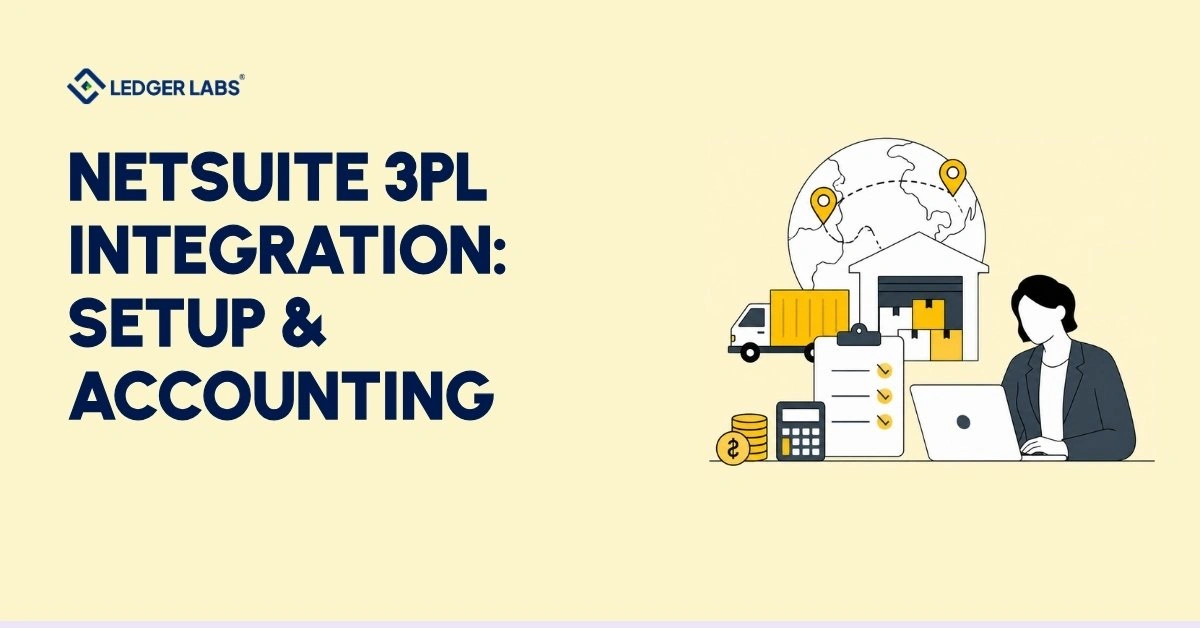
NetSuite 3PL integration connects your NetSuite ERP with your third-party logistics provider. This integration automatically syncs orders, inventory, fulfillments, and returns without needing manual data entry.
Many operators set up the integration and think the hard part is finished, but that’s not true.
Over 12 years working with NetSuite at Ledger Labs, we’ve found that the biggest issues for e-commerce businesses usually aren’t caused by a connector going down. Instead, problems often occur from Cost of Goods Sold (COGS) being posted to the wrong account, revenue being recorded in the wrong period, and returns remaining unaccounted for on the balance sheet for over 60 days, all while the integration still seems to work fine.
At Ledger Labs, our CPAs focus on the accounting side of NetSuite 3PL integrations, which is often overlooked by your connector vendor. We have helped e-commerce operators reduce their month-end close time by 30–50%, not by changing connectors, but by correcting mistakes the connectors made in their financial records. My insights on ERP implementation and accounting controls have appeared on Ramp, Cin7, Fyle, and Melio.
This guide covers integration methods, connector options, implementation costs, the five main issues that can compromise your financial records, and how a CPA firm ensures your financials remain accurate from day one.
Key Takeaways
- NetSuite 3PL integration syncs orders, inventory, fulfillments, and returns, but accurate books require CPA oversight, not just a connector.
- iPaaS platforms like Celigo and Pipe17 are the best fit for most ecommerce SMBs, faster to deploy and easier for a CPA to validate.
- COGS must post on fulfillment confirmation, not on order creation; one in three integrations we inherit is configured incorrectly.
- Batch sync lag can push $15K–$30K of revenue into the wrong period at month-end; real-time sync eliminates this risk entirely.
- Returns not flowing back into NetSuite is the most common clean-up job we take on; refund liabilities sit unreconciled for 60+ days.
- The accounting setup layer, COGS mapping, revenue recognition rules, and reconciliation workflow are scoped separately from the connector and take 2–4 weeks.
What Is NetSuite 3PL Integration And Why Your Accountant Should Be Involved
NetSuite 3PL integration connects your NetSuite ERP directly to your 3PL. This means that orders, fulfillments, inventory, and returns can sync automatically without requiring manual data entry. When done right, this keeps your financial records accurate. If done wrong, it can distort your monthly profits and losses until someone notices during closeout.
For e-commerce businesses making over $1 million in revenue, this integration is vital. If you process hundreds of orders daily from a 3PL warehouse, relying on manual data syncing will not work. This can lead to overselling, inaccurate inventory counts, and a longer month-end closing process.
Many people focus only on quickly sending orders to the 3PL, which is important. However, in my 12 years working on NetSuite implementations, the most costly mistakes often stem from misposting cost of goods sold (COGS), recognizing revenue at the wrong time, and letting returns go unprocessed for too long.
When your 3PL ships an order, three things should happen in NetSuite at once: inventory should decrease, a COGS journal entry should be made, and revenue should be recognized. If the integration only updates inventory but misses the journal entry, something that happens more often than you think, your profit and loss will be incorrect from the start.
That’s why your accountant should be involved before you build the integration, not afterward. The connector sends the data, and the CPA verifies that it has been posted correctly. These are two different jobs, and many businesses only hire someone for one of them.
What Data Actually Moves Between NetSuite and Your 3PL?
Five data flows move between NetSuite and your 3PL: sales orders, fulfillment confirmations, inventory levels, PO receipts, and returns. Each of these flows has financial impacts if something goes wrong, not just operational ones.
Most integration guides only focus on the operational side. I will explain the accounting impacts of each flow because that’s what ensures your financial records are accurate.
1. Sales Orders (NetSuite → 3PL)
Direction: Sales orders go from NetSuite to the 3PL.
What breaks when it fails: The 3PL does not know to pick, pack, or ship. Orders remain in NetSuite without being fulfilled. When order volumes are high, this creates a backlog that can take days to resolve, and each delayed order means delayed revenue recognition.
2. Tracking and Fulfillment Process (3PL to NetSuite)
Direction: When you process fulfillment confirmations and tracking numbers, they should be sent from the 3PL to NetSuite.
What breaks when it fails: Revenue recognition will not occur. Your storefront may show the order as “shipped,” but NetSuite will still list the order as open. At the end of the month, this leads to understated revenue and overstated accounts receivable. If this issue affects many orders in the last week of the month, it can significantly distort your financial reports for that period.
3. Inventory Level Sync (3PL to NetSuite)
Direction: Sync inventory from 3PL to NetSuite, either in real-time or in batches.
What breaks when it fails: NetSuite may show more inventory than you actually have. This can lead to overselling. Additionally, your balance sheet may overestimate inventory as an asset. If you rely on a line of credit or need to report to investors, an inflated inventory number can have wider effects beyond just the warehouse.
4. Purchase Order Receipts (3PL → NetSuite)
Direction: When inbound stock arrives at the 3PL, a receipt confirmation flows from the 3PL to NetSuite.
What breaks when it fails: Inventory is physically at your 3PL but not received into NetSuite. Your on-hand count is understated. More importantly, the item’s cost hasn’t been recorded as an inventory asset, so when the item sells and the COGS entry fires, NetSuite pulls from incomplete cost data. The result is distorted gross margin on every unit from that receipt batch.
5. Returns and RMA Data (3PL → NetSuite)
Direction: Return confirmation and restocking data flow 3PL → NetSuite.
What breaks when it fails: Returned inventory is physically back at the warehouse but not restocked in NetSuite. Inventory count understates available stock. The refund has been issued to the customer, but the corresponding inventory credit hasn’t been booked, leaving the liability sitting unreconciled on the balance sheet, sometimes for 60+ days before anyone catches it at close. This is one of the most common clean-up jobs we take on with new clients.
Here's the full picture in one table:
| Data Flow | Direction | If It Fails: Operations | If It Fails: Accounting |
|---|---|---|---|
| Sales orders | NetSuite → 3PL | 3PL doesn't pick, pack, or ship orders | Fulfillment backlog delays revenue recognition |
| Fulfillment confirmations + tracking | 3PL → NetSuite | Customers see incorrect shipment status | Revenue recognition doesn't trigger; accounts receivable (AR) is overstated |
| Inventory levels | 3PL → NetSuite | Overselling and stockouts occur | Balance sheet overstates inventory assets |
| PO receipts / inbound stock | 3PL → NetSuite | Inbound inventory isn't visible | Incomplete cost data distorts COGS and gross margin |
| Returns / RMAs | 3PL → NetSuite | No visibility into returned inventory | Refund liabilities remain unreconciled and inventory is understated |
In our experience, the biggest accounting issues arise from problems with fulfillment confirmations and returns. Fulfillment confirmations are crucial for recognizing revenue, delays or omissions can lead to misrecorded revenue. Returns can create ongoing errors on the balance sheet. These processes are often overlooked in integration projects because vendors focus more on the outbound order flow.
NetSuite 3PL Integration Methods: What a CPA Firm Recommends for SMBs
There are four ways to connect NetSuite to a third-party logistics provider (3PL): EDI, direct API via SuiteTalk, iPaaS connectors, and native SuiteApp. For e-commerce SMBs generating $2M–$50M in revenue, iPaaS is the best option.
It’s quicker to set up, easier to maintain, and simpler for accountants to verify. The other three methods have their uses, but many who choose them over iPaaS have specific 3PL needs or underestimate long-term costs.
Here are the four ways:
EDI: The Standard Most 3PLs Use
EDI (Electronic Data Interchange) allows systems to exchange data using structured messages. Key transaction sets in 3PL integrations include:
- 850 – Purchase Order (to 3PL)
- 856 – Advance Ship Notice (from 3PL)
- 810 – Invoice
- 820 – Payment Order
EDI is the primary method used by 3PLs serving retail clients. If your 3PL works with major retailers like Target or Walmart, they require EDI for compliance.
There is an accounting risk with EDI because it updates data on a fixed schedule, like every 4, 8, or 24 hours. This delay can lead to inventory discrepancies in NetSuite.
For instance, if shipments are confirmed after month-end, it can push $15,000 to $30,000 in revenue into the wrong period, causing significant reporting errors.
For more details on EDI transaction sets and implementation, see our NetSuite EDI integration guide.
Direct API via SuiteTalk: Flexible but Needs Ongoing Maintenance
SuiteTalk is NetSuite’s built-in API that uses SOAP and REST protocols to enable real-time data exchange between NetSuite and your 3PL’s warehouse management system (WMS).
The key benefit is real-time synchronization. When a 3PL ships an order, NetSuite gets the update immediately, ensuring costs of goods sold (COGS) and revenue recognition are accurate and timely.
However, custom APIs require developer resources and ongoing maintenance. Problems often arise 18 to 24 months after launch, when the original developer has left, leaving others without an understanding of the integration. This can lead to lost records, halted inventory updates, and unprocessed fulfillment confirmations, resulting in delays in correcting any issues.
Use custom SuiteTalk if your 3PL provides clear API documentation, you have in-house developers, and your order volume justifies the complexity. Many small- to medium-sized businesses with revenue under $20 million may not meet these criteria.
For more details on how the NetSuite API handles authentication and data exchange, see the guide.
iPaaS Connectors: The Middle Ground Most Ecommerce Operators Should Use
iPaaS (Integration Platform as a Service) tools like Celigo, nChannel, and Pipe17 help connect NetSuite with your third-party logistics (3PL) provider. They come with ready-made connections for most major 3PLs and warehouse management systems (WMS). This leads to quicker setup and lower initial costs. These tools also handle updates when NetSuite changes its API, or your 3PL changes its data format.
For many online retailers with sales between $2M and $50M, using iPaaS tools is often the best solution. This is the approach we commonly recommend at Ledger Labs.
You still need to handle your accounting setup. The iPaaS tool will send the data where it needs to go. A CPA firm will check that the data correctly maps to your NetSuite accounts, that the cost of goods sold (COGS) triggers at the right time, and that revenue recognition rules match your order types.
These tasks fall under two scopes of work: the connector vendor manages one, while the CPA firm manages the other.
Native SuiteApp Connectors: Check Here First
Before you start building anything, check SuiteApp.com. Some third-party logistics providers (3PLs), such as ShipBob and Whiplash, have created native NetSuite connectors available in the SuiteApp marketplace. These connectors are built specifically for this purpose and are maintained by the 3PL or a certified NetSuite partner.
If your 3PL has a SuiteApp, use it. This option is usually the fastest way to achieve a stable integration and carries the least technical risk compared to other methods.
However, keep in mind that “native” does not mean it’s ready for accounting. Even a certified SuiteApp connector still requires a CPA to confirm that the Cost of Goods Sold (COGS) is recorded to the correct account, that revenue recognition occurs at the correct time, and that inventory valuation matches your costing method. The connector handles data transfer, but the accounting setup requires separate attention.
The 3PL Connector Landscape: What's Available and What to Ask Before You Buy
When we evaluate 3PL connectors for clients at Ledger Labs, we’re not asking which tool has the most features. We’re asking which tool gives us the cleanest accounting data to work with.
That means: does it support bidirectional sync? Does it pass cost data on PO receipts? Does it confirm RMAs back to NetSuite? Does it log errors so we can catch sync failures before they become accounting corrections?
With that lens, here are the four tools we encounter most often in client implementations:
- Celigo: strongest pre-built NetSuite templates, good error logging, our most-used iPaaS for ecommerce 3PL setups. Celigo NetSuite integration guide here.
- nChannel / Extensiv: best for multi-3PL routing. Useful when a client has two fulfillment partners and needs inventory consolidated into a single NetSuite location hierarchy.
- Pipe17: cleanest multichannel + 3PL connector for operators running Amazon, Shopify, and direct simultaneously.
- SPS Commerce: EDI specialist. If your 3PL serves retail and needs transaction set compliance (850, 856, 810), this is the tool.
Before you commit to any of them, ask: how does it handle returns data? What is the error notification protocol? Does it support multi-location inventory?
The answers tell you more about accounting risk than the feature sheet.
NetSuite 3PL Integration Cost: What You'll Actually Pay
NetSuite 3PL integration costs can vary. A basic connector costs about $1,000, while a fully custom API can exceed $200,000. Monthly fees usually range from $300 to $2,000.
Businesses earning $2M–$50M typically spend $5,000 to $25,000 for setup and $300 to $1,500 per month.
An important but often unmentioned cost is the separate accounting setup layer, essential for accurate financial records.
What Pre-Built Connectors Actually Cost?
| Connector Type | Setup Cost | Monthly Cost | Timeline |
|---|---|---|---|
| Native SuiteApp | $1,000–$10,000 | Connector license fee | 1–3 weeks |
| iPaaS (Celigo, Pipe17, nChannel) | $5,000–$25,000 | $300–$1,500/month | 2–4 weeks |
| EDI via SPS Commerce | $5,000–$15,000 | $500–$2,000/month | 4–8 weeks |
| Custom API build | $50,000–$200,000+ | Developer maintenance | 3–6 months |
These are SMB-range figures for operators in the $2M–$50M revenue bracket. Enterprise implementations scale significantly beyond this.
Why Custom API Builds Cost More Than You Think?
The initial build cost is just one part of the total expenses. Custom integrations need ongoing maintenance from developers. Every time NetSuite updates its API or your third-party logistics provider (3PL) changes their data format, someone has to update the integration. Many operators forget to budget for this recurring cost.
Based on our experience, operators who opt for custom builds to save on monthly connector fees often end up paying more over three years than if they had used an integration platform-as-a-service (iPaaS) from the beginning. We have taken over accounting cleanup for clients who made this mistake.
The trend is clear: the custom build seemed cheaper in the first year, maintenance costs rose in the second year, and by the third year, the integration was partially broken, and no one wanted to fix it.
The Accounting Setup Layer
Many vendors overlook an important aspect of integration: the accounting setup, which ensures your financial statements are accurate.
At Ledger Labs, we focus on five key areas in this setup:
- We map the Cost of Goods Sold (COGS) accounts for each product category so that costs are recorded correctly.
- We configure revenue recognition rules for different order types to ensure income is reported in the right period.
- We confirm your inventory valuation method, whether it’s First In, First Out (FIFO) or weighted average, matches how your 3PL handles receiving and shipping stock.
- We document the reconciliation process, so your team knows exactly what to do if inventory counts don’t match.
- We update your month-end closing procedure to accommodate the new data flows.
All of these steps are essential and not part of the connector vendor’s scope.
At Ledger Labs, this process typically takes between 2 and 4 weeks and runs alongside the technical build. Be sure to budget for it separately from the connector cost, and check that whoever is quoting your integration has included it.
The 5 Integration Failures We See Most Often in Client Implementations
The five common problems with NetSuite 3PL integration are: mismatches in SKU mapping, delays in batch synchronization, returns not being recorded in NetSuite, incorrect COGS posting due to incorrect trigger events, and misconfigured multi-location inventory.
Each of these issues can be prevented, and each one can cause significant accounting problems that worsen over time if not addressed.
SKU Mapping Mismatches: NetSuite and the 3PL WMS use different item codes. Orders route to the wrong product. COGS posts incorrectly. Margin reporting by SKU becomes meaningless.
Fix: complete a full SKU mapping document before the build begins.
Batch Sync Lag: Inventory updates sync every 4–8 hours. Between syncs, NetSuite shows stock you don’t have. Overselling follows, then refund liabilities.
Fix: get hourly sync committed in writing in the connector SLA before you sign.
Returns Not Flowing Back: The item is physically restocked at the 3PL, but NetSuite doesn’t know. Refund liability sits unreconciled on the balance sheet for 60+ days.
Fix: require the vendor to demo all four steps of the returns flow before go-live sign-off.
COGS on the Wrong Trigger: COGS posts on order creation, not shipment. Revenue is recognized on shipment. Gross margin is wrong from day one.
Fix: a CPA must validate the COGS trigger point: this is a NetSuite accounting configuration, not a connector setting.
Multi-Location Inventory Mapped Incorrectly: Two 3PLs pooled into one NetSuite location. Transfer orders create phantom transactions. Inventory audits become impossible.
Fix: map each physical facility to its own NetSuite location record before the build begins.
How Does NetSuite 3PL Integration Affect Your Accounting and Financial Close?
Many integration guides only explain order routing. However, it’s important to understand how the integration affects your accounting, which your middleware vendor may not explain.
COGS Posting: Which Event Triggers the Journal Entry
When a 3PL ships an order, the correct trigger for the COGS journal entry is the fulfillment confirmation, not order creation, not invoice generation.
The entry should be:
| Account | Debit | Credit |
|---|---|---|
| Cost of Goods Sold | ✓ | |
| Inventory Asset | ✓ |
In our experience, roughly one in three integrations we inherit has this configured incorrectly, posting COGS on the wrong event and silently misstating gross margin every month.
Revenue Recognition Timing
Under ASC 606, revenue is recognized when control transfers to the customer; for most ecommerce 3PL setups, that’s shipment.
Batch sync lag can push last-day-of-month shipments into the next period. For a $5M operator, that’s $15K–$30K of revenue in the wrong period every month-end.
Inventory Valuation When Stock Lives at a 3PL
Your physical inventory is at the 3PL’s warehouse but must appear accurately on your balance sheet. FIFO calculations break down if the integration doesn’t pass receipt dates correctly. A weighted average is more forgiving but still requires accurate cost data for every PO receipt event.
Reconciliation - Weekly, Not Monthly
When the counts from your 3PL WMS and NetSuite inventory don’t match, you need a way to catch the differences before they grow. Conduct a weekly check of 3PL WMS counts against NetSuite by SKU. If your team cannot own that weekly check, a NetSuite bookkeeper can run it and document the open items for the close. A monthly check can lead to significant errors, especially during busy times like peak season or promotions.
Responsibilities are clear: operations manages the data feed and fixes connector errors, while the CPA firm oversees the financial close and approves inventory corrections in NetSuite. The weekly reconciliation report is the key handoff point.
The Bottom Line on Close Speed
Clean data flows eliminate the 2–3 days of manual reconciliation that a misconfigured integration creates every month. We’ve helped clients cut close time by 30–50%, not by working faster, but by fixing the accounting layer of their 3PL integration.
Conclusion
Many operators view 3PL integration as just an IT project. They focus on getting the connector live, confirming orders are routed, and then moving on. However, this is the wrong approach.
The connector acts as a channel. What moves through it, like COGS entries, revenue recognition events, inventory receipts, and return confirmations, affects whether your financial statements are correct or incorrect every month.
We’ve seen operators discover six months after launch that COGS had been recorded at order creation all along. We have also seen the month-end close take 4 days because returns weren’t updating in NetSuite, resulting in manual inventory corrections each month.
Both of these problems can be avoided if a CPA is involved before the build starts, not after. At Ledger Labs, our CPAs manage the accounting layer of your NetSuite 3PL integration, ensuring your books are accurate from day one.
Talk to a Ledger Labs CPA about your NetSuite 3PL integration
FAQs
What is NetSuite 3PL integration?
NetSuite 3PL integration automatically connects NetSuite ERP with a third-party logistics provider. It syncs five key data flows: sales orders, fulfillment updates, inventory levels, purchase order receipts, and returns. This prevents overselling, speeds up fulfillment, and ensures accurate financial data in NetSuite when set up by an accounting firm.
How long does NetSuite 3PL integration take?
The integration timeline varies by method. Native SuiteApp connectors go live in 1 to 3 weeks. iPaaS connectors like Celigo, Pipe17, and nChannel take 2 to 4 weeks. EDI integrations require 4 to 8 weeks, while custom API builds with SuiteTalk take 3 to 6 months. The accounting setup layer, COGS mapping, revenue recognition rules, and reconciliation workflow add 2 to 4 weeks to the process, regardless of the integration method.
How much does NetSuite 3PL integration cost?
Pre-built connectors cost $5,000 to $25,000 to set up, plus $300 to $1,500 monthly. Native SuiteApp connectors are cheaper upfront, at $1,000 to $10,000, but require a license fee. Custom API builds start at $50,000 and can exceed $200,000 for complex projects. The accounting setup by a CPA firm is separate from the technical build.
What are the best 3PL connectors for NetSuite?
The top options for SMB ecommerce operators are Celigo, Pipe17, nChannel/Extensiv, and SPS Commerce. Celigo offers the best pre-built templates for NetSuite, while Pipe17 is ideal for multichannel selling. nChannel/Extensiv is great for multiple 3PL providers, and SPS Commerce is best for EDI and retail compliance. Check SuiteApp.com first, as your 3PL might already have a direct connector for NetSuite, which can save you from using a third-party platform.
How does 3PL integration affect my NetSuite accounting?
When a third-party logistics (3PL) provider ships an order, it should trigger three events in NetSuite accounting at once: reducing inventory, creating a cost of goods sold (COGS) entry, and recognizing revenue. Incorrect integration, such as posting COGS at order creation rather than at shipment, or failing to sync confirmations in real time, can cause ongoing financial errors. A CPA firm reviews these trigger points and posting rules before the system goes live.
What is the difference between EDI and API for 3PL integration?
EDI sends structured flat-file messages on a set schedule, which is common for third-party logistics (3PL) companies that work with retail or wholesale clients. APIs, such as NetSuite’s SuiteTalk, enable real-time data exchange. This method is faster and more flexible but needs developers to build and maintain it. iPaaS platforms, such as Celigo, support both methods. They offer a good solution for most small and medium-sized ecommerce businesses, providing near-real-time syncing without the hassle of custom builds.
Do I need a CPA to manage my NetSuite 3PL integration?
You can have a NetSuite implementation partner or your IT team handle the technical setup, but a CPA must oversee the financial data. Tasks such as mapping COGS accounts, timing revenue recognition, and performing month-end reconciliations require CPA input to ensure accuracy. If the setup works operationally but is done incorrectly for accounting purposes, your financial statements will be unreliable.
What happens when my 3PL inventory count doesn't match NetSuite?
This is a reconciliation event, common in 3PL integration and manageable with the right process. Causes include sync delays, unprocessed purchase orders, unconfirmed returns, or connector errors. To fix this, conduct a weekly reconciliation by comparing SKU counts in the 3PL WMS with NetSuite. Identify discrepancies exceeding a set threshold, investigate them, and correct them in the appropriate system. A CPA firm handles corrections in NetSuite, and operations manage the data feed.