
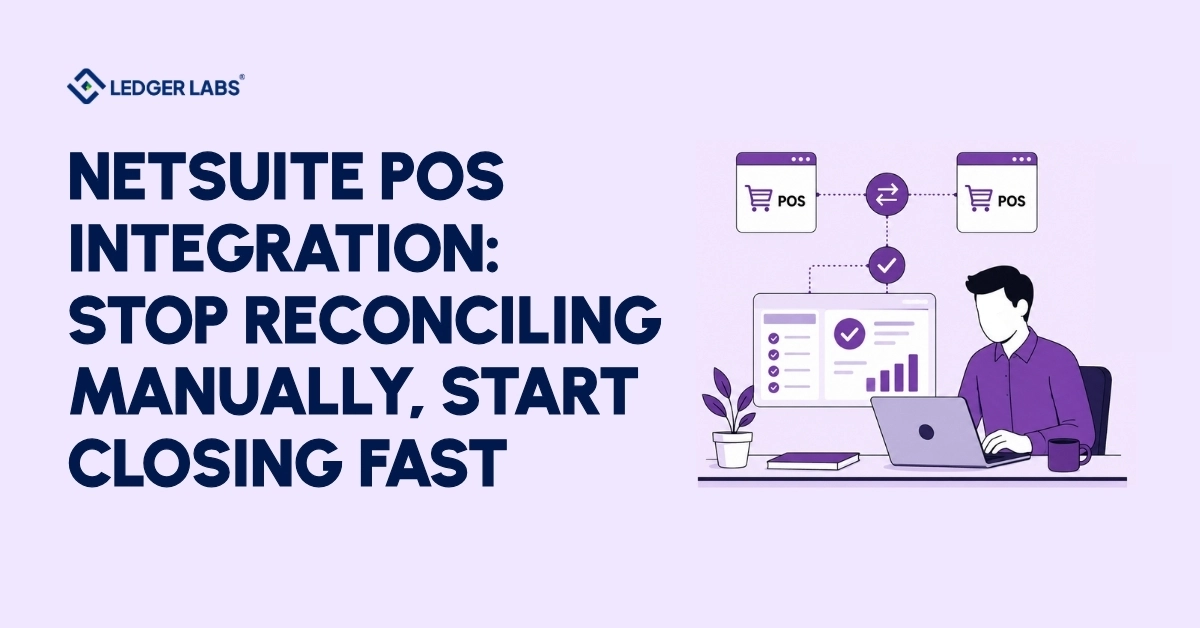
If you’re running Square, Clover, or Shopify POS at the register and NetSuite in the back office, you already know what happens at month-end: sales figures that don’t match, inventory counts that drift, and a reconciliation process that should take an hour but takes a day.
The problem isn’t your POS. It isn’t NetSuite. It’s the gap between them, and specifically, what happens (or doesn’t happen) at the accounting layer when POS data moves into your general ledger.
This guide covers the three integration methods, what each one means for your books, how much each implementation costs, where they can fail, and what an accounting firm working in NetSuite does differently from a connector vendor.
Key Takeaways
- Your integration method directly determines how clean your GL, journal entries, and close will be.
- Every tender type needs its own GL account; card payments must route to a clearing account, not revenue.
- Gift card sales are a liability until redeemed. Posting them to revenue immediately overstates income.
- End-of-day journal entries require manual configuration; no connector sets this up correctly by default.
- The biggest cost drivers are COA restructuring, historical data migration, and multi-location GL mapping.
- Connector vendors move data. An accounting firm working in NetSuite configures what the data means in your books.
Which POS-NetSuite Integration Method Fits Your Accounting Setup?
Not all POS-NetSuite integrations are built the same, and the method you choose has direct consequences for how your GL is structured, how journal entries post, and how clean your books are at close.
Pre-Built Connector - Fast Deployment, Standard Chart of Accounts
A pre-built connector uses an iPaaS platform, Celigo, Boomi, or SPS Commerce, to move data between your POS and NetSuite on a schedule or in near real-time. Setup is faster than a custom build and doesn’t require a NetSuite developer.
Best for SMBs on Shopify POS, Square, or Lightspeed with a straightforward chart of accounts, 1–3 locations, and no multi-entity or multi-currency requirements.
Connectors handle transaction volume well. Where they fall short is in accounting configuration, tender-type mapping, GL account assignment, and end-of-day journal-entry rules, which are rarely set up correctly out of the box. Most connector vendors are integration specialists, not accountants. That gap is where reconciliation failures happen.
Timeline: 4–6 weeks
Cost: Low four figures to mid five figures.
SuiteCommerce InStore - Native NetSuite, Full Accounting Control
SuiteCommerce InStore (SCIS) is Oracle’s native in-store POS module, built directly into NetSuite. There is no data movement between systems; every transaction posts directly to your GL in real time.
Best for retailers already deep in the NetSuite ecosystem who want a single system of record, especially those running multiple subsidiaries, complex revenue recognition, or inventory costing models that require tight ERP alignment.
Because SCIS lives inside NetSuite, payment types, tax codes, location IDs, and COGS entries post directly to your GL with no mapping layer in between. There’s no connector to misconfigure and no accounting gap between systems, which is why SCIS produces the cleanest books of the three methods, provided your NetSuite environment is well-configured before it goes in.
Timeline: 8–12 weeks
Cost: Higher than connectors; scales with environment complexity.
Custom API Build - Complex Ledger, Multi-Entity, Multi-Currency
A custom integration uses NetSuite’s SuiteTalk REST API or SuiteScript to create a direct connection that meets your specific accounting needs.
This option is best for businesses with unique point-of-sale hardware, multiple entities, operations in different currencies, or accounting needs that pre-built connectors cannot handle. It also addresses gift card liability tracking across entities, location-level profit and loss, or consolidated reporting for subsidiaries.
We customize every general ledger mapping, posting rule, and reconciliation process to meet your needs. This system can easily track gift card liabilities across locations and show location-level profit and loss right from the start. Most ready-made connectors cannot do this.
Timeline: 12–20+ weeks
Cost: Starts higher; scales with developer hours and scope.
Decision Matrix: Choose by Locations, POS System, and Accounting Complexity
| Your Situation | Recommended Method |
|---|---|
| 1–3 locations, Shopify POS / Square / Lightspeed, standard COA | Pre-built connector |
| Already on NetSuite, multi-subsidiary, want one system of record | SuiteCommerce InStore (SCIS) |
| 4+ locations, multi-entity, multi-currency, complex inventory costing | Custom API build |
| Gift card liabilities, split tender, location-level P&L | Custom API or SCIS |
| Non-standard or legacy POS hardware | Custom API build |
What Happens to Your Books the Moment POS Data Hits NetSuite?
This section is often overlooked in integration guides. Connector vendors explain how data is transferred, but they don’t clarify what happens to your general ledger when the data arrives. They also don’t discuss what can go wrong if the accounting system is not set up correctly.
GL Account Mapping by Payment Type (Cash, Card, Gift Card)
Every payment type processed by your POS must connect to a specific GL account in NetSuite. This requires precise configuration based on your chart of accounts.
Cash payments should go to your cash-on-hand account. This is simple if your POS treats cash as a separate payment type and your connector maps it correctly.
Card payments need to be recorded in a merchant processing clearing account, not directly as revenue. The funds haven’t hit your bank yet; they clear when your processor completes the transaction, usually in one or two days. If card payments go straight to revenue or cash, your bank reconciliation won’t match your NetSuite balance.
Gift cards are often set up incorrectly. When a customer buys a gift card, it creates a liability, not immediate revenue. You only recognize revenue when the gift card is used. If your system posts gift card sales to revenue, you’ll overstate your income until the card is redeemed. In businesses with multiple locations and high gift card sales, this error can add up quickly.
For split tender transactions, each part must be mapped separately. Many basic connectors treat split tenders as a single payment, so your GL won’t show the actual payment breakdown.
End-of-Day Journal Entries - What Should Auto-Post vs. What Needs Configuration
Many connector-only systems combine all sales into one total for the day. This means there is no detailed breakdown for payments, cost of goods sold (COGS), or taxes. As a result, your bookkeeper has to sort through this information manually each day before closing the accounts.
A properly set up integration will create a summary journal entry at the end of the business day that includes:
- Gross sales by location and product category
- Sales tax collected by jurisdiction
- Payment method breakdown: cash, card, gift card, store credit, each mapped to its correct GL account
- COGS and inventory decrement if inventory is managed in NetSuite
- Discounts and promotions as separate line items
You need to set up this template according to your chart of accounts before you go live. We include this configuration in every implementation, but it is not part of what connector vendors provide. If you don’t set it up before going live, you can’t cleanly adjust it later.
Revenue Recognition, COGS, and Inventory Valuation After Each Transaction
When managing inventory in NetSuite, every POS sale should trigger three key actions simultaneously: record revenue in the correct income account by product category, debit COGS and credit the inventory asset, and update inventory quantities across all locations.
If these three actions don’t occur together, or if COGS isn’t set up because the connector doesn’t manage inventory, your income statement will show inflated gross profit until you manually adjust it at the end of the month.
This issue is particularly harmful to retailers using FIFO or average-cost valuation in NetSuite, as it completely disrupts your cost layers.
How Proper Integration Transforms Your Month-End Close?
With the right setup:
Day 1: Pull the NetSuite P&L; sales figures exactly match the POS reports.
Day 1: Complete the bank reconciliation; card settlements automatically clear the merchant processing account.
Day 1: Check inventory; NetSuite quantities match physical counts within acceptable limits.
Day 2–3: Review, make adjustments, and close.
Without the right setup, Day 1 is spent fully reconciling daily POS batch reports with NetSuite. You have to figure out why the figures don’t match and make journal entry corrections before you can start the actual closing work. This process can take 3–5 hours each day during the first week of closing for a mid-sized retail operation.
NetSuite POS Integration Cost, Timeline, and Accounting Scope
Cost and Timeline by Integration Method
| Method | Typical Timeline | Cost Range | What Extends It |
|---|---|---|---|
| Pre-built connector | 4–6 weeks | $8,000–$40,000 | Non-standard COA, historical data migration, 3+ locations |
| SuiteCommerce InStore (SCIS) | 8–12 weeks | $30,000–$80,000+ | Environment prep, custom hardware, multi-subsidiary |
| Custom API build | 12–20+ weeks | $50,000+ | Legacy POS, complex GL requirements, multi-currency |
What Drives Cost Up?
Restructuring your chart of accounts (COA) is a key cost factor that is often overlooked. If your COA was not designed for point-of-sale (POS) integration and lacks clearing accounts, a gift card liability account, and location-based income division, it needs to be restructured before the integration can work correctly. This is an accounting task, not a technical one, and many connector vendors do not include this in their services.
Migrating historical data is the biggest expense. If you want past POS transaction history in NetSuite for reporting or inventory cost calculations, each historical record must match your current COA. Make sure to define this clearly before signing any implementation contract.
Mapping the general ledger for multiple locations also increases costs. Each location requires its own department codes, location IDs, and possibly separate subsidiary assignments. Managing finances for five locations will cost much more than managing one.
When to Hire an Accounting Firm vs. a DIY Connector?
Use a DIY connector if you have one location, a simple chart of accounts (COA), no gift cards or split payments, and your bookkeeper has experience with NetSuite.
Hire an accounting firm that works in NetSuite if you have:
- Three or more locations
- Gift cards, store credit, or split payments in your transactions
- A need for location-level or department-level profit and loss reports in NetSuite
- Manual reconciliation between your point-of-sale system and NetSuite during your current close, whether it’s your first setup or a connector that wasn’t set up properly
- Operations with multiple entities or currencies
The connector transfers the data. The accounting firm interprets the data in your general ledger (GL). This will affect whether your financial close takes two days or two weeks.
Accounting Failures That Break POS-NetSuite Integrations
Many failures in integrating POS with NetSuite aren’t due to technical issues. The data transfers successfully, and the sync completes, but problems arise in the accounting layer. These issues often show up at the end of the month rather than during the initial setup.
Tender Type Mapping Errors and GL Mispostings
When your POS sends a transaction marked as “card payment,” your connector maps it to a revenue account. NetSuite records it as income received, but the money isn’t in your bank yet. When you receive the settlement, your bookkeeper may create a duplicate entry or leave the clearing account unbalanced. Over the course of a month, this leads to significant reconciliation issues that can take days to resolve.
Fix: Set up a merchant processing clearing account before going live. Map all card payment types to this account. Create an automated rule to clear it when the bank deposit posts. This two-hour setup can save you weeks of reconciliation work.
SKU Mismatches That Corrupt Inventory Valuation
If your POS uses “SHOE-BLK-10” and NetSuite uses “FOOTWEAR-BLACK-SIZE10,” the connector can sync the sale but may not find the matching item. This can lead to wrong postings, such as defaulting to a catch-all account or creating duplicates. Over time, NetSuite’s inventory value becomes incorrect, misaligning COGS, and your physical count won’t match.
Fix: Build a SKU mapping table before launch that links every POS product ID to its NetSuite item. Conduct a full inventory audit in the first week after launch to catch any issues early.
Unreconciled Gift Card Liabilities
Posting gift card sales directly to revenue rather than to a liability account is a major accounting mistake. This error makes revenue appear higher than it should be and causes problems with redemptions, either posting incorrectly or requiring manual fixes. For a retailer selling $50,000 in gift cards monthly, this misstatement can become serious within a quarter.
Fix: Establish a gift card liability account before going live. Map gift card payments to this account upon sale. Set up a redemption rule to transfer the balance from liability to revenue when a card is redeemed.
Multi-Location Revenue Allocation Errors
To get location-level profit and loss in NetSuite, every POS transaction must include a location ID or department code. Many connector setups do not configure this tagging, resulting in all transactions posting to a default location. This results in a combined P&L that does not show which locations are profitable.
Fix: Create location mapping rules before setting up the integration. Ensure each POS location corresponds to a NetSuite location or department. All transactions must include this tagging.
Why Ledger Labs Implements POS-NetSuite Integrations Differently?
Many Point of Sale (POS) and NetSuite projects focus on connecting data, which is the main job of integration vendors. However, ensuring your financial records are accurate after this connection is not part of their responsibilities.
At Ledger Labs, we prioritize the accounting setup during implementation. Before going live, every project includes:
- Chart of accounts review – we restructure if needed so POS data can post correctly from day one
- Tender type GL mapping – every payment type (cash, card, gift card, store credit, split tender) mapped to the correct account, including merchant processing clearing accounts for card settlements
- Gift card liability setup – liability account created, redemption rule configured so revenue is only recognized at point of use
- End-of-day journal entry template – built against your specific COA, covering gross sales by location, COGS, tax payable, and discounts as separate line items
- COGS and inventory valuation rules – configured if inventory is managed in NetSuite, so every sale triggers the correct revenue, COGS, and inventory decrement simultaneously
- Multi-location department mapping – location IDs and department codes defined so NetSuite P&L is reportable by location from day one
- Sandbox testing – every mapping tested against live transactions before go-live
After go-live: 30-day close review – we run your first month-end close with you, catch any mapping gaps before they compound, and sign off before handing back.
The Bottom Line
A POS-NetSuite integration works well only if the accounting setup is done right. The connector transfers data, but the real factors that keep your books accurate, speed up your financial closing, and ensure your profit and loss statements are reliable happen in the general ledger (GL) layer. This includes how you map payment types, set rules for journal entries, handle gift card liabilities, configure cost of goods sold (COGS), and allocate expenses by location.
Many implementations overlook this important aspect. The connector may go live, data may flow, but you will likely face reconciliation problems from the very first month-end close.
At Ledger Labs, we focus on the accounting setup during implementation. We are an accounting firm that works in NetSuite daily, and we configure both the integration and the financial books. This way, your first close can go as it should: sales will match on day one, bank reconciliations will clear automatically, and your team will spend time reviewing numbers instead of tracking them down.
If your current POS-NetSuite setup is not producing clean financials, the issue is likely in the accounting configuration and can be fixed.
Book a free 30-minute consultation. We will review your current setup, spot where the accounting setup is failing, and tell you exactly what needs to change.
FAQs
1. What is the biggest accounting risk in a POS-NetSuite integration?
Tender type mapping. When payment types aren’t mapped to the correct GL accounts, every transaction posts incorrectly. The error is invisible at go-live and surfaces at month-end as a reconciliation gap that takes days to unwind. Configuring this before go-live is the single highest-impact accounting task in any POS-NetSuite implementation.
2. Does NetSuite handle revenue recognition automatically after POS integration?
You need to configure it. For most retail businesses, the key issue is ensuring that gift card sales are recorded as a liability until they are redeemed. This setup isn’t automatic in any connector and has to be configured manually.
3. How does POS integration affect my month-end close timeline?
A well-configured integration can significantly shorten the time it takes to close. On the first day, sales should match point-of-sale reports, bank reconciliation should happen automatically, and inventory should stay in sync. In contrast, a poorly configured integration adds extra days of manual work before closing can even begin. The main difference comes down to how the accounting layer is set up.
4. Do I need a separate accountant and a NetSuite implementation partner?
Most operators use two vendors, an integration partner for the connector and an accountant for the books. The gap between them is where accounting failures happen. A single firm that owns both the integration and the accounting configuration eliminates the hand-off gap and ensures the integration is set up to your accounting requirements from day one.